 Sérusier, PaulDanmark, 1864–1927
Landscape
Må man se det?
Tager ikke imod for tiden

The Cleveland Museum of Art
Cleveland, USA
Det hører til samlingen, men er ikke udstillet for tiden.
- Kontrolleret
- Uændret siden
- Kilde
- Museet
Om værket
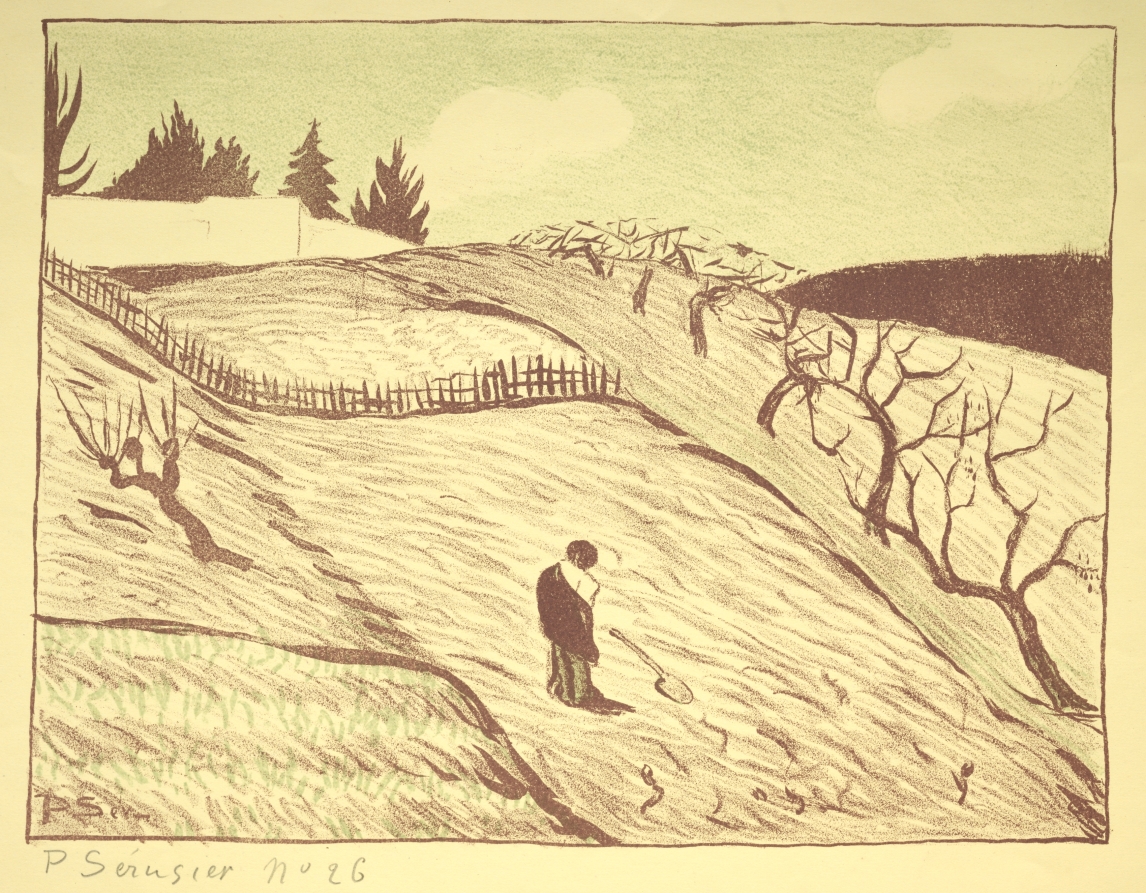
Twenty-four-year-old Paul Sérusier met Paul Gauguin in Brittany at the artists' colony in Pont- Aven. Sérusier enthusiastically embraced the older artist's flat, simplified forms and bold colors. He became one of Gauguin's closest disciples, promoting his aesthetic among a group of Parisian artists who became known as the Nabis-the Hebrew word for "prophets"-because they predicted a new era in art. Sérusier was primarily interested in creating decorative surfaces which juxtaposed flat planes of opposing colors. Sérusier made only a few prints during his career, but the bold, primitive-looking Breton Landscape was selected for publication in L'estampe originale, a quarterly publication of original prints that appeared from 1893 to 1895. Breton Landscape pays homage to Gauguin's Volpini Suite, a series of eleven zincographs printed on canary yellow paper in 1889. The high horizon, tilted ground, winding fence, and geometric shapes of the fields echo details in Gauguin's Breton Women by a Fence.
The Cleveland Museum of Art
Oplysninger
- Inventarnummer
- 2004.39
I kataloget
Kilder
- The Cleveland Museum of Art
- Billede: The Cleveland Museum of Art — Museum open access
Imens i livet hos Sérusier, Paul
Hele livetearly 1890s
Ideologist of the Nabis and a central figure of the early 1890s
He leads a whole movement, and many discoveries of Gauguin, who has left for Oceania, are attributed to him; the Nabis group (its name from the Hebrew word for “prophet”) proclaims a program of painterly Symbolism: emotions and symbols can be conveyed through the relationships of forms. The critic Albert Aurier calls him the first among the young artists in his article “The Symbolists” and promises him a great future.
1892
Meeting Charles Mackie
He meets and befriends the Scottish artist Charles Hodge Mackie while Mackie and his wife are honeymooning in France.
1895
Travels in Italy and Germany with Maurice Denis
Travelling through Italy and Germany with Maurice Denis, he is among the first European artists to discover the special beauty of the Italian and German primitives, finding in them expressive power and originality of decorative solutions.
1895
“Pastorale Bretonne” in The Evergreen
His friendship with Mackie leads him to contribute the illustration “Pastorale Bretonne” to “The Evergreen: A Northern Seasonal: The Book of Spring”, published by Patrick Geddes and colleagues in Edinburgh.