 Paul KleeTyskland, 1879–1940
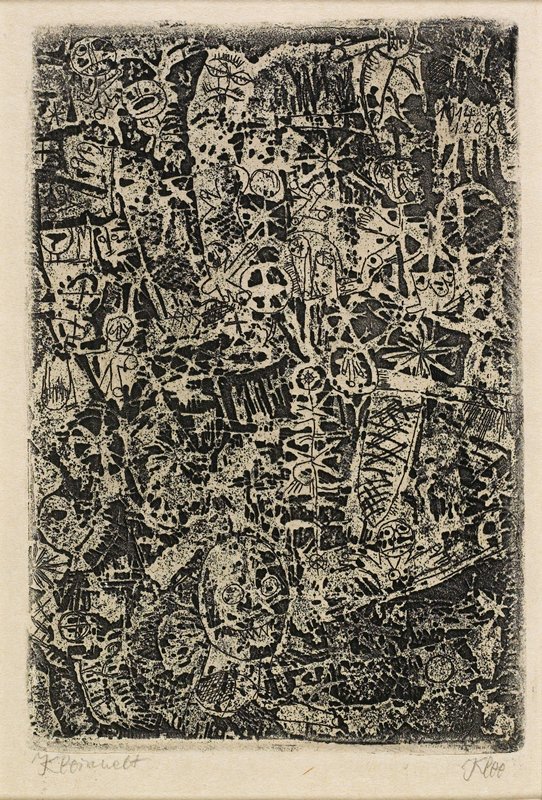
Kleinwelt
Må man se det?
Tager ikke imod for tiden

Minneapolis Institute of Art
Minneapolis, USA
Det hører til samlingen, men er ikke udstillet for tiden.
- Kontrolleret
- Uændret siden
- Kilde
- Museets egne samlingsdata
Oplysninger
- Inventarnummer
- 2004.151.1
I kataloget
Kilder
- Minneapolis Institute of Art: the museum's own open data · hentet for 7 dage siden
- Billede: Minneapolis Institute of Art — © Minneapolis Institute of Art
Imens i livet hos Paul Klee
Hele livet12 February – 18 March 1912
The second “Blue Rider” exhibition: 17 drawings
Seventeen of Klee’s graphic works were shown at the second exhibition of the “Blue Rider” editors, at Hans Goltz’s Munich gallery; it was called “Black-White” because it included only graphic works and watercolours. His ink drawing “Steinhauer” was also reproduced in the almanac, whose only issue appeared in May 1912; Klee’s meeting with Hans Arp dates from the same period.
11 April 1912
Robert Delaunay’s studio: discovering abstraction
On 11 April Klee visited Robert Delaunay’s studio in Paris and discovered abstract painting detached from natural forms; his understanding of light and colour changed substantially. In December he began translating Delaunay’s essay “On Light” (La Lumière) for Herwarth Walden’s magazine Der Sturm, and in 1914, under Delaunay’s influence, he painted “Abstraction. Coloured Circles Interwoven with Coloured Ribbons”.
from 3 April 1914
Tunisia with Macke and Moilliet: Klee the painter
On 3 April 1914 Klee set out from Bern with August Macke and Louis Moilliet, via Lyon and Marseille to Tunisia — Saint-Germain, Sidi Bou Said, Carthage, Hammamet, Kairouan — and he alone of the three kept a diary. Struck by the light, Klee wrote that colour had taken possession of him for ever and that he was a painter; back home he painted his first purely abstract work, “In the Style of Kairouan”, built of coloured rectangles and a few circles.
March 1916
First exhibition of abstract watercolours at Walden’s
Herwarth Walden’s gallery held the first exhibition of Klee’s abstract watercolours, a success with the public. He gave the works new titles, marking his break with war themes, and Walden asked him for more.
February 1917
Second show at Walden’s: the first commercial success
Klee showed the watercolours of the past year; many works were sold, and critics called him the most important German artist since Marc’s death. The success was made possible by a changed market: collectors had appeared who were ready to buy modern art.
October 1920
Gropius invites Klee to teach at the Bauhaus
In October 1920, on behalf of the Bauhaus staff, its director Walter Gropius invited Klee to teach; from January 1921 to April 1931 he was a “form master” — first in the bookbinding workshop, then, together with Kandinsky, in the stained-glass and mural-painting workshops, and later he ran a painting class.