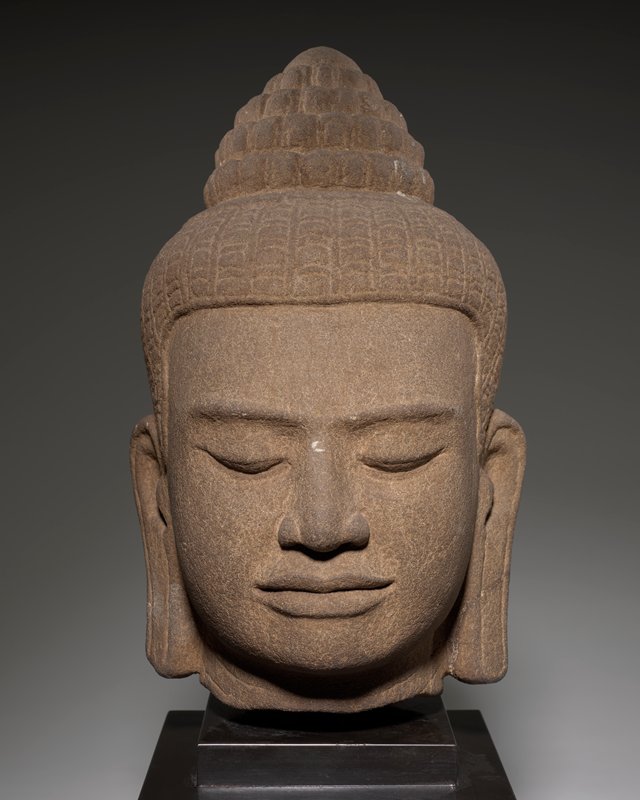
Head of the Buddha
Kan det ses?
Ikke udstillet lige nu
Hvor er »Head of the Buddha« i dag? Samling: Minneapolis Institute of Art, Minneapolis. Ikke udstillet lige nu. Kontrolleret 29. september 2026.

Minneapolis, USA
Det hører til samlingen, men er ikke udstillet for tiden.
- Kontrolleret
- Uændret siden
- Kilde
- Museet
Om skulpturen
Makers of Buddhist icons use some common conventions when depicting buddhas. Elongated earlobes indicate his enlightened status, for example, while the prominent pyramidal shape on top of the head, called an ushnisha, represents the larger brain attained through enlightenment. This head belongs stylistically to the latter part of the reign of King Jayavarman VII (1181–1219), a devout Buddhist who established the Bayon as his state temple in the Khmer capital of Angkor and commissioned numerous Buddhist sculptures to fill that space and others. This work is a prime example of a new style developed during his reign based on more naturalistic body and face types distinguished by faint smiles, closed eyes, and hair rendered like a tight-fitting cap with a lotus-shaped bun.
Minneapolis Institute of Art
Oplysninger
- Inventarnummer
- 50.46.222
I kataloget
Kilder
- Minneapolis Institute of Art
- Billede: Minneapolis Institute of Art — public domain







