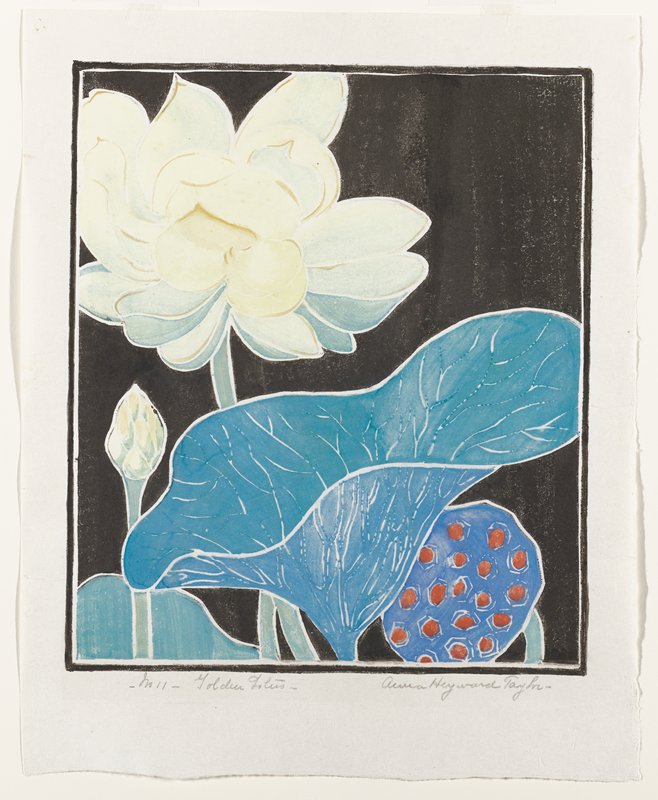
Golden Lotus
Kan det ses?
Ikke udstillet lige nu
Hvor er »Golden Lotus« i dag? Samling: Minneapolis Institute of Art, Minneapolis. Ikke udstillet lige nu. Kontrolleret 12. oktober 2026.

Minneapolis, USA
Det hører til samlingen, men er ikke udstillet for tiden.
- Kontrolleret
- Uændret siden
- Kilde
- Museet
Om værket
Anna Heyward Taylor depicted this lotus with its seed head, bud, and leaf, the kind of thing botanical illustrators did in the 16th century when recording a newly discovered specimen. A native of South Carolina, where the growing season is long, Taylor did a number of flower woodcuts. But Golden Lotus, with its overtones of historicism and modernity, is among her finest. It also shows her mastery of the woodblock. The round seed head has rough, tentative marks, befitting expectant little seeds, while the flower has the subtle color gradations of a painting. The modern look of the sheet comes from Taylor’s simplification of forms, disregard for spatial depth, and images sliced off at the margins, all trademarks of Japanese woodblock prints.
Læs videre
The distinctive white outlining was a technique Taylor learned in Provincetown, Mass., around 1915 from its inventor, B.J.O. Nordfeldt. Looking for a way to print a multicolored design from a single block without the colors mixing, he introduced the idea of carving a groove around each area of color. On Golden Lotus, Taylor carved narrow grooves around each plant form, several petals, and on the rim of the leaf. Because these areas carry no ink, they print white. The outlines are especially striking against her black background, but the black also carries a warning: at nightfall, the lotus will close back up.
Minneapolis Institute of Art
Oplysninger
- Inventarnummer
- 2017.65
I kataloget
Kilder
- Minneapolis Institute of Art
- Billede: Minneapolis Institute of Art — © Estate of Anna Heyward Taylor









