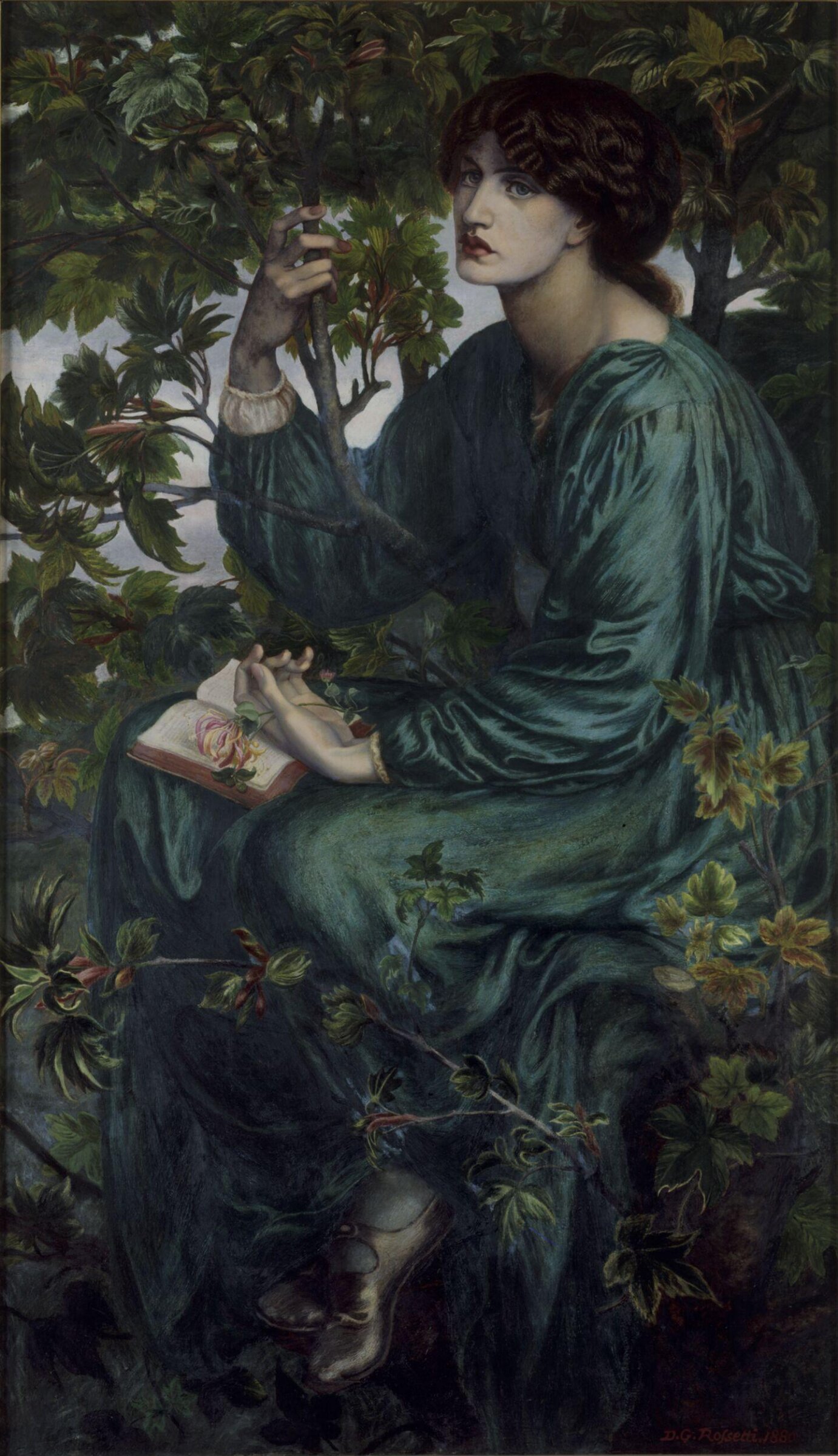
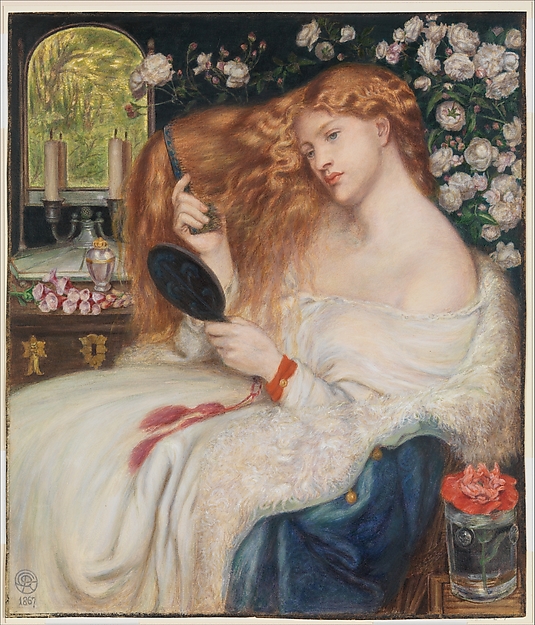
Dante Gabriel RossettiEngland, 1828–1882
Found
Kan det ses?
Ukendt
Hvor er »Found« i dag? Samling: The Tullie, Carlisle. Om det er udstillet i dag, er ukendt.
Carlisle, Storbritannien
Ejeren er kendt; om værket er udstillet i dag, vides ikke.
- Uændret siden
- Kilde
- Museet
Oplysninger
- Inventarnummer
- 1949.125.33
I kataloget
Kilder
- Wikidata
- Billede: The Tullie — Dante Gabriel Rossetti · Public domain · Wikimedia Commons
Imens i livet hos Dante Gabriel Rossetti
Hele livet1850s
A new watercolour and pen-and-ink technique
Translations of Italian poetry and Malory’s “Le Morte d’Arthur” inspired Rossetti’s art of the 1850s: he created a method of painting in watercolours with thick pigments mixed with gum to give rich effects like medieval illuminations, and developed a novel pen-and-ink drawing technique.
after 1851
Siddal sits only for him
Elizabeth Siddal, who had entered the Pre-Raphaelite circle after Walter Deverell noticed her working in a milliner’s in Leicester Square, modelled exclusively for Rossetti after 1851, remaining his muse and pupil.
1852
The 1852 photography exhibition
In 1852 Rossetti visited an exhibition of photographs; in the following years he used photographs as landscape backgrounds or for posthumous portraits, often photographed his own paintings and once even painted over a photograph.
1854–1862
Teaches drawing and painting to the lower classes
From 1854 to 1862 Rossetti taught drawing and painting at the first educational institution in England for the lower classes of society.
1855
First published illustration: “The Maids of Elfen-Mere”
Rossetti’s first published illustration was “The Maids of Elfen-Mere” (1855), for a poem by his friend William Allingham.
1856–1857
Meets Morris and Burne-Jones
Edward Burne-Jones and William Morris, who did not know Rossetti but were much influenced by his works, met him by recruiting him as a contributor to their Oxford and Cambridge Magazine, which Morris founded in 1856; in February 1857 Rossetti wrote that they had become very intimate friends of his and called Burne-Jones’s designs marvels of finish.