 Gustave CourbetFrankrig, 1819–1877
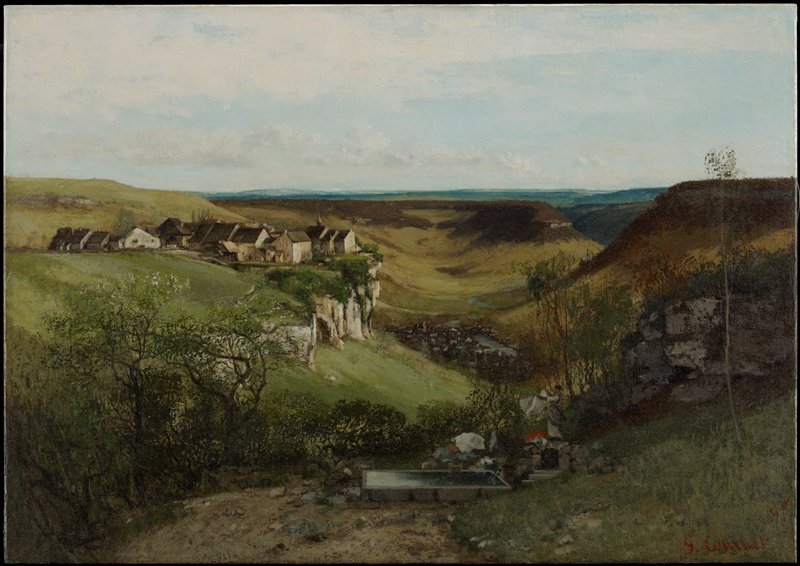
Château d’Ornans
Kan det ses?
Ikke udstillet lige nu
Hvor er »Château d’Ornans« i dag? Samling: Minneapolis Institute of Art, Minneapolis. Ikke udstillet lige nu. Kontrolleret 29. september 2026.

Minneapolis, USA
Det hører til samlingen, men er ikke udstillet for tiden.
- Kontrolleret
- Uændret siden
- Kilde
- Museet
Om maleriet
The country around his native town of Ornans, in eastern France, inspired most of Gustave Courbet's paintings. Like his contemporaries who worked near Barbizon, Courbet revitalized the landscape tradition with views of distinctive regional features observed at first hand. The town of Ornans appears in the valley below.
Minneapolis Institute of Art
Oplysninger
- Inventarnummer
- 72.66
I kataloget
Kilder
- Minneapolis Institute of Art
- Billede: Minneapolis Institute of Art — public domain
Imens i livet hos Gustave Courbet
Hele livet1855
Stages the “Pavilion of Realism”
Refusing to accept the jury's decision, Courbet asked museums and private owners to lend his paintings, had a separate building erected and showed about forty canvases there, without state permission, under the Second Empire. The public was baffled and laughed at the “crude art”, and the critics mocked him; the paintings were appreciated by Delacroix and Baudelaire.
1855
The “Realist Manifesto” in the exhibition catalogue
The catalogue of the Pavilion of Realism opened with a manifesto in which Courbet claimed the right to artistic freedom and the right to show his works to the public on his own. He defined his aim as conveying the customs, ideas and appearance of his time, to be not only a painter but a man as well: to “create living art”.
1855
The Exposition Universelle jury turns down three paintings
Courbet submitted fourteen paintings to the Salon of 1855, part of the Exposition Universelle; three were rejected “for lack of space”, among them the monumental “A Burial at Ornans” and “The Artist's Studio”.
1855
Empress Eugénie before “The Bathers”
According to Proudhon's recollection, Empress Eugénie, visiting the Pavilion of Realism, stopped before Courbet's “Bathers”, with its robustly peasant-like nude body shown without the usual idealization, and exclaimed, “Is this a Percheron too?” She had just been looking at Rosa Bonheur's “Horse Fair”.
1857
Salon of 1857: “Young Ladies on the Banks of the Seine”
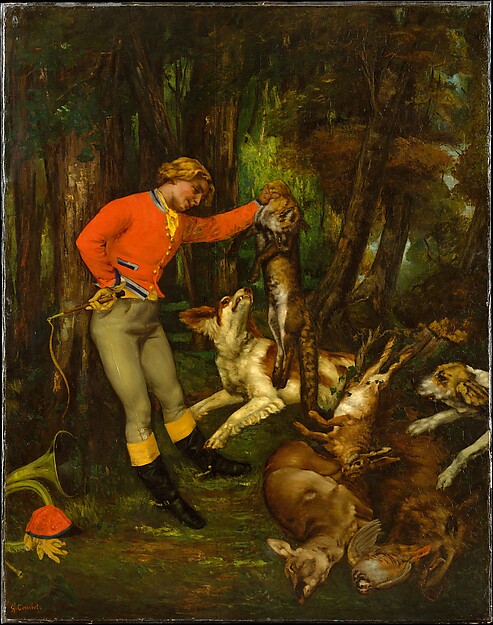
At the Salon of 1857 Courbet showed six paintings, among them “Young Ladies on the Banks of the Seine (Summer)”, painted the year before, and the first of his many hunting scenes. Modern women casually displaying their undergarments caused a scandal; pairing sensational works with hunting scenes secured Courbet both notoriety and sales.