
USA, Ungarn, Frankrig, Jøder · 1913–1954
Robert Capa
- 67i kataloget
- 0udstillet nu
- 6samlinger
- 2lande
USA, Ungarn, Frankrig, Jøder · 1913–1954
Fødsel · 22. oktober 1913
Budapest
Begivenhed · 22 October 1913
Born in Budapest: Endre Ernő Friedmann
The future Robert Capa was born into the Jewish family of Júlia (née Berkovits) and Dezső Friedmann: his mother owned a successful fashion shop and his father worked in it as a tailor. He had two brothers, the older László and the younger Cornell, also a photographer.
Samtiden · Budapest
Arrested by the Hungarian secret police and made to leave
In 1931, just before his first photograph was published, Friedmann was arrested by the Hungarian secret police for his radical political activity, beaten and jailed. A police official’s wife, who happened to know his family, won his release on condition that he leave Hungary immediately.
Uddannelse · 1931–1933
Studies at the Hochschule für Politik in Berlin
From 1931 Friedmann studied at the Deutsche Hochschule für Politik in Berlin, until 1933, when the Nazi Party instituted restrictions on Jews and banned them from universities; alongside his studies he worked part-time as a darkroom assistant.
Begivenhed · in youth (until 1931) · Budapest
The Munkakör circle and protests against the Horthy regime
As a teenager Friedmann was drawn into Munkakör, a Budapest group of left-wing intellectuals and avant-garde artists, and took part in protests against the right-wing authoritarian regime of Miklós Horthy.
Møde · Paris
Meets Gerta Pohorylle (Gerda Taro)
In 1934 in Paris Friedmann, who then called himself André, met Gerta Pohorylle, a German Jewish refugee, and taught her photography; she later took the name Gerda Taro.
Begivenhed
The birth of the name “Robert Capa”
From 1935 Friedmann worked under the pseudonym Robert Capa. It was a mystification devised together with Gerda Taro: she spread rumours among journalists about a famous and wealthy American photographer ready to sell his pictures, while Friedmann himself played the fictitious character.
Værk
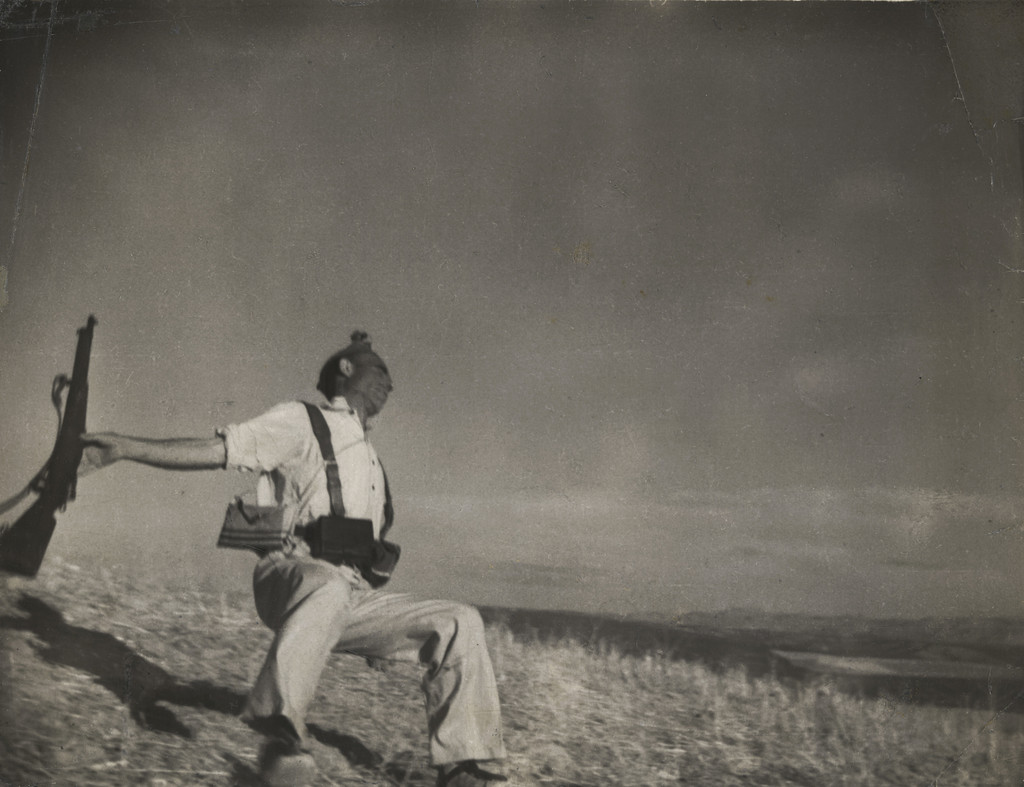
The photograph “The Falling Soldier”
In 1936 Capa took the photograph known as The Falling Soldier, purported to show the death of a Republican soldier; it was published in magazines in France and then by Life and Picture Post. The authenticity of the picture was later questioned: other photographs from the scene suggest it may have been staged.
Took part · 19. juni 1937 – 12. september 1937
foto '37
Familie · July 1937
The death of Gerda Taro near Brunete
In July 1937 Gerda Taro was killed near Brunete: returning from a photographic assignment covering the battle, the car she was travelling in (apparently standing on its footboard) collided with an out-of-control tank. Capa, who was reportedly engaged to her, was deeply shocked and never married.
Rejse · 1939–1940 · New York City
Moves from Paris to New York
At the start of the Second World War Capa was already in New York, having moved there from Paris to look for work and to escape Nazi persecution.
Karriere · during the Second World War
Collier’s, then Life: the “enemy alien” photographer
During the war Capa was sent on photographic assignments to various parts of the European theatre: he first worked for Collier’s Weekly but was fired and switched to Life. He was the only “enemy alien” photographer working for the Allies.
Samtiden · June 1944
The only civilian photographer on Omaha Beach
On D-Day Capa, attached to the 16th Infantry Regiment of the 1st Infantry Division (“Big Red One”), landed on Omaha Beach as the only civilian photographer. The photographic historian A. D. Coleman suggests that he travelled in the same landing craft as Colonel George A. Taylor and came ashore near Colleville-sur-Mer an hour and a half after the first wave.
Værk · 19 June 1944
“The Magnificent Eleven” in Life magazine
Capa stated that he took 106 pictures but that all but 11 were destroyed; Life printed the 11 on 19 June 1944 with captions written by magazine staffers. The loss of the rest was blamed on waterlogged cameras or a young assistant’s mistake in the London photo lab, but this story has been challenged by Coleman and others; John G. Morris, then picture editor of Life’s London bureau, agreed in 2016 that Capa more likely captured just 11 images.
Værk · 18 April 1945
The fight for a bridge in Leipzig: “the last man to die”
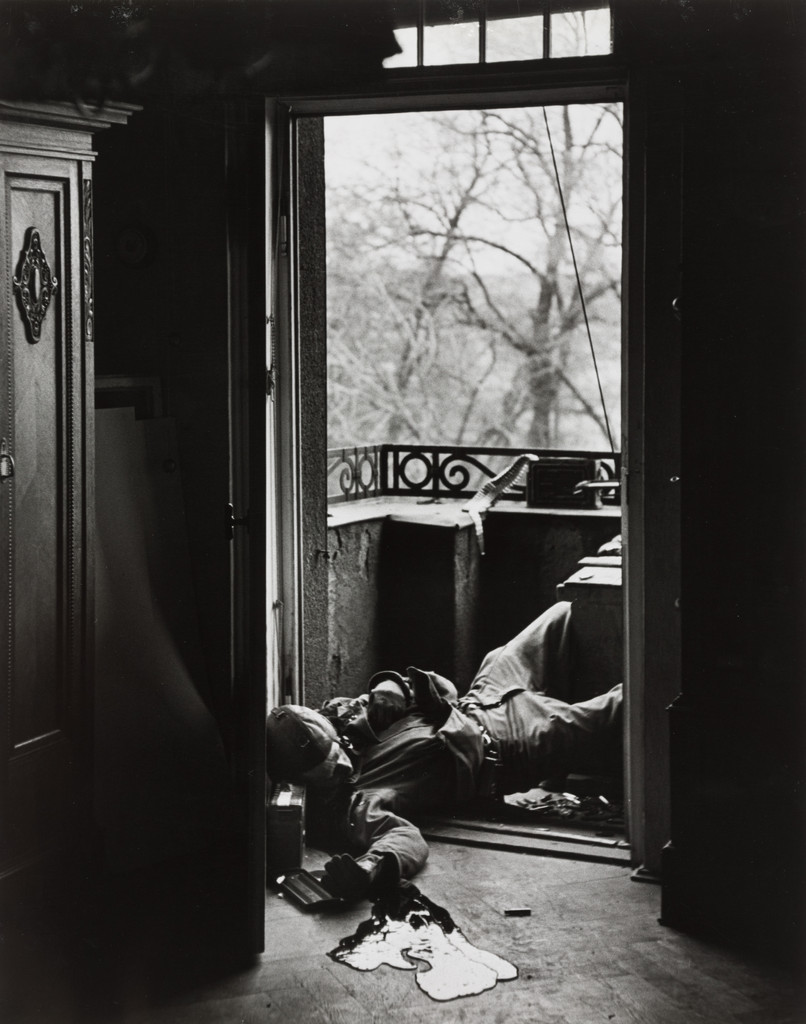
On 18 April 1945 Capa photographed the fight to secure a bridge in Leipzig; the pictures included the death of Raymond J. Bowman by sniper fire, which Life published with a caption calling it the picture of the last man to die.
Rejse · December 1945 – summer 1946
Follows Bergman to Hollywood, then goes to Turkey
In December 1945 Capa followed Bergman to Hollywood; the relationship ended in the summer of 1946, when he travelled to Turkey.
Karriere · Paris
Founds the Magnum Photos agency
In 1947 in Paris Capa founded Magnum Photos with Henri Cartier-Bresson, William Vandivert, David Seymour and George Rodger: the first cooperative agency for freelance photographers worldwide.
Udmærkelse
Medal of Freedom
Rejse · early 1950s
To Japan for a Magnum exhibition
In the early 1950s Capa travelled to Japan for an exhibition associated with Magnum Photos; while there, Life magazine asked him to go on assignment to Southeast Asia.
Karriere · Thái Bình
Accepts a Life assignment in Indochina
Although a few years earlier he had claimed to be finished with war, Capa accepted an assignment in Southeast Asia, where the French had been fighting the First Indochina War for eight years; he accompanied a French regiment in Thái Bình Province with two Time-Life journalists, John Mecklin and Jim Lucas.
Udmærkelse
Croix de guerre des théâtres d'opérations extérieures
Død · 25. maj 1954
Thái Bình
Begravelse
Amawalk Hill Cemetery
Udmærkelse
International Photography Hall of Fame and Museum
Udmærkelse
Béla Balázs Award
Udstilling · 24. juni 1977 – 2. oktober 1977
Documenta 6

Møde · 1936–1939
Photographs the war in Spain with Hemingway
Capa accompanied the journalist and author Ernest Hemingway in Spain to photograph the war, which Hemingway later described in his novel For Whom the Bell Tolls (1940). Life magazine published an article about Hemingway and his time in Spain with numerous photographs by Capa.
Værk · 5. september 1936
“The Falling Soldier”
Udgivelse · New York City
The book “Death in the Making” with photographs by Capa and Taro
In 1938 the book Death in the Making, with photographs by Capa and Taro, was published in New York.