James Sidney Edouard, Baron Ensor was a Belgian painter and printmaker, an important influence on expressionism and surrealism who lived in Ostend for most of his life.
James Sidney Edouard, Baron Ensor (13 April 1860 – 19 November 1949) was a Belgian painter and printmaker, an important influence on expressionism and surrealism who lived in Ostend for most of his life. He was associated with the artistic group Les XX.
His father encouraged the talent of a boy with little aptitude for school and, when he was eleven, sent him to study with the local painters Édouard Dubar and Michel van Cuyck. Other accounts say Ensor left school and began training with two local painters at fifteen.
1876
Værk · c. 1876 · Ostend
Paints “The Bathing Hut”
At sixteen Ensor entered the Ostend academy and painted the small “Bathing Hut” on cardboard. The sea had captivated him since youth with its colour, smell and mystery, and the picture can be read as the dream he described 21 years later in a letter to his friend Jules Dujardin.
1877
Møde · 1877–1880
Brussels friends and the Rousseau household
At the Academy Ensor befriended Willy Finch, Fernand Khnopff and Théo Hannon, and through Hannon met Ernest Rousseau, a professor at the Free University of Brussels, whose house drew the Brussels avant-garde to debate socialist and anarchist ideas. The lady of the house, Mariette Rousseau, became one of the few women close to him, though she kept him at a certain distance.
1880– 1889
1880
Karriere · Ostend
A studio in the attic of his parents' house
Disappointed by the dry teaching, Ensor left the Brussels Academy — 'an establishment for the half-blind' — and returned to Ostend, where until 1917 he worked in the attic of his parents' house above his mother's souvenir shop. There he created all his key paintings of the 19th century — even the huge “Christ's Entry into Brussels”, which, under the low ceiling, he painted now kneeling, now standing on a chair.
Rejse · 1880s
Brief trips to France and the Netherlands
Ensor travelled very little: in the 1880s, just three brief trips to France and two to the Netherlands.
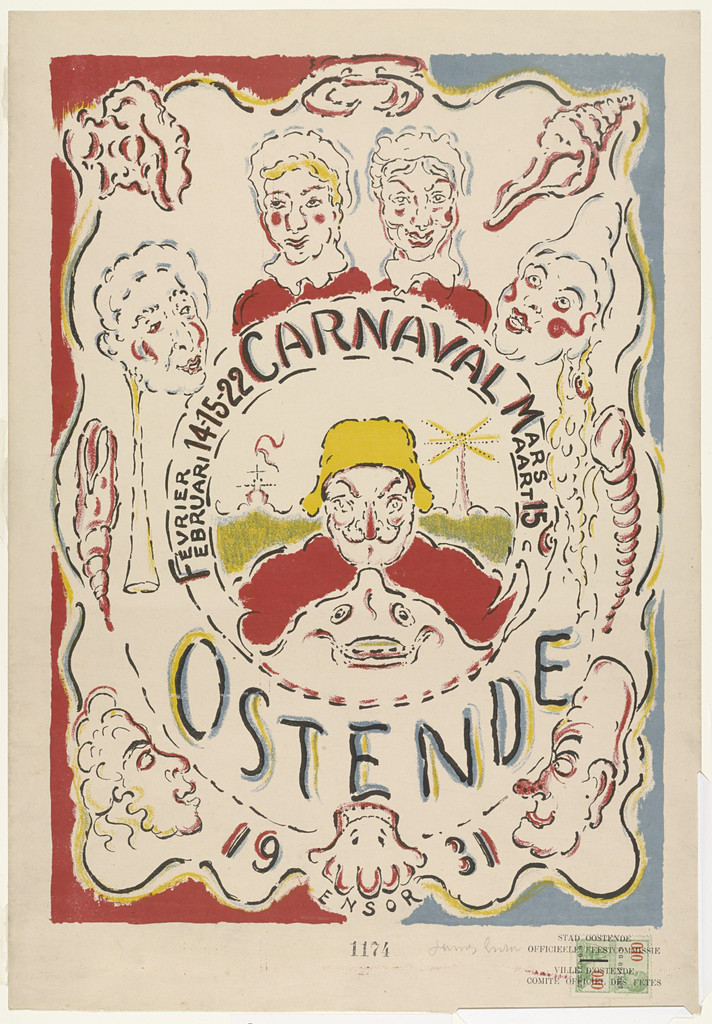
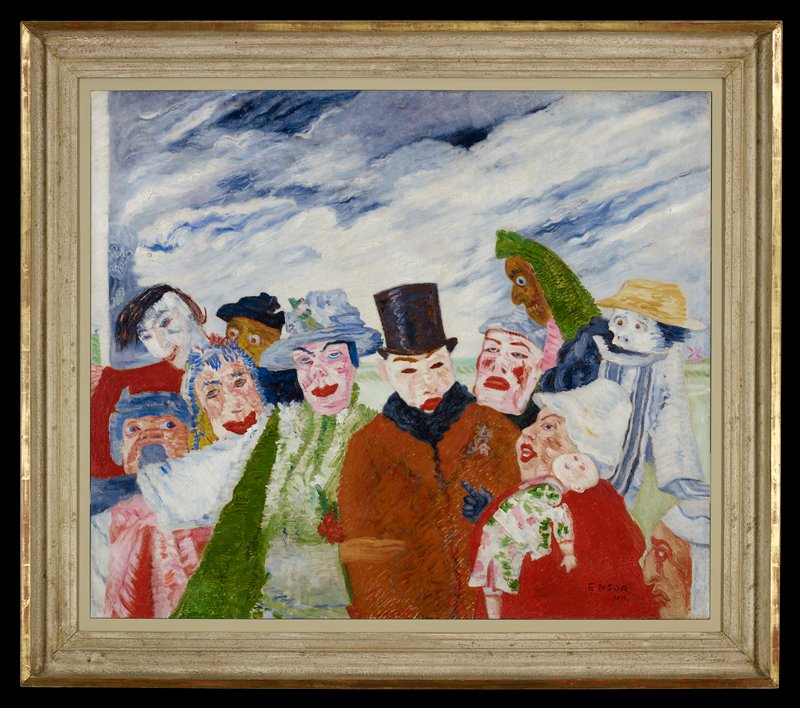
Carnival, masks, puppets, skeletons and fantastic allegories dominate the mature Ensor: he dressed up skeletons in his studio and arranged them on canvas in colourful, enigmatic tableaux.
1892
Rejse
Four days in London
One of the few journeys in the stay-at-home Ensor's life: a four-day trip to London.
1895
Udstilling
First solo exhibition in Brussels
Acceptance came gradually: the Royal Museums of Fine Arts of Belgium acquired his painting “The Lamp Boy” (1880), and Ensor had his first solo exhibition in Brussels.
1898
Begivenhed · Ostend
The Dead Rat Ball
Ensor and his friends began the tradition of the Ostend 'Bal du Rat mort' (Dead Rat Ball), which is still held every year for charity.
1900– 1909
1900
Begivenhed · 1900s · Ostend
Turning to music: improvising on the harmonium
His output of new works was dwindling: with no musical training, Ensor proved a gifted improviser on the harmonium and spent much time playing for visitors. In later years he said he had followed the wrong path in life and should have devoted himself to music.
A vehement attack on those responsible for the use of animals in medical experiments — one of his significant late works.
1929
Karriere
Retrospective in Brussels and a barony
After his first major retrospective in Brussels Ensor was made a baron by King Albert; that same year the composer Flor Alpaerts devoted his “James Ensor Suite” to him. Once a baron, the artist tried to withdraw his political etchings of 1889 from circulation.
Ensor was awarded the ribbon of the Légion d'honneur. That same year he painted “Port of Ostend” and “Ensor at the Harmonium”.
1934
Begivenhed · Ostend
A letter on etching: 'My intention is to survive'
In a letter to Albert Croquez Ensor called printmaking the key to his legacy: 'My intention is to survive, and I think of the solid copper plate, the unalterable ink, easy reproduction, faithful prints.'
1939
Samtiden · 1939–1945
Stays in Ostend through the war
Against the advice of friends, Ensor remained in Ostend throughout the Second World War despite the risk of bombardment. In old age he was an honoured figure in Belgium, and his daily walk made him a familiar sight in the town.
Ensor first showed his work in public, with the Belgian avant-garde group La Chrysalide in Brussels.
Værk · Ostend
Paints “Russian Music”
Ensor's early works, such as “Russian Music” and “The Drunkards” (1883), are realistic scenes in a sombre palette; later his colours would brighten and his subjects grow ever more bizarre.
1882
Udstilling
The Paris Salon: 'rubbish'
Ensor's works were shown at the Paris Salon with the Brussels association L'Essor, but one critic called his pictures 'rubbish'.
Udstilling · Antwerp
The Salon rejects “The Oyster Eater”
“The Oyster Eater”, a portrait of the artist's sister, was rejected by the Antwerp Salon, and a year later by L'Essor, because of its unconventional composition. These setbacks led Ensor to join Les XX, founded in 1883 with Khnopff, Finch and Théo van Rysselberghe among its members.
Ensor's first painting with masks — inspired, many biographers believe, by his father's drinking; the masks themselves he had known since childhood from his mother's souvenir shop, which sold them for the Ostend carnival. That same year he abandoned the Impressionist manner and everyday subjects for symbolic ones, baffling his contemporaries.
Medlemskab · 1883–1893
Les XX
1887
Familie · Ostend
Death of his father
His father, James Frederic Ensor, died — a scion of a wealthy English family who never found his footing in Belgium, mocked by small-town Ostend as a drunkard and failure, yet always supportive of his son's passion for art. Left the only man in the family, James felt a special responsibility for his younger sister Mariette (Mitche).
Værk · Ostend
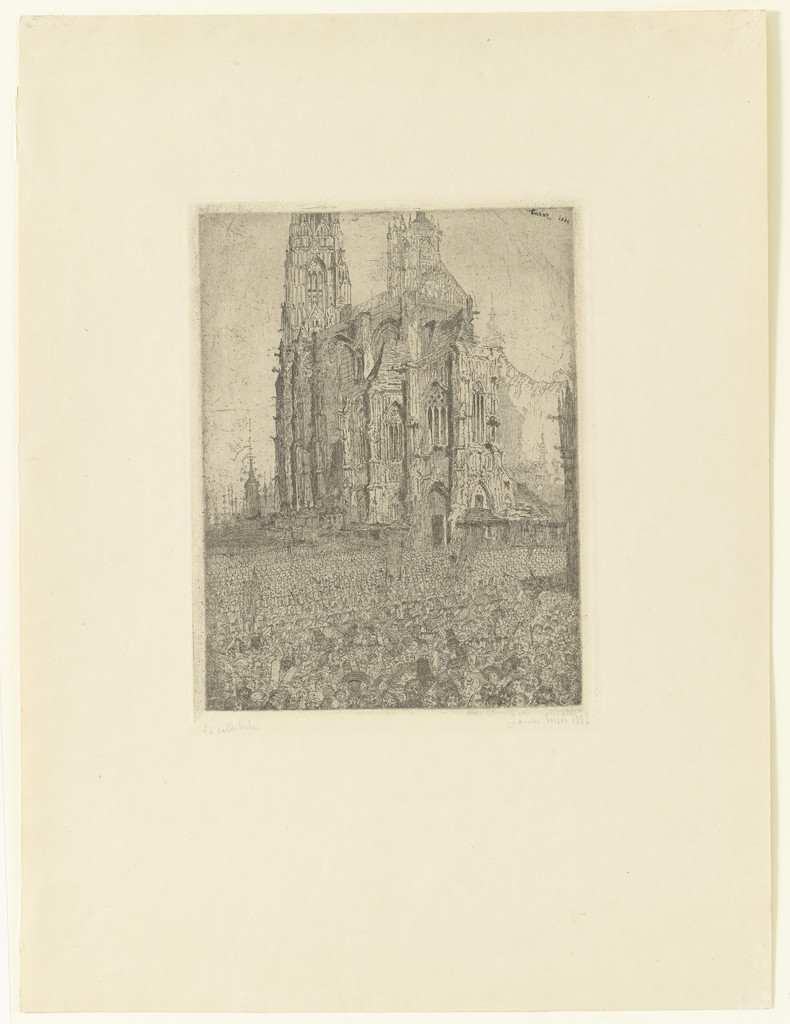
The etching “Le Pisseur”: a reply to the critics
The etching shows the artist urinating on a wall scrawled with 'Ensor est un fou' ('Ensor is a madman') — a defiant reply to critics who, as Octave Maus put it, saw him as the leader of a clan, a carrier of anarchistic principles and 'a dangerous person'.
Værk · Ostend
Paints “The Temptation of Saint Anthony”
Later Alfred H. Barr Jr., the founding director of the Museum of Modern Art in New York, having considered this painting, declared Ensor the boldest painter of the day.
1888
Begivenhed · 1888–1892 · Ostend
Turning-point years: the Passion of Christ
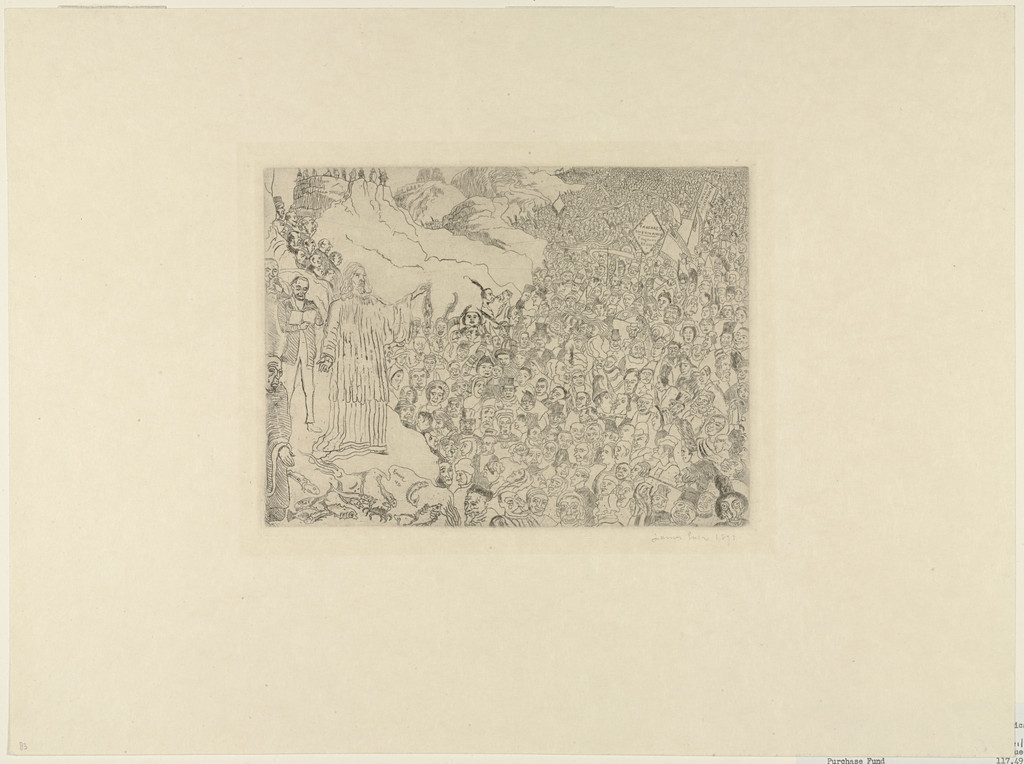
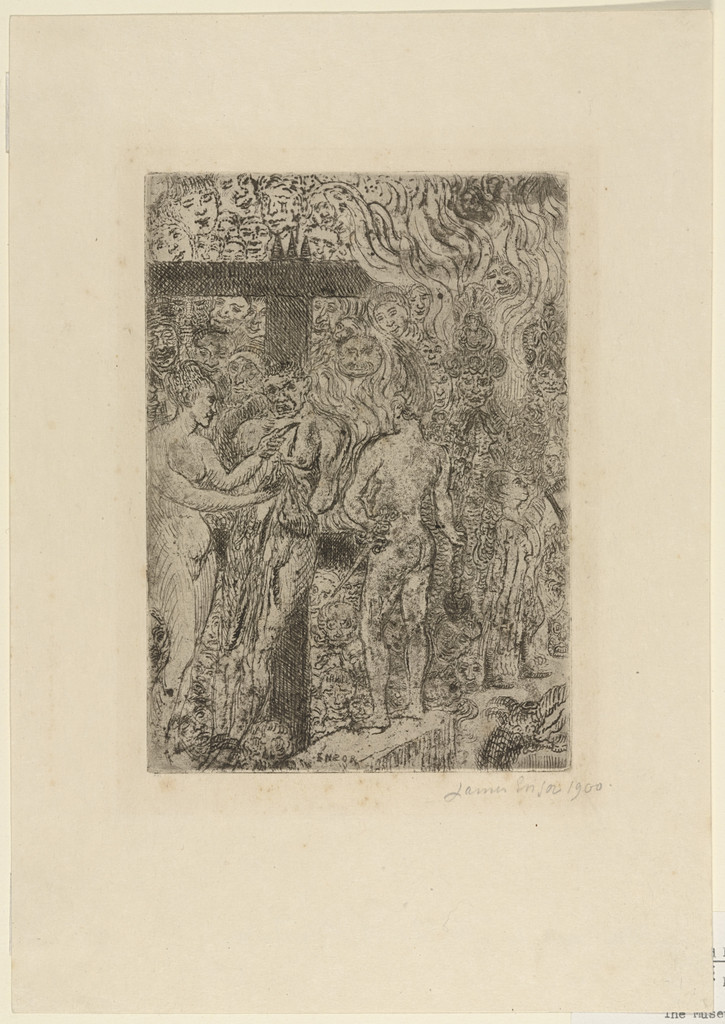
Ensor turned to religious themes, most often the torments of Christ, expressing through them his disgust at the inhumanity of the world; an atheist, he identified with Christ as a victim of mockery. At the height of his creative powers, between 1886 and 1891, he made 86 of his 133 etchings.
Værk
“Christ's Entry Into Brussels in 1889”
Værk · Ostend
Forty-five etchings in a single year
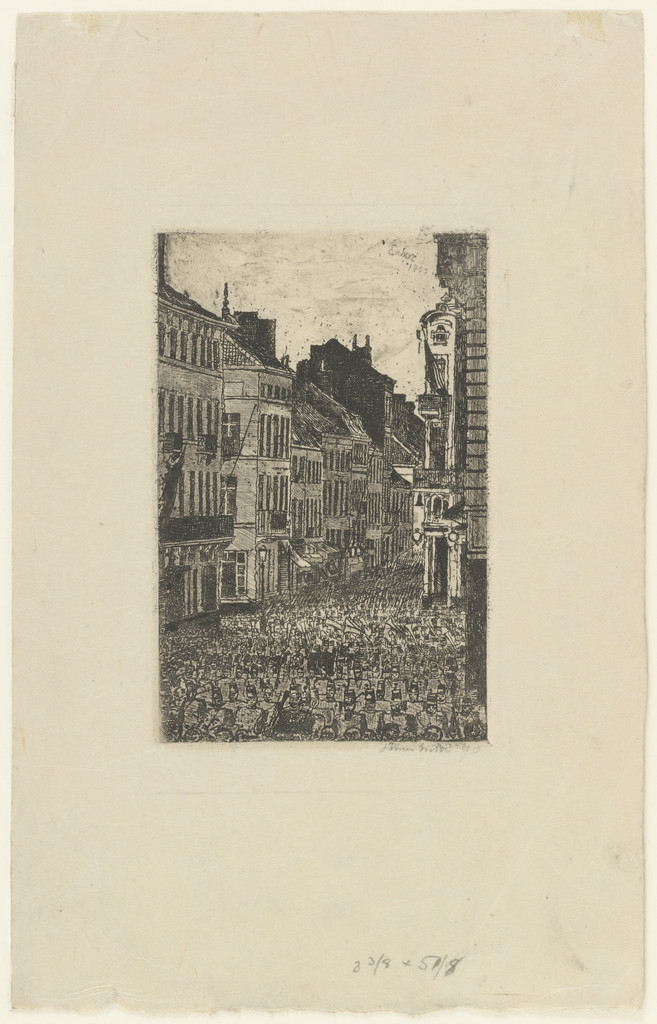
In 1888 alone Ensor made forty-five etchings and painted his most ambitious canvas, the immense “Christ's Entry into Brussels in 1889”, in which a carnival mob in grotesque masks advances on the viewer. Les XX rejected the painting, and it was not shown in public until 1929.
1889
Værk · Ostend
Political etchings against king and church
In “Doctrinal Nourishment” a bishop, the king and other pillars of Belgium defecate on the masses, while in “Belgium in the 19th Century, or King Dindon” Leopold II watches soldiers violently quell a protest.