
City guide
Art in Nancy: Where to See Caravaggio, Manet and the City Painted by Friant
A cemetery procession and a portrait sent home by its model make Nancy’s paintings personal. Start on Place Stanislas, then follow the city into its collection.
2026年11月2日 · 阅读约 7 分钟 · ART WIKI 编辑部
A girl has broken away from the adults to give money to a beggar. Behind her, women in black carry flowers towards Nancy’s Préville cemetery. Émile Friant’s All Saints’ Day makes a city’s annual ritual feel interrupted for a second, just long enough for two people to notice each other. Painted in 1888, the scene offers a useful beginning in Nancy. Its art history belongs to streets and families as much as to imported names.
The Musée des Beaux-Arts occupies a pavilion on Place Stanislas. The square was created in 1755 in honour of Louis XV, son-in-law of Stanislas, duke of Lorraine. Give the museum a substantial morning, then use the afternoon for the city outside it. These five paintings take you from the ducal court to a cemetery entrance, and from a fashionable woman who decided where her portrait should go to a former model who took control of the brush.
Caravaggio arrives by a route with missing pieces
Caravaggio’s Annunciation had already changed churches before revolutionaries seized it from Nancy’s cathedral in 1793. One of his last paintings, dated around 1607–10, it had decorated the altar of Saint-Georges in the ducal palace, then moved to the primatial church sometime after 1618. The original commission remains uncertain. Its subsequent journey, from courtly devotion to church worship and public collection, follows changes in the city’s own institutions.
Caravaggio sends the angel across the upper part of the canvas with his back turned towards us. Mary bends beneath him. There is no equally weighted conversation between two figures facing one another across an elegant room. The messenger takes up space; the recipient folds into it. Follow the line of his arm down towards her before trying to make out the furnishings in the dark.
The canvas has suffered damage and later intervention, so it should not be treated as an untouched record of every original brushstroke. The angel is especially important to an account of what survives. That makes looking slightly slower and more discriminating. The darkness belongs to the design, but the object also has a physical history. You are looking at a painting that has crossed several kinds of institution, not at a perfectly preserved illustration of a Bible passage.
Two winters, two ways of remembering Nancy
Charles X’s visit to Nancy in 1828 prompted the commission for Delacroix’s Battle of Nancy. Finished in 1831, it returns to 5 January 1477, when Charles the Bold died during the battle that defeated his attempt to take Lorraine. Delacroix depicts the fatal encounter with the knight Bauzémont. The commission asked a nineteenth-century painter to furnish the city with an image of its own distant survival.
The battle does not offer the tidy legibility of a map. Horses and men converge, while the landscape gives the violence a wider setting. Stand back first, then isolate the encounter within the movement. A visitor can know who won and still have difficulty locating a stable centre. That instability is part of what separates a painted battle from a diagram explaining military positions; bodies must occupy the ground that a map reduces to symbols.
Friant’s All Saints’ Day brings the city’s memory down to the scale of an ordinary observance. The setting is the entrance to Préville cemetery. Black clothes cut a procession across the pale wintry background; chrysanthemums identify the purpose of the visit. The faces were carefully developed in the studio, probably with photographs. The impression of a passing instant is the result of preparation, not evidence that Friant simply copied a moment as it happened.
The picture won a special prize at the Salon of 1889 and was bought by the state. It came to Nancy’s museum after Friant’s death. Its local subject had first acquired a national audience. Look particularly at the child’s extended hand. The adults are on their way to remember the dead, but the small transaction briefly directs the procession’s attention towards someone living at the gate.

Méry Laurent chooses her own destination
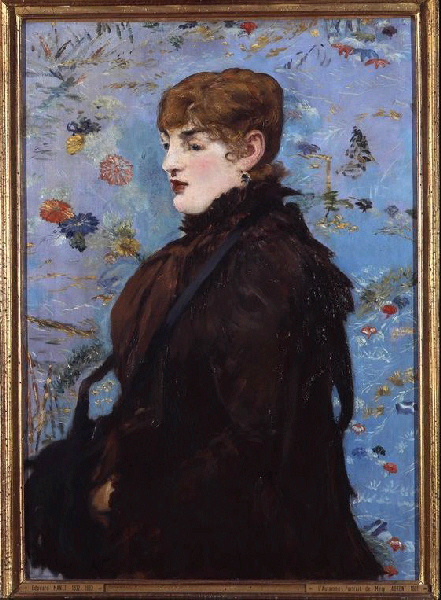
Manet’s Autumn reached Nancy through the woman it depicts. Méry Laurent left it to the city of her birth, and the bequest entered the collection in 1905. At the sale after Manet’s death, the painting had been bought for 1,550 francs, probably on her behalf. A model became the person who helped determine the public future of her own image, a decision worth remembering when the portrait’s clothes begin to distract you.
Laurent appears in profile, wrapped in a fur-trimmed garment against a patterned Japanese textile. Autumn has become a matter of dress rather than a landscape of falling leaves. The profile keeps her from returning the viewer’s gaze, but the colour of her face remains the point towards which the dark clothing and blue background lead. Nothing in this arrangement requires her to perform an anecdote for us.
The portrait belonged to an unfinished project of seasonal figures. Manet completed only two of the proposed four; the precise development of the plan is uncertain. Antonin Proust encouraged the undertaking, but it is not clear that the entire cycle was settled from the beginning. The incompletion suits the picture’s independent life. Laurent could own and bequeath this particular image without needing the rest of a decorative scheme to make it intelligible.
Valadon gives the model three bodies
Suzanne Valadon had learned about painting while working as a model. For Casting the Net, she reversed the arrangement. André Utter, her younger lover and a painter himself, supplied the male body, shown in three successive poses. The canvas dates from 1914. Instead of a single frozen instant, the casting action unfolds across the picture, with the net providing a reason for shifts of balance and effort.
Its appearance at the Salon des Indépendants provoked an abusive attack by Arthur Cravan, who was convicted of defamation. The episode is easy to repeat as scandal; the painting deserves longer attention than the insult. Trace the transfer of weight through the three figures. The heavy outlines keep each body distinct, while the repeated model allows the eye to compare one phase of movement with the next. Valadon makes the person who once watched painters at work responsible for arranging the body everybody else will inspect.
If you have a second afternoon, the Musée de l’École de Nancy extends the question of private taste into a former collector’s home. It opened in 1964 in the property associated with Eugène Corbin, the department-store patron. For a first day, however, resist compressing it into whatever minutes remain. Confirm the five paintings’ availability with the Beaux-Arts before travelling, then give Place Stanislas some daylight. Friant’s city becomes easier to imagine once the museum doors are behind you.
封面: L'Annonciation — Michelangelo Merisi Da Caravaggio. Phillipot, Mignot; Ministère de la Culture (France), base Joconde
City guide
Art in Cambridge: Blake, Titian and Monet at the Fitzwilliam Museum
A date contradicted by paper, a Roman journey remembered years later, and trees saved from the axe. Give Cambridge’s Fitzwilliam a day of close looking.
City guide
Art in Bordeaux: The Venus of Laussel, Delacroix and Rosa Bonheur in Two Museums
A prehistoric figure bears the marks of a pickaxe, and a Delacroix still carries the loss caused by a city fire. Bordeaux’s museums preserve the accidents as well as the intentions.
City guide
Art in Montauban: A Day with Ingres, Bourdelle and Napoleon’s Ghosts
An emperor ordered a dream for his bedroom; a sculptor’s model refused to lend his face. Montauban brings their stories together in a bishop’s former palace.