City guide
Art in Lille: David, Goya, Delacroix and Monet at the Palais des Beaux-Arts
A general’s helmet collects coins, Medea’s embrace becomes a trap, and two Goyas turn out not to be the pair they seem.
2026年11月2日 · 阅读约 7 分钟 · ART WIKI 编辑部
The helmet has become a begging bowl. In David's Belisarius Begging for Alms, a child holds it out while a woman gives money and a soldier throws up his hands. He has recognised his former commander. The recognition comes too late to preserve the old man's dignity, but just in time to make the spectator understand what has happened.
That is an effective beginning for a day at Lille's Palais des Beaux-Arts. Public power keeps losing its composure in this collection. A general begs, Medea's embrace becomes a threat, and Goya's elderly women face an unwelcome visitor with a broom. These are paintings worth giving separate stretches of attention, with a break before Monet's London begins to disappear into the weather.
The palace itself records an act of municipal ambition. Opened in 1892, it fulfilled a promise by mayor Géry Legrand; the city received permission to borrow more money and run a lottery to help finance the project. Lille wanted a building proportionate to its collection. You need not try to repay that ambition by seeing everything in one visit. Four encounters, involving five paintings, make a more usable afternoon.
David's general applies to the Academy
David prepared Belisarius Begging for Alms for approval by the Royal Academy and presented it at the Salon in 1781. A painting about a man's fall helped another man establish his career. The king did not buy it; David sold it to the Elector of Trier, and Lille eventually acquired it in 1863.
The episode is a legend, not a reliable report of the Byzantine general's last years. The story of Belisarius being blinded and reduced to begging became popular centuries after his death. Jean-François Marmontel's novel of 1767 helped revive it for painters and patrons concerned with the abuse of authority. David could make the injustice legible without reconstructing an actual street encounter.
The helmet does much of that work. It belongs to the military identity the soldier recognises, yet its immediate purpose is to receive a coin. The child mediates between the blind man and the person giving. Behind them, the soldier's raised arms turn private charity into public discovery. The figures do not all learn the same thing at the same instant.
Read their hands before reading their faces. The donor's small action and the soldier's expansive reaction occupy different registers, while Belisarius cannot see either of them. David places the spectator in the uncomfortable position of knowing more than the central figure. The scene's grandeur depends on a humiliatingly ordinary transaction, a small sum passed into an overturned piece of armour.

Delacroix keeps Medea in Paris for another year
The state bought Delacroix's Medea for Lille after the Salon of 1838. He nevertheless asked for it to remain on display at the Musée du Luxembourg for a year before it left Paris. The painting's destination was provincial; its maker still wanted the capital's audience. A museum acquisition could be settled while the struggle over visibility continued.
Medea holds the children she is about to kill. Jason's abandonment supplies the myth's terrible motive, but the picture stops before the act. The knife changes the meaning of the bodies pressed together. What could, at a distance, resemble a mother protecting her children becomes a situation from which they need protection.
Delacroix gives the group a compact force. The children cannot simply step out of the arrangement, and the mother's grip occupies the space in which an embrace should reassure them. Follow the direction of her head and the pressure of the arms separately. They do different jobs. One part of the body is alert to what lies outside the group; another holds the victims within it.
There is no need to dwell on an imagined aftermath. The choice of the preceding instant is already sufficient. After David's general, whose disaster belongs to the past, this painting places the disaster ahead of us and makes us wait. The two canvases offer very different reasons for a figure to be unable to escape the moment in which a painter has placed it.
Goya's pair that was made into a pair
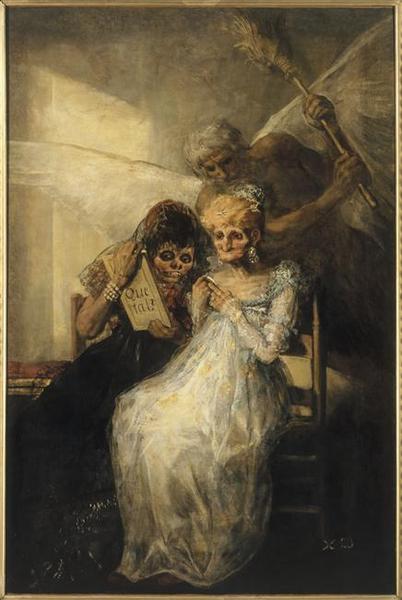
The labels seem to offer a ready-made lesson. The Old Women, or Time can be set against The Letter, also called The Young Women, as a before-and-after story of beauty. Yet the paintings were not conceived as pendants. The older women's canvas was enlarged in the nineteenth century, helping make the two pictures look compatible. Their apparent relationship owes something to later handling.
In The Old Women, a mirror carries the question “Qué tal?” while Time waits behind the women with a broom. The combination is cruelly domestic. A mythological force has arrived with a cleaning implement, as though human vanity were something to sweep away. One woman still attends to an image of herself; the spectator can already see who is standing behind her.
Scientific examination complicates the surface too. X-ray fluorescence revealed that the pale dress was originally dark blue and had ruffles. The canvas also covers an earlier composition. A familiar museum image contains another arrangement beneath it, and its present outline is not wholly Goya's decision. That makes a useful warning against explaining every effect as an unaltered expression of intention.
The woman in The Letter pauses to read while a companion holds a parasol and a dog seeks her attention. What does the letter say? The picture gives no text to consult. A 2022 technical study also challenged the usual reading of pale forms in the distance as drying laundry, identifying an escarpment crowned by a town instead. Even the background has resisted a settled account.
Monet borrows a hospital's view
For his later London paintings, Monet looked towards Parliament from St Thomas' Hospital. He had first encountered London while escaping the Franco-Prussian War in 1870, then returned in 1899–1901. The Lille Houses of Parliament, Stormy Sky is dated 1904. The gap matters: a rapidly changing atmosphere could become the subject of prolonged studio work.
Parliament supplies a recognisable shape without supplying a stable edge. Towers and water compete with the weather for definition. After the hands, weapons and faces in the previous paintings, the difficulty is almost physical: how far can a building dissolve before you stop identifying it? Move between the broad silhouette and the separate marks of paint. The subject survives at one distance and fragments at another.
Give this last encounter enough quiet to feel different from the earlier ones. Before travelling, confirm the availability of the paintings that matter most to you; the collection list is not a guarantee of the day's display. Once inside, choose a bench when your attention starts to scatter. Lille's museum was built with large ambitions, but it rewards the visitor who can spend ten unhurried minutes on a helmet, a broom or a patch of river.
封面: Bélisaire demandant l'aumône — Jacques-Louis David. RMN-Grand Palais; Ministère de la Culture (France), base Joconde
City guide
Art in Melbourne: Tiepolo, Waterhouse and Australian Painting at the NGV
A shearing shed needed paid dust-raisers, and a shipload of sirens caused a public argument. Melbourne’s paintings have stories on both sides of the frame.
City guide
Art in Besançon: Where to See Courbet, Bellini and Bronzino in One Day
A Medici gift crossed the Alps, and a collector’s portrait helped change a museum. Besançon rewards a day spent following the people behind its paintings.
City guide
Art in Minneapolis: A Day with Goya, Rembrandt and Bonnard at Mia
A doctor receives a painting in thanks; an actress receives one as an insult. Follow five pictures through the intimate disputes and public gifts that brought them to Minneapolis.