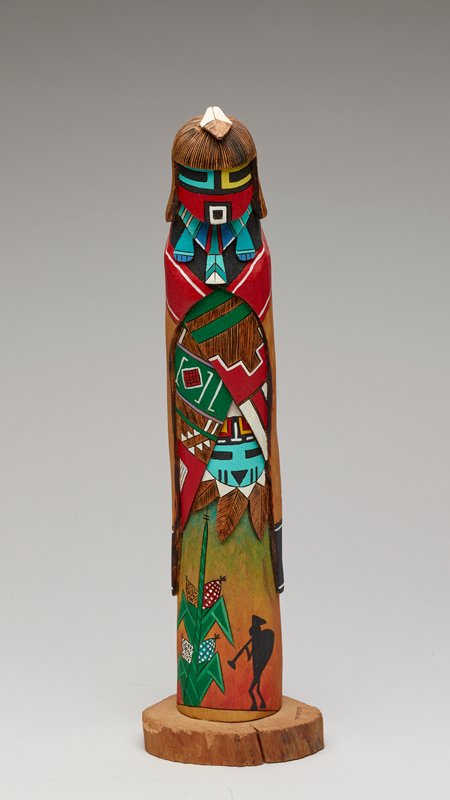
White Chin Corn Maiden
能看到吗?
目前未展出
《White Chin Corn Maiden》现在在哪里? 收藏方: 明尼阿波利斯美術館, 明尼阿波利斯. 目前未展出. 核实 2026年9月29日.

明尼阿波利斯, 美國
仍属馆藏,只是目前没有展出。
- 核实
- 此状态始于
- 出处
- 博物馆
关于这件雕塑
L2021.153.1 - L2021.153.5
继续阅读
This gift offers excellent examples of how the Hòpituh Shi-nu-mu (Hopi) have carved katsinam figures for centuries. It is a skill only mastered through a lifetime of dedication, not simply to the craft but also to the culture and society as well. Katsinam are the physical embodiment of the spirits that bring rain and sustenance to the Hopi people. It is a common belief in Native American communities that everything has a spirit. In Hopi culture, spirits of plants, animals, food, and water are brought to life by the katsinam. When choosing the cottonwood root, the carver waits patiently until the wood presents itself to be carved. The spirit of the cottonwood is then given a physical form, to be used in a ceremonial manner or as teaching tools for children. Carvers are limited to carving figures only seen in their own clan societies. Traditional carvings are done with minimal detail. Contemporary carvings, like the ones here, are incised with fine lines and accentuated by paint.
L2021.153.6
Before creating in clay, Joe Cajero, Jr., sits in a meditative state waiting for the clay to take shape in his mind. His attention to detail is so great, this Koshare’s face would be recognizable in any Pueblo. The Koshare is holding two frogs, one in each hand, with a third frog sitting atop his head. In Pueblo culture, the frog is a connection to nature and represents fertility. Though playful, the Koshare is important to Pueblo culture and ceremony: a spiritual representation of fertility, he is often seen in ceremonial dances celebrating a bountiful harvest.
明尼阿波利斯美術館
作品信息
- 馆藏编号
- 2021.116.1
已收入目录
出处
- 明尼阿波利斯美術館
- 图片: 明尼阿波利斯美術館 — © Minneapolis Institute of Art