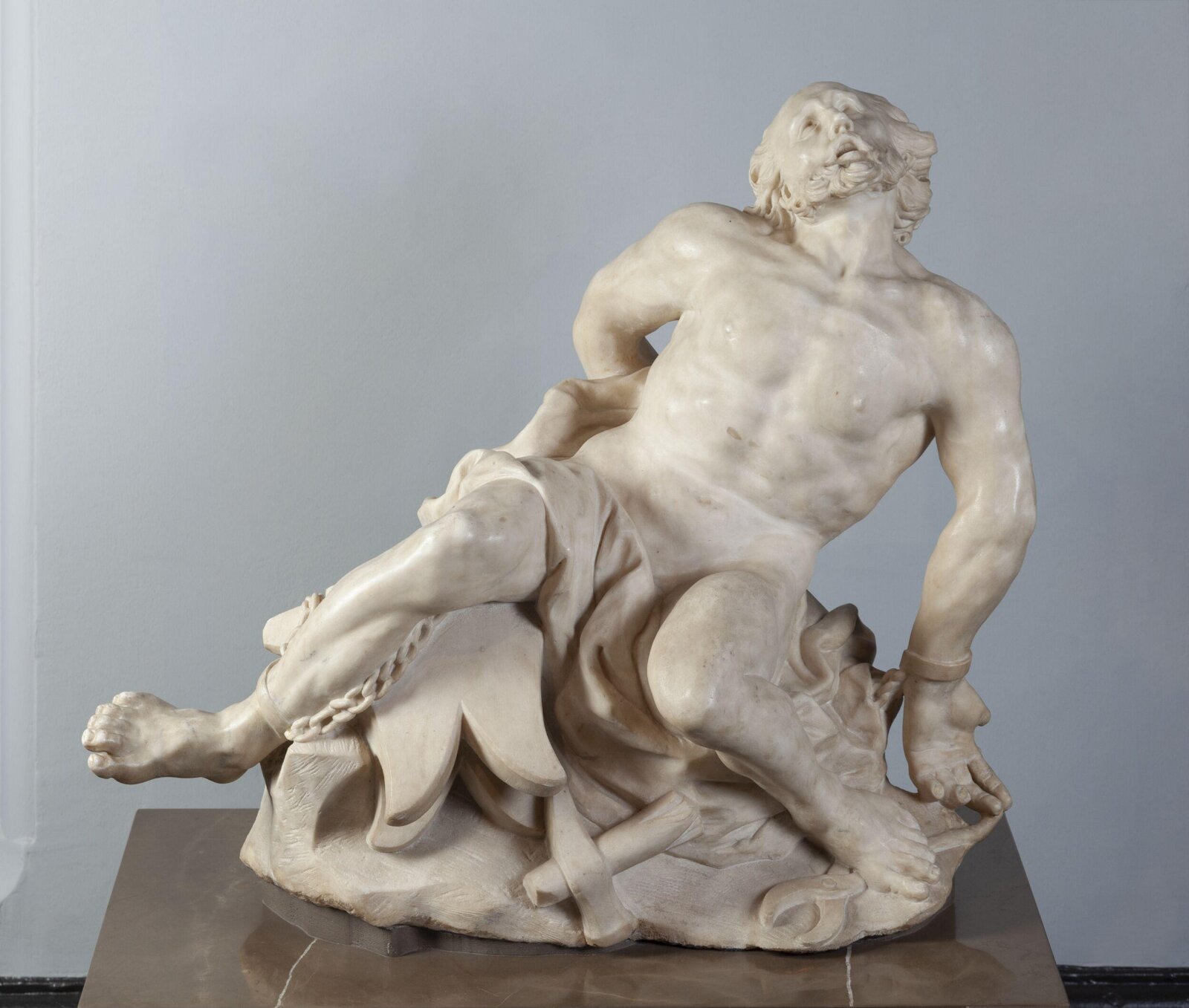
Vulcan (or possibly Prometheus) chained to a rock
能看到吗?
是,正在展出
《Vulcan (or possibly Prometheus) chained to a rock》现在在哪里? 维多利亚和阿尔伯特博物馆, Sculpture, Room 22, The Dorothy and Michael Hintze Galleries, 倫敦. 是,正在展出. 核实 2026年9月25日.

闭馆· 10:00 开馆
正对公众展出。
- 核实
- 此状态始于
- 出处
- 博物馆
关于这件雕塑
The figure is closely related to David's statue of St Bartholomew in the church of S. Maria di Carignano in Genoa, Italy. Malcolm Baker has suggested that it's one of the few free-standing sculptures of mythological figures to have been executed by a sculptor working in England in the first half of the 18th century'.
继续阅读
Although traditionally thought to represent the mythical Prometheus, chained to a rock by the god Jupiter, the figure probably represents Vulcan. The diary of Sir Matthew Decker, who saw the piece in its original setting in 1728, provides an explanation of its symbolism. Placed on the landing half-way up the main staircase, the figure was intended to be accompanied by a further figure of William III, as part of an allegorical representation of how William's arrival in England and the Glorious Revolution of 1688 had averted a civil war. 'Vulcan is accordingly represented as chained, rather than fashioning the instruments of war.'
维多利亚和阿尔伯特博物馆
作品信息
- 馆藏编号
- A.3-1981
画面内容
已收入目录
出处
- 维多利亚和阿尔伯特博物馆
- 图片: 维多利亚和阿尔伯特博物馆 — © Victoria and Albert Museum, London




![[Die Auferweckung des Lazarus; The Raising of Lazarus. Small Plate; Résurrection de Lazare], Rembrandt, 1642](https://diglib.hab.de/varia/haum/rembrandt-v3-4562/max/000001.jpg)
![[Die kleine Löwenjagd mit zwei Löwen; The Small Lion Hunt with Two Lions; Chasse aux lions], Rembrandt, 1629](https://diglib.hab.de/varia/haum/rembrandt-v3-4599/max/000001.jpg)