Auguste Rodin法国, 1840–1917
TORSE D'ADELE
能看到吗?
不明
《TORSE D'ADELE》现在在哪里? 收藏方: 羅丹美術館, 巴黎. 今日是否在展,尚不得而知.
巴黎, 法國
所有者已知,目前是否展出尚不清楚。
- 此状态始于
- 出处
- 博物馆
关于这件雕塑
Torso of Adele is an 1878-1884 sculpture by the French artist Auguste Rodin, originally modelled in plaster before being worked in terracotta.
作品信息
- 馆藏编号
- S 3219
画面内容
已收入目录
出处
- 羅丹美術館
- 图片: Wikimedia Commons — Attribution 2.0 Generic | Author: Flickr user Jean-Pierre Dalbéra
Auguste Rodin当时的生活
完整生平1880
Receives the commission for “The Gates of Hell”
His first state commission was a sculptural portal for a planned Museum of Decorative Arts; with it Rodin received two studios on the Rue de l'Université. The museum was never built and “The Gates of Hell” remained unfinished: they were first cast in bronze after the master's death.
1880
The 1880 Salon: third prize
Rodin showed “St. John the Baptist”, which won third prize. In the same Salon “The Age of Bronze” was exhibited a second time, now cast in bronze.
c. 1880 – 1881
Juliette Adam's salon and first recognition
Rodin was received at the salon of the writer Juliette Adam, where he was presented to Gambetta; Gambetta recommended him to Antonin Proust, the minister of fine arts, who bought “St. John the Baptist” for the state. It was the first recognition to reach a sculptor who was already forty.
1881
London: meeting William Ernest Henley
Rodin's friend Alphonse Legros introduced him in London to the poet William Ernest Henley, who did more than anyone to win him a British audience. Through Henley Rodin met Robert Louis Stevenson and Robert Browning.
1883
Meets Camille Claudel
Standing in for Alfred Boucher, who was away, Rodin supervised his students' course and met the eighteen-year-old Camille Claudel. She became his assistant, model, lover and creative rival.
1884
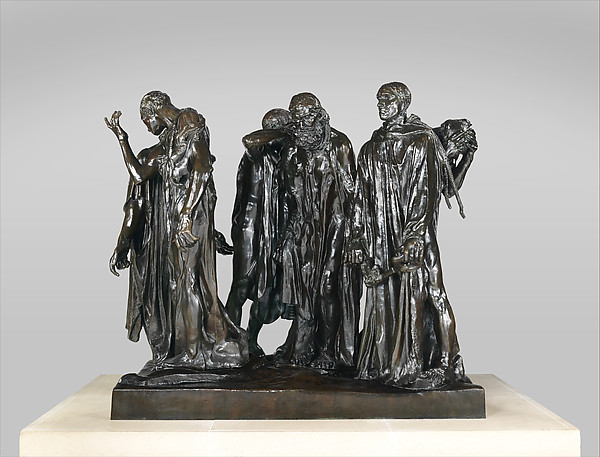
Commission for “The Burghers of Calais”
Rodin pursued the commission for a monument to the town of Calais, but instead of a lone hero, Eustache de Saint-Pierre, he conceived six citizens, each with his own emotions. A year later the committee was unimpressed with his progress; Rodin was ready to abandon the project rather than change his design, and the town told him to carry on.