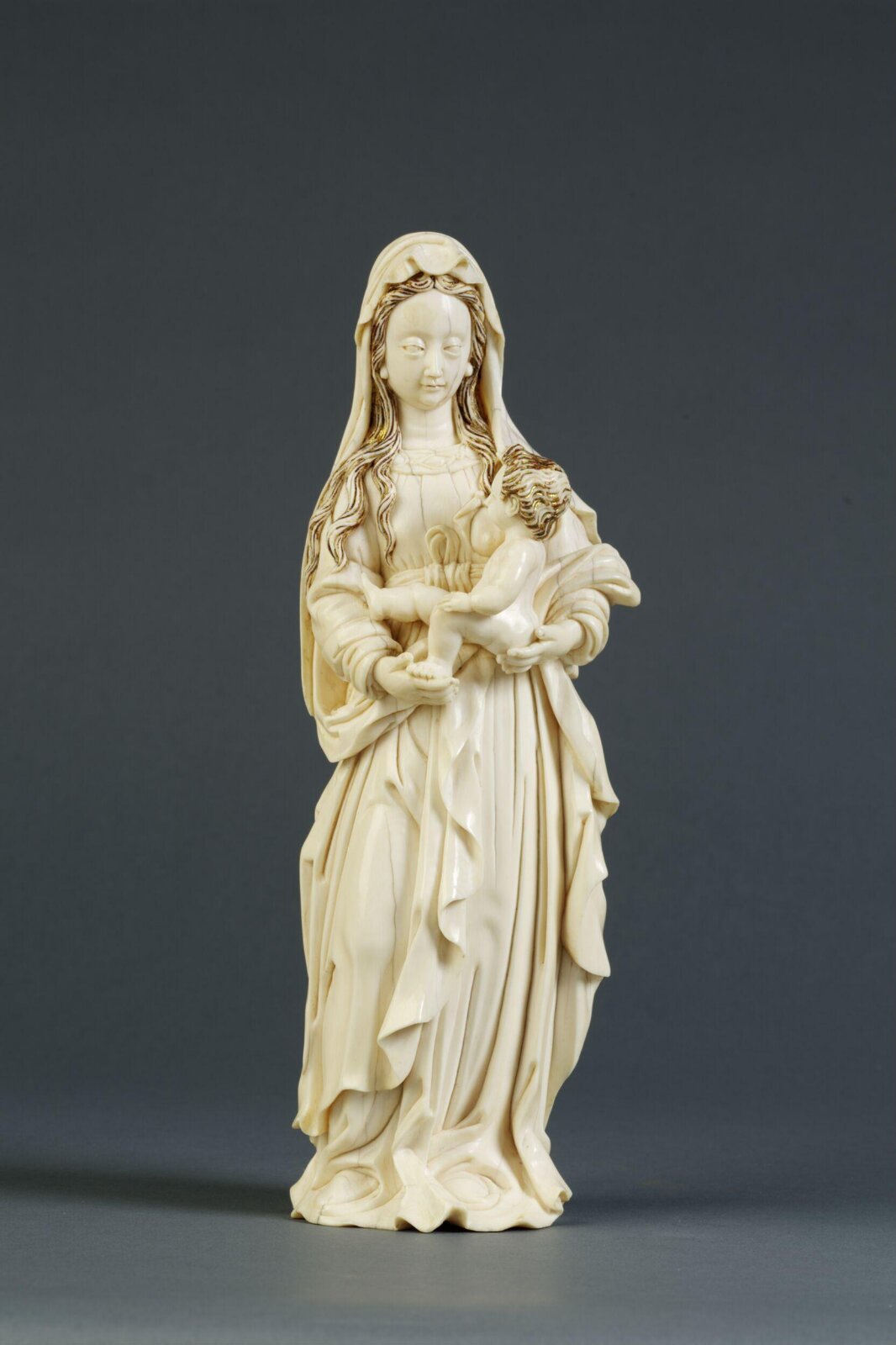
The Virgin and Child
可否一睹真容?
可以,正在迎客

正对公众展出。由谁担保,见下文。
- 核实
- 此状态始于
- 出处
- 博物馆
关于这件雕塑
The Virgin stands, holding the Christ Child in her arms. Traces of gilding can be seen on the hair of both the Virgin and the Child. Both the figures have the remains of red pigment on their lips, and brown on their eyes. The Virgin has bared her left breast, and the naked Christ Child clutches her headdress with his right hand. The Virgin's feet are swathed in the long drapery of her dress; the outlines are visible through the folds. Feet for the Chinese were thought to be erotic, and this may be the reason for their being hidden but suggested, beneath her robe. At the back of the Virgin's high-waisted dress is a tuck, a phenomenon which can also be seen on other ivory figures of the Virgin made in the Far East. It is uncertain whether this finely-carved sculpture was produced in mainland China, or in the Philippines.
继续阅读
From the 17th through to the 19th century ivories were evidently worked in the Philippines by Chinese sculptors who had emigrated; Manila was a sea voyage of some eight days from the Chinese coast. By 1639 some 30,000 Chinese were living there, many of them craftsmen and traders, known as sangleyes, in the Parián area, meaning market place, an enclave specially built for them just outside the city walls. Additionally, by the first half of the eighteenth century, a number of native Filipino and Chinese mestizos (of mixed race) were recorded as ivory carvers there. But this statuette could also have been made in China. During the Ming period (1580-1640) and later, ivory carvers were based on the South East coast of China, particularly in the city of Zhangzhou, in southern Fujian province.
This statuette bears a resemblance to figures of Guan Yin, the Chinese Buddhist goddess of fertility. It is likely that the Guan Yin figures were themselves influenced by European imagery of the Virgin and Child, and the iconography of this piece also distantly recalls baroque Spanish sculpture, such as the work of the Seville sculptor Juan Martínez Montañés (1568-1649). While it is difficult to date, its assured and sophisticated carving suggest that this ivory was made in the early eighteenth century.
Ivory is a rare, exotic and luxurious raw material. However this Virgin was probably made not primarily as a costly work of art, but as a devotional piece, to educate, perhaps to convert, and to help with prayers and worship. It was no doubt commissioned from the sculptor by a Spanish patron, such as a prelate, or a member of one of the orders, the Franciscans, Dominicans or Augustinians, all of whom were active in the Philippines. Perhaps designed to be exported back to the Iberian Peninsula, it may also have been used locally to maintain the Christian beliefs of the local population. Delicately carved, and distinctive in handling, its features are in many ways typical of Hispano-filipino ivory Madonnas: rippling drapery, the striated and gilded hair of both the Virgin and Child, the heavy eyelids and thick fingers, and the idiosyncratic tuck in the robe at the back.
作品信息
- 馆藏编号
- 1459-1902