Joseph Mallord William Turner英国, 1775–1851
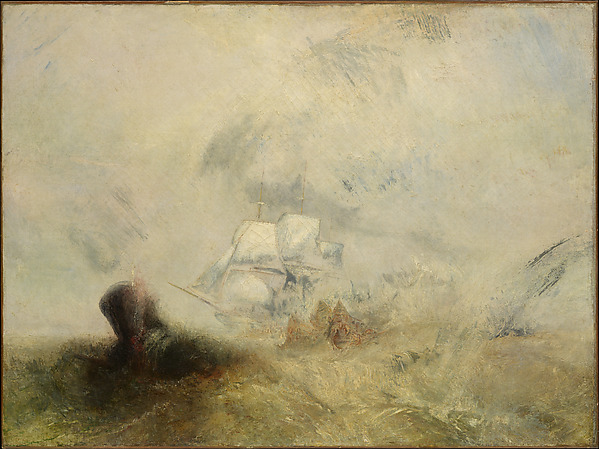
The Shipwreck

关于这幅画
The Shipwreck is a landscape painting by J. M. W. Turner in the collection of the Tate. It was completed around 1805, when it was exhibited in Turner's own gallery in Queen Anne Street. The painting is an important example of the sublime in British art.
It is thought that the picture probably records the then recent sinking of the Earl of Abergavenny, which foundered off Weymouth in Dorset on 4 February 1805.
作品信息
- 馆藏编号
- NG476
已收入目录
出处
- 维基数据
- 图片: 国家美术馆 — J. M. W. Turner · Public domain · Wikimedia Commons
Joseph Mallord William Turner当时的生活
完整生平1802–1803
Paris and the Swiss Alps in a year of peace
In the only year without war in Europe between 1793 and 1814 (the Peace of Amiens, 1802–1803) a consortium of noblemen sponsored a visit to Paris, where he saw old master paintings in the Louvre, and then he toured the Swiss Alps; his Alpine sketches later let him represent “the sublime” in paintings such as “Snow Storm: Hannibal and his Army Crossing the Alps” (1812).
1804
Opens his own gallery
Distrustful of dealers, he opened his own gallery so that he could sell directly and group the pictures he wanted seen together, something he could not control at the Royal Academy exhibitions; his father left his barbershop to help in the gallery and studio. For over a decade the gallery was a regular feature of the London exhibition season.
1804
His mother dies in Bethlem Hospital
His mother, Mary Marshall, whose symptoms of mental disorder grew worse, had to be placed by his father in St Luke’s Hospital for Lunatics; she was later moved to Bethlem Hospital, commonly known as “bedlam”, where she died in 1804.
summer 1805
Summer 1805: along the Thames
In the summer of 1805 he systematically sketched places along much of the Thames, from Oxford to the Thames Estuary; these intense months of observation so inspired him that for the next five or six years he presented many river-themed paintings in each of his annual gallery shows, based on his sketchbooks.
1806–1819
Work on the “Liber Studiorum”
For nearly twelve years he worked on about 70 mezzotints — the “Book of Studies”, inspired by Claude’s Liber Veritatis and meant as a manifesto of British landscape art; commercially it failed because of poor handling of sales and distribution, but it did elevate the prestige of landscape painting.
1807–1811
A floating studio at Hammersmith
Inspired by the Thames, he rented houses on or very near the river: in Isleworth (1804–1806) and in Hammersmith (1807–1811), where he converted a boat into a floating studio; fishing and boating were two of his favourite activities.