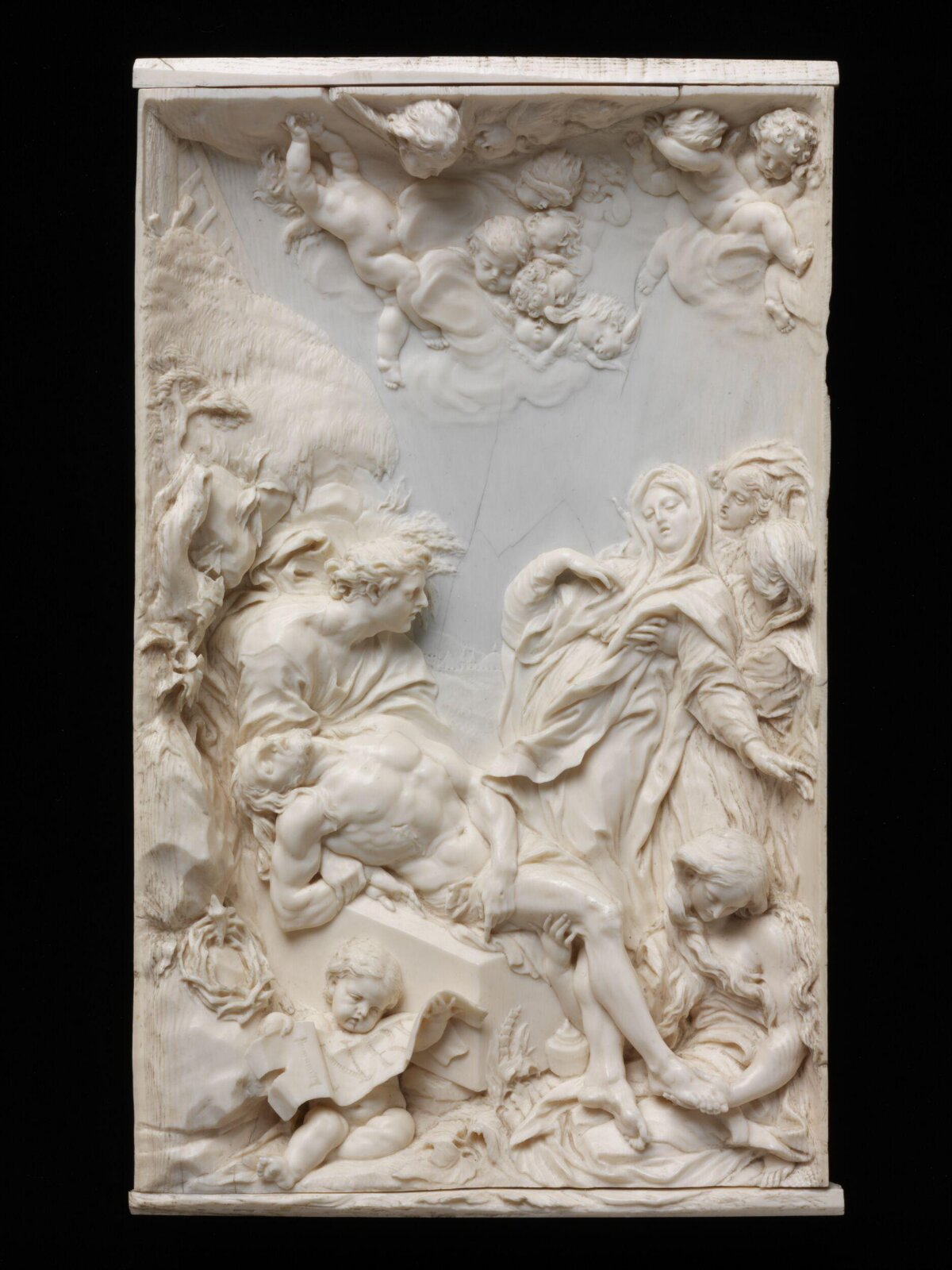
 Balthasar Permoser德国, 1651–1732
The Entombment
可否一睹真容?
可以,正在迎客

正对公众展出。
- 核实
- 此状态始于
- 出处
- 博物馆
关于这件雕塑
Throughout the ages artists and craftsmen have made virtuoso carvings as a display of their skill and ingenuity. Although ivory, wood and stone are relatively easy to carve, other materials such as gemstones are much more demanding. Most of these carvings were made for wealthy patrons and collectors, who delighted in the rarity of the material and quality of the carving. Balthasar Permoser(1651-1732) was famous for his monumental sculpture, but he also worked on a more intimate scale. He was among the foremost sculptors of the late Baroque period in Germany. This ivory exemplifies his sensitive carving, in particular the swooning Virgin falling away from the figure of the dead Christ. The concave top of the relief reflects the shape of the ivory tusk. In terms of subject matter, he executed both profoundly religious works, and elegant pieces of a purely secular nature.
继续阅读
He trained initially in Salzburg and in 1671 went to Vienna, where he is likely to have studied ivory carving. He visited Rome in 1674-5, and in about 1677 entered the service of the Medici in Florence in the sculpture workshops run by Giovanni Battista Foggini (1652-1725). Some of his ivory figure groups were later reproduced in porcelain by the Doccia, Fürstenberg and Meissen manufactories. In 1690 he moved to Dresden to work at the court of the Elector of Saxony, and remained there for the rest of his life, apart from a spell in Berlin, where he collaborated with Andreas Schlüter (c. 1659-1714) on the Berliner Schloss.
维多利亚和阿尔伯特博物馆
作品信息
- 馆藏编号
- A.30-1949
画面内容
已收入目录
出处
- 维多利亚和阿尔伯特博物馆
- 图片: 维多利亚和阿尔伯特博物馆 — © Victoria and Albert Museum, London