Paul Signac当时的生活
完整生平1888
Discovering anarchist ideas
In 1888 Signac discovers anarchist ideas by reading Élisée Reclus, Kropotkin and Jean Grave; with his friends Charles Angrand, Henri-Edmond Cross, Maximilien Luce and Camille Pissarro he contributes to Grave's paper, Les Temps Nouveaux (New Times). Politically he remains an anarchist, as were many of his friends, among them Félix Fénéon.
1889
A visit to Van Gogh in Arles
In March 1889 Signac visits Van Gogh at Arles; he had met him in Paris in 1886 and had travelled with him to Asnières in 1887.
1892
Down the Garonne to the Mediterranean — to Saint-Tropez
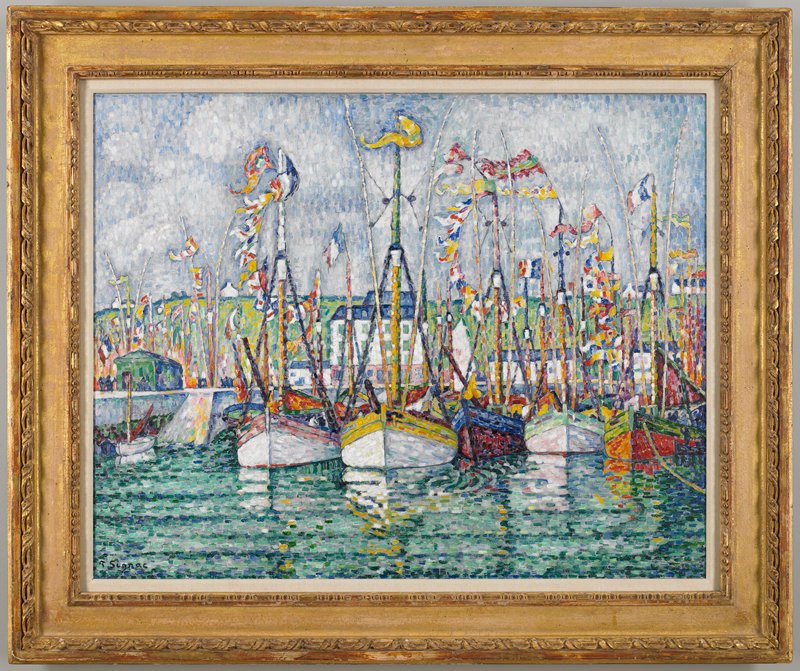
In 1892 Signac sails down the Garonne to the Mediterranean and spends time in Saint-Tropez. The Mediterranean coast becomes a major theme of his painting: each summer he leaves the capital for the south of France, for Collioure or Saint-Tropez, envisioning it as the perfect location for a future anarchist utopia.
1892
Married: Berthe Roblès
1897
Buying the house La Hune in Saint-Tropez
In December 1897 the Signacs acquire a house in Saint-Tropez named La Hune, where the painter has a vast studio built; he inaugurates it on August 16, 1898. In Saint-Tropez he invites his friends to stay.
1898–1899
“From Eugène Delacroix to Neo-Impressionism” appears
In 1898–1899 Signac's programmatic work “From Eugène Delacroix to Neo-Impressionism” appears, a set of rules for the artists of the new movement: any optical mixture, he argues, leads to clarity and brilliance, any material mixture to darkening and discoloration. Henri Matisse, after reading the essay, adopts the Divisionist technique in 1898.