 Jonathan Borofsky美国, 1942
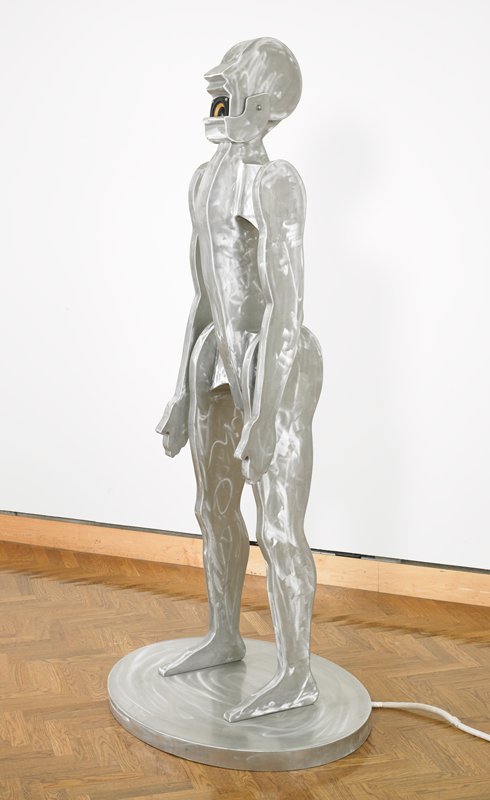
Singing Man
能看到吗?
目前未展出
《Singing Man》现在在哪里? 收藏方: 明尼阿波利斯美術館, 明尼阿波利斯. 目前未展出. 核实 2026年11月16日.

明尼阿波利斯, 美國
仍属馆藏,只是目前没有展出。
- 核实
- 此状态始于
- 出处
- 博物馆
关于这件雕塑
Jonathan Borofsky, born in 1942 in Boston, Massachusetts, has stated that most of his work is a mode of self-portraiture. Singing Man (1994) reflects an autobiographical expression of the artist’s interest in music, while, at the same time, manifests of his long struggle with the anxieties of daily patterns.
继续阅读
Borofsky took aspects of the competing impulses of Pop art and Minimalism and combined them in this playful figurative sculpture, the aspect of his work for which he is best known. This classic example of his sculpture also merges his interests in humor and spirituality. It is an artwork that stands as both a timeless piece of figurative sculpture and a signature piece of its time. With its cyborg-like form of stainless steel and a mechanical jaw stuck in endless repetitive “singing, ” it reflects one of the central concerns of 20th century philosophy – the loss of humanity in an age of mechanization. At its essence, it is an artwork that raises questions about the human spirit.
Borofsky is well known for his sculptures of large figures like the Hammering Man, Chattering Man, and Many Walking to the Sky. One collective theme behind Borofsky's artwork is a reference to the ordinary contemporary man. His figures are unfocused and dream-like. Borofsky believes that in modern society we tend to judge who we are with how we are seen by others. The resulting anxiety leaves man trapped in a boring routine by repeating set patterns of dissatisfying behavior. At the same time our spirit strives for freedom from this behavior.
Singing man breaks away from boring and frustrating patterns in daily life as he peacefully sings a chant. A portrait of the artist as well as a surrogate audience, Borofsky explains that the figure is an evolution to a more peaceful state of mind. Given the artist's interest in music, this piece is particularly personal and autobiographical. It is accompanied by a 35-minute song titled Voice that was recorded by Borofsky in 1997 and used as the original installation sound track fo the GOD Project at Brandeis University's Rose Art Museum. It was also used as the performance soundtrack for the Kiyomizu Temple Project in Kyoto, Japan where Borofsky set up easels in the Temple and made paintings for seven days.
明尼阿波利斯美術館
作品信息
- 馆藏编号
- 2010.58.5a-e
已收入目录
出处
- 明尼阿波利斯美術館
- 图片: 明尼阿波利斯美術館 — © Jonathan Borofsky