.jpg?width=96) Vincent van Gogh荷兰, 1853–1890
Vincent van Gogh荷兰, 1853–1890自画像
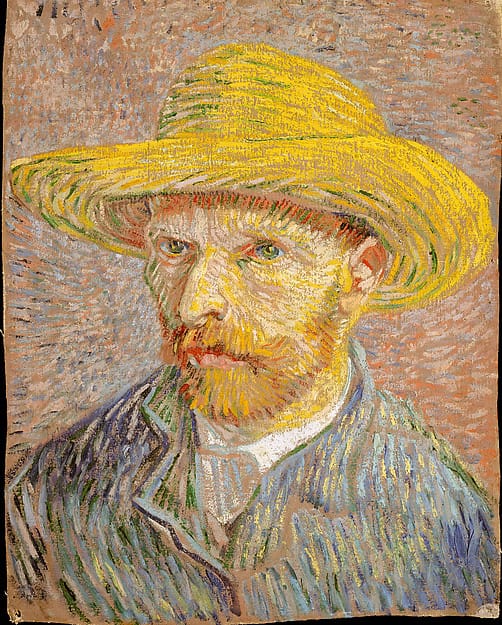
Self-portrait
关于这幅画
The Dutch Post-Impressionist painter Vincent van Gogh painted a self-portrait in oil on canvas in September 1889. The work, which may have been his last self-portrait, was painted shortly before he left Saint-Rémy-de-Provence in southern France. It is now in the collection of the Musée d'Orsay in Paris.
This self-portrait was one of about 32 produced by van Gogh over a 10-year period, and these were an important part of his work as a painter; he painted himself because he often lacked the money to pay for models. He took the painting with him to Auvers-sur-Oise, near Paris, where he showed it to Dr. Paul Gachet, who, according to Van Gogh, was "absolutely fanatical" about it.
继续阅读
Art historians are divided as to whether this painting or the self-portrait without a beard in a private collection is van Gogh's final self-portrait. The art historians Ingo F. Walther and Jan Hulsker consider this to be the last, with Hulsker believing that it was painted in Arles following van Gogh's admission to hospital after mutilating his ear, whereas Ronald Pickvance considers the self-portrait without a beard to be the later painting.
Van Gogh sent the picture to his younger brother, the art dealer Theo; an accompanying letter read, "You will need to study [the picture] for a time. I hope you will notice that my facial expressions have become much calmer, although my eyes have the same insecure look as before, or so it appears to me."
Walther and Rainer Metzger consider that "the picture is not a pretty pose nor a realistic record... [it is] one that has seen too much jeopardy, too much turmoil, to be able to keep its agitation and trembling under control". According to Sister Wendy Beckett the dissolving colours and turbulent patterns signal a feeling of strain and pressure, symbolising the artist's state of mind, which is under a mental, physical and emotional pressure.
The Musée d'Orsay notes that "the model's immobility contrasts with the undulating hair and beard, echoed and amplified in the hallucinatory arabesques of the background".
作品信息
- 馆藏编号
- RF 1949 17
与此同时,在Vincent van Gogh的生活中
完整生平February 1888
To Arles, dreaming of a “Studio of the South”
The public still neither accepted nor bought his paintings, and in February 1888 Van Gogh left for Arles in the south of France to found a “Studio of the South”, a brotherhood of like-minded artists in which he gave Gauguin the leading role. Theo backed the plan with money.
23 October 1888
Gauguin arrives in Arles
After much pleading Gauguin arrived in Arles, and in November the two painted together: Gauguin portrayed Van Gogh in “The Painter of Sunflowers”, and their first joint outing was to the Alyscamps. At Gauguin's suggestion Vincent painted from memory, producing “Memory of the Garden at Etten”.
23 December 1888
The severed ear
After an altercation on the evening of 23 December, Van Gogh, seemingly hearing voices, severed his left ear, wholly or in part, with a razor and delivered it, wrapped in paper, to a woman at a brothel. Next morning a policeman found him unconscious; in hospital he was diagnosed with “acute mania with generalised delirium”.
May 1889
Voluntarily into the Saint-Paul asylum
Van Gogh left Arles and voluntarily entered the Saint-Paul-de-Mausole asylum, a former monastery in Saint-Rémy-de-Provence, accompanied by the Protestant clergyman Frédéric Salles. Of his two cells with barred windows one became a studio, and the clinic and its garden became the main subjects of his paintings.
27 July 1890
A fatal wound: a revolver shot