Satyress
能看到吗?
是,正在展出
《Satyress》现在在哪里? 克利夫蘭藝術博物館, 117A Italian Renaissance, 克利夫兰. 是,正在展出. 核实 2026年9月29日.

正对公众展出。
- 核实
- 此状态始于
- 出处
- 博物馆
关于这件雕塑
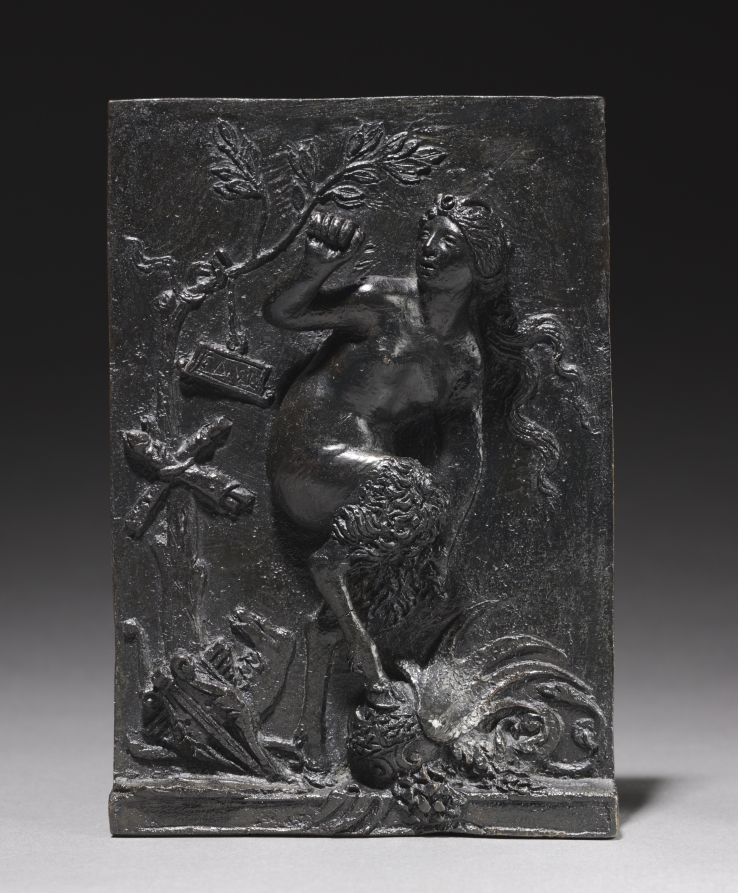
In antiquity, satyrs were lustful woodland deities who delighted in wine and revelry. Renaissance artists adopted them as symbols of vice and carnal love; the female satyr, or satyress, on this bronze plaquette, recently reattributed from Riccio to Mosca, was probably derived from a copper engraving of a Roman sarcophagus by Marcantonio Raimondi (c. 1470/82-1527/34). Both the sarcophagus and subsequent engraving depicted a bacchanalia, or scene of orgiastic carousal; the peculiar objects surrounding the satyress have been added by the artist, possibly in an effort to remove the figure from her lewd original composition and give a more refined meaning. The satyress rests her right hoof upon a plumed helmet. A coiled shape, possibly a snake, winds out of the helmet. To her left, a laurel tree stands with only half of its branches in bloom.
继续阅读
Two severed animal legs are tied around its trunk and an illegible plaque hangs from one of its branches. A lyre, a pan pipe, an animal jawbone and a bow are gathered at the base of the tree. The highly allegorical nature of the work uses obscure symbols, rather than a distinct narrative, to convey meaning and could possibly be read as an allegory of physical pleasure overcoming virtue.
克利夫蘭藝術博物館
作品信息
- 馆藏编号
- 1947.29
已收入目录
出处
- 克利夫蘭藝術博物館
- 图片: 克利夫蘭藝術博物館 — Museum open access
Giovanni Maria Mosca当时的生活
完整生平1515–1530 · 工作地
Padua
1515–1530 · 工作地
Venice
1530–1553 · 工作地
Kraków