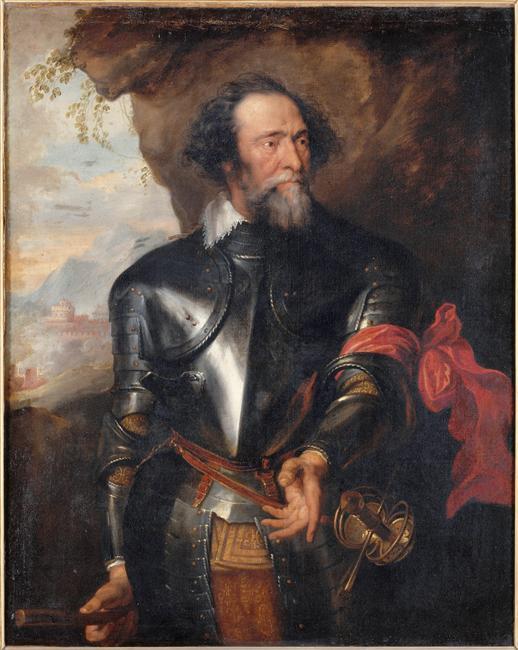
 Anthony van Dyck佛兰德, 1599–1641
PORTRAIT DU COMTE HENRI DE BERGHE
能看到吗?
不明
《PORTRAIT DU COMTE HENRI DE BERGHE》现在在哪里? 收藏方: 孔蒂博物馆, 尚蒂伊. 不明.
尚蒂伊, 法國
所有者已知,目前是否展出尚不清楚。
- 此状态始于
- 出处
- 博物馆
作品信息
- 馆藏编号
- PE 126
画面内容
已收入目录
出处
- 孔蒂博物馆
- 图片: 孔蒂博物馆 — © R.G. Ojeda ; Harry Bréjat ; Réunion des musées nationaux - utilisation soumise à autorisation; Ministère de la Culture (France), base Joconde
Anthony van Dyck当时的生活
完整生平1624
Quarantine During the Plague in Palermo
In Palermo Van Dyck found himself in quarantine during the plague of 1624, one of the most severe in Sicily's history; there he created an important series of paintings of Saint Rosalia, the city's patroness, establishing her iconography for the Italian Baroque.
1624
Invitation to Palermo
In April 1624 Emmanuel Philibert of Savoy, Viceroy of Sicily, invited Van Dyck to Palermo to paint his portrait.
1626–1632
The Iconography Print Series
After returning to Antwerp, Van Dyck conceived a large series of engraved portraits of his contemporaries, the Iconography; he etched eighteen plates himself, executing the preparatory drawings mainly between 1626 and 1633. The first edition (80 plates) appeared in Antwerp in 1632.
1627
Return to Antwerp
In 1627 Van Dyck returned from Italy to Antwerp, where he remained for five years, creating portraits of the Flemish nobility and large altarpieces, and beginning to work in printmaking.
1629
Beginning of His Relationship with Charles I
Van Dyck's relationship with Charles I began in 1629: through the intermediary Sir Endymion Porter, the king acquired his painting Rinaldo and Armida.
by 1630
Court Painter to Archduchess Isabella
From 1630 Van Dyck was court painter to Archduchess Isabella Clara Eugenia of Habsburg, regent of the Spanish Netherlands; for her portrait he received a gold chain.