 Georges Seurat法国, 1859–1891
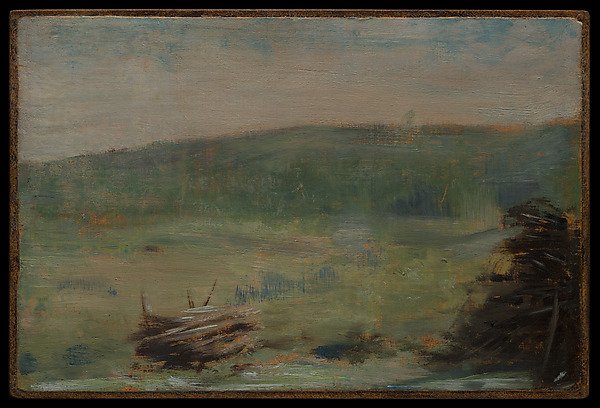
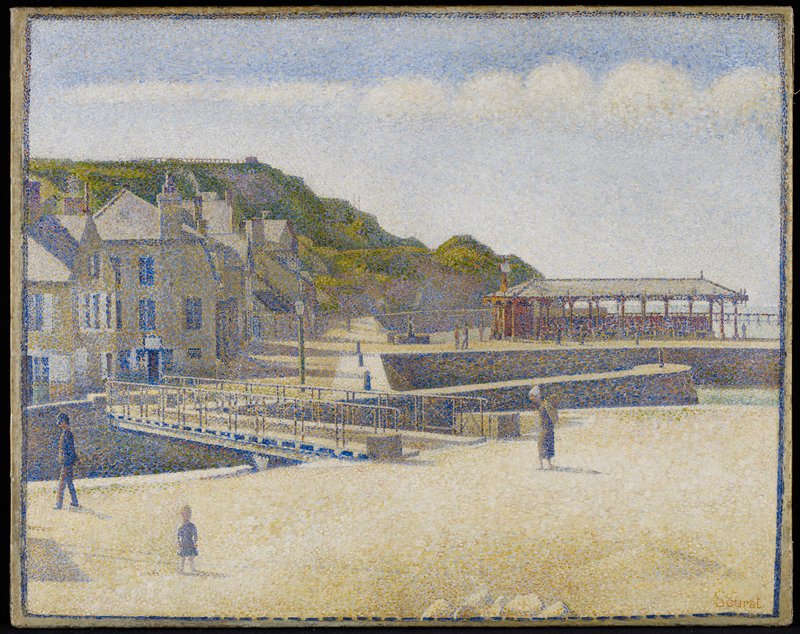
Port-en-Bessin
能看到吗?
目前未展出
《Port-en-Bessin》现在在哪里? 收藏方: 明尼阿波利斯美術館, 明尼阿波利斯. 目前未展出. 核实 2026年9月29日.

明尼阿波利斯, 美國
仍属馆藏,只是目前没有展出。
- 核实
- 此状态始于
- 出处
- 博物馆
关于这幅画
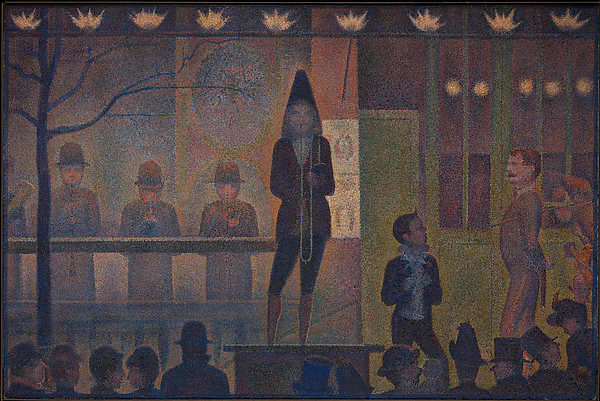
In the summer of 1888, Georges Seurat worked in Port-en-Bessin, a small fishing village in Normandy. He painted six views of the seaport and its surrounding countryside. His intention was to translate as exactly as possible the luminosity of the open air, with all its nuances. Although Seurat shared the Impressionists' goal of translating nature's light and color, he also wished to make Impressionism more precise. He wanted to replace its spontaneous, improvisational qualities with a more systematic, objective approach that could reflect the essential structures of a landscape, not just its transitory effects. To this end, Seurat developed an unusual new technique, variously called pointillism, divisionism, or Neo-Impressionism. He juxtaposed small dots of pigment according to his interpretation of scientific theories of color and optics. His followers, like Paul Signac, continued the pointillist style after Seurat's early death from pneumonia.
明尼阿波利斯美術館
作品信息
- 馆藏编号
- 55.38
已收入目录
出处
- 明尼阿波利斯美術館
- 图片: 明尼阿波利斯美術館 — public domain
Georges Seurat当时的生活
完整生平1880s
Charles Henry's lectures at the Sorbonne
In the 1880s Seurat hears lectures by the mathematician Charles Henry at the Sorbonne on the emotional properties and symbolic meaning of lines and colour; there remains controversy over how far he adopted Henry's ideas.
1886
Nine works, the public's mockery and the critics' defence
At the last Impressionist exhibition Seurat presents nine works; the critics R. Marx and Félix Fénéon write favourable reviews, but the public ridicules the “pictures painted in dots”, and the Swiss critic Émile Hennequin finds them grey and poor in light. The Impressionists are sceptical: when Pissarro says that “La Grande Jatte” is very interesting, Degas replies that he would have noticed, but it is so large; Seurat himself blames the hall for being too dark and cramped to give the picture the necessary distance.
15 May – 15 June 1886
“La Grande Jatte” is first shown at the eighth Impressionist exhibition
“A Sunday Afternoon on the Island of La Grande Jatte” is shown to the public for the first time at the eighth Impressionist exhibition, held from 15 May to 15 June 1886. The painting will initiate Neo-Impressionism and alter the direction of modern art.
19 September 1886
Fénéon names “Neo-Impressionism” and defends Seurat
Félix Fénéon, who gives the new movement the name “Neo-Impressionism”, defends the artist in an article for the Belgian paper “L'Art Moderne” of 19 September 1886: here, he argues, no virtuosity of brushwork or impasto is needed, but the eye must be quick, sharp and perceptive.
1889
Madeleine Knobloch moves into Seurat's studio
Seurat conceals his relationship with the artist's model Madeleine Knobloch (1868–1903); in 1889 she moves in with him in his studio on the seventh floor of 128 bis boulevard de Clichy.
16 February 1890
The birth of his son Pierre-Georges
When Madeleine becomes pregnant the couple move to a studio at 39 passage de l'Élysée-des-Beaux-Arts (now rue André Antoine), where on 16 February 1890 she gives birth to their son, who is named Pierre-Georges.