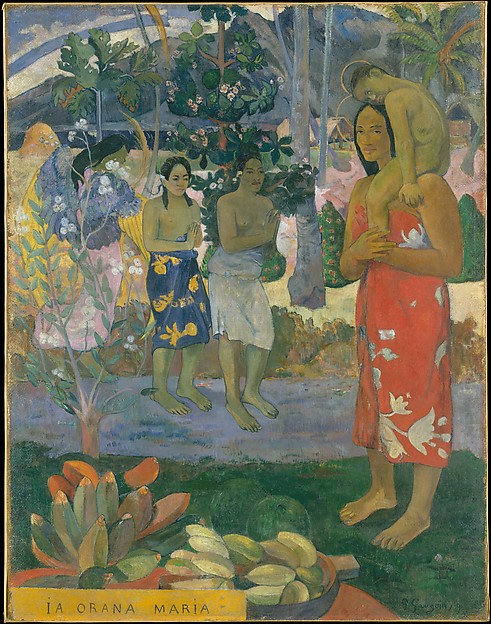
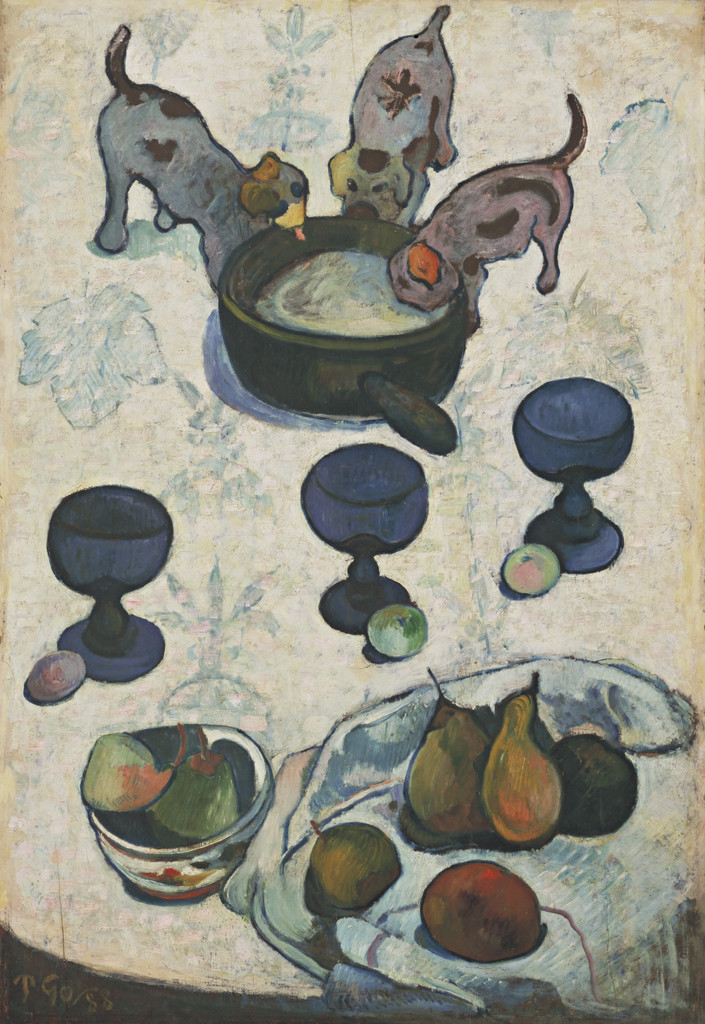
Paul Gauguin法国, 1848–1903
Poèmes Barbares
能看到吗?
是,正在展出
《Poèmes Barbares》现在在哪里? 哈佛藝術博物館, Gallery 1220, floor 1, European Art, 19th–20th century, 剑桥. 是,正在展出. 核实 2026年9月29日.

正对公众展出。
- 核实
- 此状态始于
- 出处
- 博物馆
关于这幅画
Gauguin’s model for this painting was likely Pau’ura a Tai, a 14-year-old girl whom the artist described as his “native wife” while living in Tahiti in the 1890s. Widelycriticized today, the painter’s sexual relationships with local adolescents were also condemned by some of his contem poraries in French Polynesia. The painting maybe a response to the 1896 death in infancy of Gauguin’s daughter with Pau’ura a Tai. The figure’s wings, posture, and drapery evoke representations of the Virgin Mary and Christ Child. But instead of cradling a baby in her left arm, she protectively clutches her abdomen, emphasizing her loss. Reinforcing this narrative of birth and death is the presence at lower left of Ta’aroa, the Tahitian creator of the universe. Pau’ura a Tai averts her gaze from the deity, who Gauguin anthropomorphizes in an unusually childlike form.
继续阅读
The girl’s downcast stare, coupled with her exposed chest, underscores the powerimbalance between artist and sitter.Below the SurfaceAn X-radiograph of this painting reveals a different image beneath the surface. It confirms that Gauguin first painted a horizontal landscape with riders on galloping horses before turning the canvas and repainting it with the composition of Poèmes Barbares. The pigments that the artist used for the underlying landscape are denser than those used on the surface layer. As a result, they block X-rays more effectively, leaving a brighter imprint on the radiograph. Gauguin was frequently short on supplies in Tahiti, so it’s possible he sacrificed one painting to create another. The landscape imagery of the underpainting relates to several pastoral scenes that Gauguin executed during this period—perhaps he felt comfortable abandoning one of his more common compositions to produce a work that marked the birth and death of his child.[x-radiograph image]
哈佛藝術博物館
作品信息
- 馆藏编号
- 1951.49
已收入目录
出处
- 哈佛藝術博物館
- 图片: 哈佛藝術博物館 — © President and Fellows of Harvard College
Paul Gauguin当时的生活
完整生平1891–1901 · 工作地
Tahiti
1894
Exhibition at Durand-Ruel
The exhibition at the Durand-Ruel gallery had moderate success: 11 of the 40 paintings shown were sold at fairly high prices; soon afterwards, however, Gauguin lost Durand-Ruel's patronage.
February – April 1895
Failed Auction and the Oviri Scandal
In February 1895 Gauguin tried to repeat the Hôtel Drouot auction, but without success; in April he submitted the large ceramic sculpture Oviri to the salon of the Société Nationale des Beaux-Arts, whose reception caused a scandal, and wrote an indignant letter on the state of modern ceramics in Le Soir.
28 June 1895
Final Departure for Oceania
On 28 June 1895 Gauguin sailed once more for Tahiti — Eugène Carrière arranged cheap passage for him — arriving in September; he never saw Europe again. He spent the next six years mostly near Papeete, building a spacious house at Punaauia.
1897
News of the Death of His Daughter Aline
In April 1897 Gauguin received news that his beloved daughter Aline had died of pneumonia; the same month he learned that he had to vacate his house, and, taking out a bank loan for a new one, by the end of the year he was on the brink of ruin and despair.
c. 1898
Suicide Attempt
After finishing Where Do We Come From? What Are We? Where Are We Going?, Gauguin attempted suicide by taking arsenic, but the dose proved too large, and a violent fit of vomiting saved his life.