 Frederic Edwin Church美国, 1826–1900
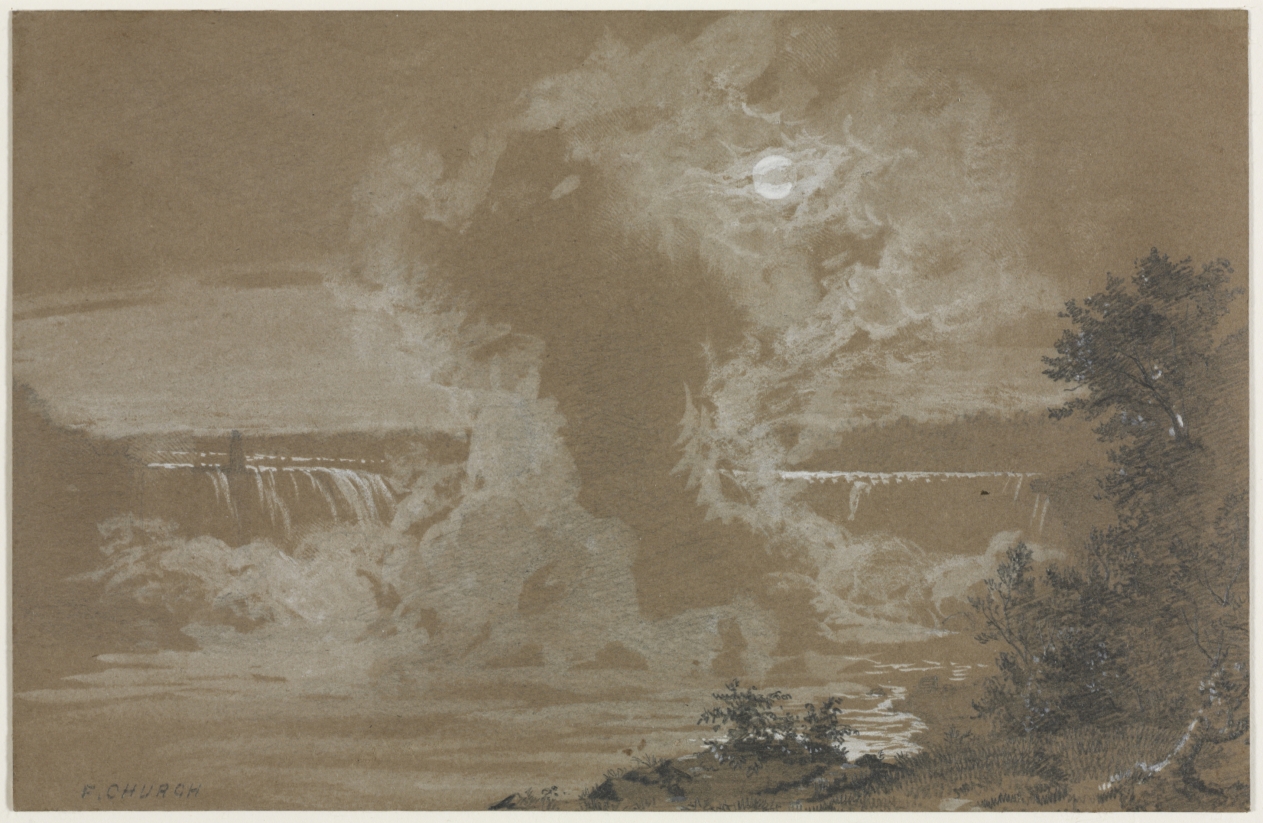
Niagara Falls by Moonlight

关于作品
By the time Frederic E. Church executed this study of the Canadian side of Horseshoe Falls, Niagara Falls was already an icon of both American art and the American nation. Tourists and artists flocked to the falls in pursuit of a firsthand experience of the sublime, a sensation of elation and terror that portrayals of Niagara Falls had notorious difficulty reproducing. Church’s celebrated oil painting The Great Fall, Niagara (1857) was one of the few depictions believed to capture the fall’s power in pictorial terms. Like many artists of the Hudson River School, Church used drawings made on site to preserve the visual memory of the place he intended to paint in oil. Cleveland’s sheet was possibly executed during one of the four trips he took to the falls in 1856 to prepare for Niagara. As a night scene, this study in light and shadow is unusual among Church’s drawings.
继续阅读
The dark brown paper enhances the image’s nocturnal quality and allowed Church to render the atmospheric effects of mist and clouds. He used white gouache not only as a highlight, but also to define the luminous forms of water and vapor, crafting the landscape’s substance out of negative and positive space. On the picture’s left-hand side, Church represented the man-made Terrapin Tower in shadowy miniature, a testament to his interest in site-specific details—and also, perhaps, a reminder of the diminutive status of human creation in the face of awesome natural forces.
克利夫蘭藝術博物館
作品信息
- 馆藏编号
- 1976.30
已收入目录
出处
- 克利夫蘭藝術博物館
- 图片: 克利夫蘭藝術博物館 — Museum open access