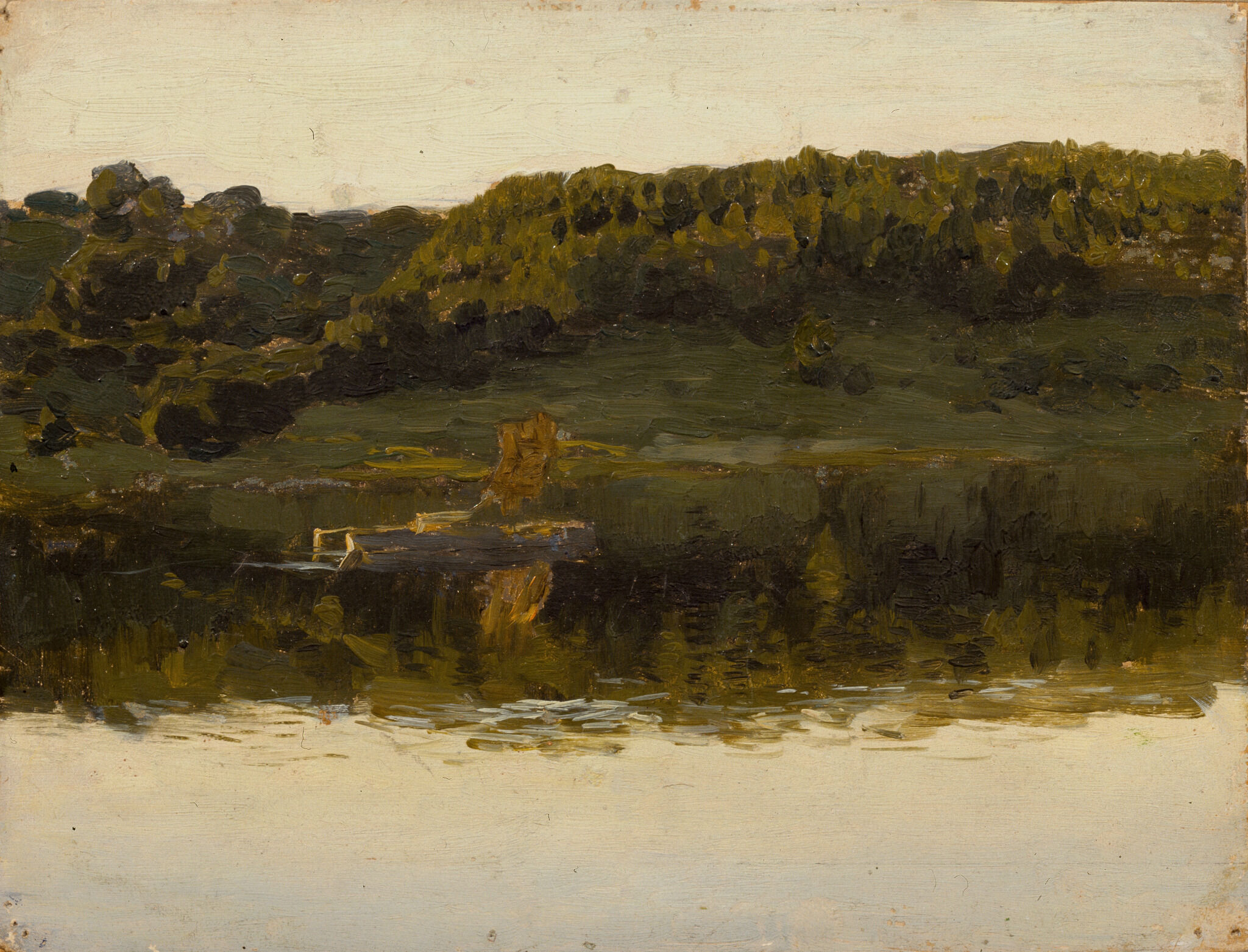
Этюды Левитана притягательны художественной выразительностью. Их небольшой размер нисколько не мешает наслаждаться красотой и сложностью живописной техники пейзажиста. От светлой недвижной полосы воды у переднего края взгляд уходит к берегу и видит отражение в реке плотной зелени и поднимающихся на взгорок деревьев, над которыми вечереющее небо перекликается с такой же светлой полосой воды на переднем плане этюда. Мягкими кистями Левитан пишет разные оттенки плотного холодного зеленого цвета, а поднимающиеся на пригорок купы деревьев он чуть окрашивает золотистым светом, благодаря чему создается ощущение сложного богатства природного мира. Глаз и кисть художника наслаждаются возможностью воплотить эту божественную красоту. Эффект золотистого вечернего освещения Левитан мастерски передал в завершенной картине «На Волге» (1888, Третьяковская галерея). В натурных этюдах художник улавливал эти мгновенные изменчивые состояния в природе с тем, чтобы использовать их в завершенных полотнах.
继续阅读
Летние месяцы 1888 года Левитан с удовольствием и успехом провел вместе с друзьями-художниками А.С. Степановым и С.П. Кувшинниковой в заштатном волжском городке Плёсе, который полюбился всем троим пейзажистам. Эти места подарили Левитану и его друзьям много радостных дней вдохновенного труда. Здесь были созданы или задуманы лучшие волжские пейзажи Левитана.
Levitan's material situation improves in the mid-1880s, but a hungry childhood, an unsettled life and hard work tell on his health: his heart disease sharply worsens.
1885–1886
Scenery for Mamontov's Private Opera
With Korovin he paints scenery for performances of Savva Mamontov's Private Russian Opera; according to Polenov's memoirs, the audience applauded the underwater scene of the opera “Rusalka” that Levitan painted with Viktor Vasnetsov.
1886
The Crimea and an exhibition of fifty landscapes
A trip to the Crimea in 1886 restores his strength; on his return Levitan organises an exhibition of fifty of his landscapes.
1887
His first trip to the Volga: the river seems dreary
In 1887 he at last fulfils his dream and goes to the Volga, which his teacher Savrasov had painted so movingly (in the early 1880s his sister's illness had prevented the trip). In cold, overcast weather the river disappoints him: it seems to him dreary and dead.
spring 1888
He discovers Plyos on the Volga
In spring 1888 he sails by steamer along the Oka to Nizhny Novgorod and on up the Volga with the artist Alexei Stepanov and Sofia Kuvshinnikova; to their own surprise they discover the small, quiet town of Plyos and decide to stay on for a while. The three summer seasons there (1888–1890) prove extremely productive: some two hundred works bring Levitan wide fame.
late 1889 – early 1890
His first trip to Western Europe
He visits France and Italy, wanting to get to know modern painting better as shown at the World Exhibition in Paris — probably above all the Barbizon school and the Impressionists. According to Nesterov, in the West he became convinced that the path he had chosen was the right one.
 Isaac Levitan1860–1900