

与此同时,在John Cage的生活中
完整生平from 1960 until the early 1970s
Arthritis: Cage stops performing in public
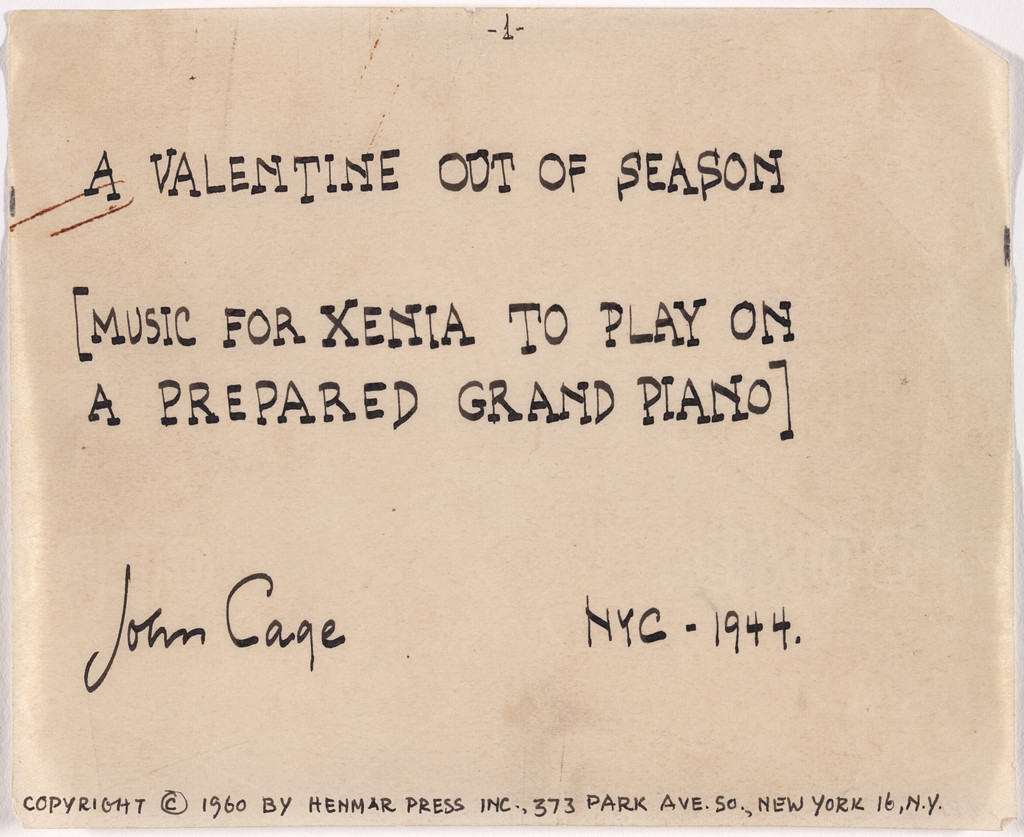
Arthritis troubles Cage from 1960, and by the early 1970s his hands are painfully swollen, so that he can no longer perform — “Cheap Imitation” is the last work he plays in public — and manuscripts for publication, previously done in his calligraphic script, now have to be completed by assistants. On top of this, David Tudor leaves performing for composition in the early 1970s, and Cage, for the first time in two decades, has to rely on other performers — Grete Sultan, Paul Zukofsky, Margaret Leng Tan and many others.
1964–1969
His parents die; ashes in the Ramapo Mountains
Cage's parents die during the decade — his father in 1964, his mother in 1969; he has their ashes scattered in the Ramapo Mountains near Stony Point and asks for the same to be done to him after his death.
1967–1979
Books: “A Year from Monday”, “M”, “Empty Words”
Cage goes on writing books of prose and poetry (mesostics): “A Year from Monday” is first published by Wesleyan University Press in 1967 (other accounts give 1968), “M” in 1973 and “Empty Words” in 1979.
1969
“HPSCHD”: seven harpsichords and 64 projectors
In 1969 the University of Illinois Urbana-Champaign hosts the five-hour first performance of “HPSCHD”, a large-scale multimedia work created with the composer and computer scientist Lejaren Hiller: seven harpsichords play chance-determined excerpts from Cage, Hiller and the classical canon, joined by 52 tapes of computer-generated sound, 6,400 slides (many supplied by NASA) and forty motion-picture films; audience members are free to move around the space.