


与此同时,在Frank Stella的生活中
完整生平1960s
Travels in the Middle East
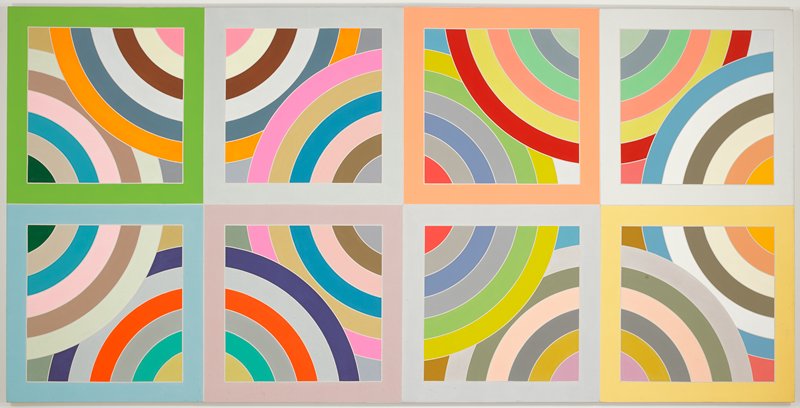
He visits circular-plan cities in the Middle East and is especially intrigued by the arches and decorative patterns he sees in the architecture and art of Iran; these cities will later give their names to works of the Protractor series.
1964
Radio discussion with Judd and Flavin
In a radio discussion of contemporary art with fellow artists Donald Judd and Dan Flavin, Stella sums up his approach: only what can be seen is there — “What you see is what you see.” The tautology later became known as the unofficial motto of minimalism.
mid-1960s
Begins working with master printer Kenneth Tyler
In the mid-1960s he begins his long involvement with printmaking, first working with the master printer Kenneth Tyler at Gemini G.E.L.
1965–1966
Guggenheim: “The Shaped Canvas” and “Systemic Painting”
His work is included in two exhibitions at the Solomon R. Guggenheim Museum: The Shaped Canvas (1965) and Systemic Painting (1966).
1967
Sets and costumes for Merce Cunningham
Designs the set and costumes for Merce Cunningham's dance piece Scramble.
1968年6月27日–1968年10月6日
Exhibition: 4. documenta




![Ginevra de' Benci [obverse], Leonardo da Vinci, c. 1474/1478](https://api.nga.gov/iiif/8f29e3c9-a289-4d53-abf0-31a66e9e98fa/full/!2400,2400/0/default.jpg)
![Wreath of Laurel, Palm, and Juniper with a Scroll inscribed Virtutem Forma Decorat [reverse], Leonardo da Vinci, c. 1474/1478](https://api.nga.gov/iiif/ff62e8d0-45c4-498f-ad36-6358de827e04/full/!2400,2400/0/default.jpg)


