Chuck Close美国, 1940–2021
Frank
能看到吗?
目前未展出
《Frank》现在在哪里? 收藏方: 明尼阿波利斯美術館, 明尼阿波利斯. 目前未展出. 核实 2026年11月16日.

明尼阿波利斯, 美國
仍属馆藏,只是目前没有展出。
- 核实
- 此状态始于
- 出处
- 博物馆
关于这幅画
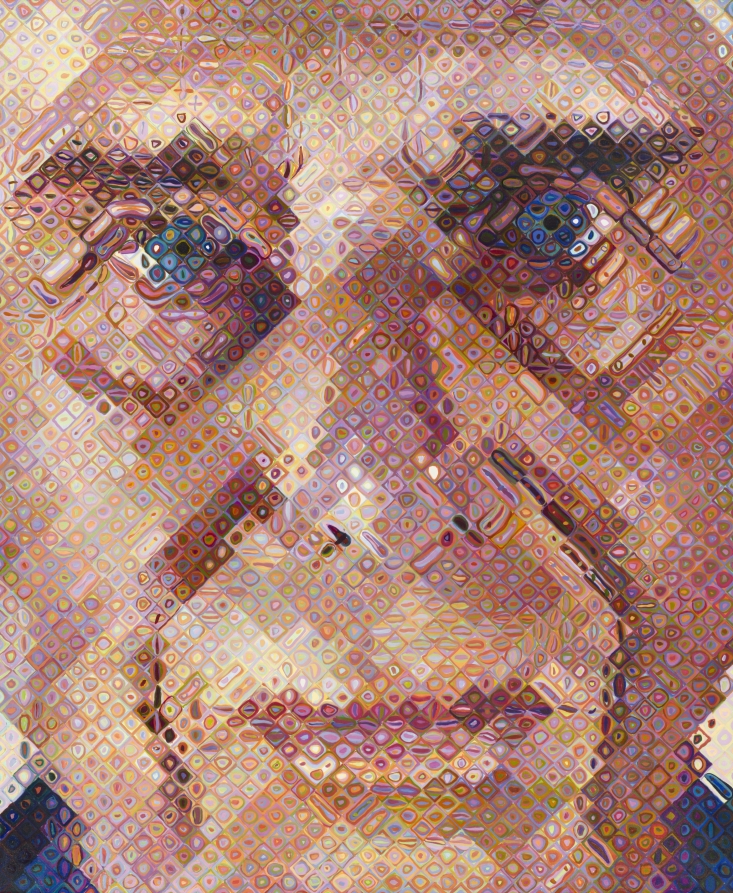
查克·克洛斯1969年根据一张照片画了《弗兰克》。这幅放大的肖像在明尼阿波利斯艺术学院。他的来源是一张八乘十英寸的照片,而不是现场写生。克洛斯放大图像,盖上方格,把每一格转到画布上,一块一块仔细完成。这一方法保留了照片客观无我的细节,却造出一个巨大的人头。它的尺度促使观众分开看各个局部:毛孔和毛发可以变成白、灰、黑的抽象排列。
博物馆的介绍
The model for this painting was not Frank himself but rather an 8-by-10-inch photograph of him. Since the late 1960s, Chuck Close’s method has been to start with a photographic print that he enlarges and overlays with a grid. He then systematically transposes each gridded block directly onto the canvas or paper, meticulously refining and finishing the image. The result is a technically masterful and ironically monumental portrait. By his painstaking technique, he preserves the objectivity of photography. A work of such grand scope—typical of American painting after 1950—is unsettling, particularly when it features a colossal human head. “The large scale, ” Close said, “forces the viewer to read the surface of the painting differently . . . [to] look at it piece by piece.” The details, then, can be perceived either as facial pores and hairs or as an abstract pattern of black, gray, and white.
明尼阿波利斯美術館
作品信息
- 馆藏编号
- 69.137
已收入目录
出处
- 明尼阿波利斯美術館
- 图片: 明尼阿波利斯美術館 — © Chuck Close, courtesy PaceWildenstein, New York
Chuck Close当时的生活
完整生平1967
Gives up the brush to force a breakthrough
In 1967 he chooses to make art hard for himself and force a personal artistic breakthrough by abandoning the paintbrush; as he later explains, he chose to do things he had no facility with, because a limit imposed on what you have done before pushes you somewhere you have never gone.
1967
His first solo show is closed by the university over nudity
Close’s first solo exhibition, at the University of Massachusetts Art Gallery in Amherst, with paintings, painted reliefs and drawings based on photographs of record covers and magazine illustrations, is promptly closed by the university administration, which cites the male nudity as obscene. The ACLU and the AAUP come to his defence and a landmark court case ensues; a Massachusetts Supreme Court justice decides in the artist’s favour, but when the university appeals Close chooses not to return to Boston, and an appeals court ultimately overturns the decision (the university will award him an honorary doctorate of the arts in 1995).
1967
Moves to New York and settles in SoHo
In 1967 Close moves to New York City and establishes himself in SoHo.
1969
The Walker Art Center buys “Big Self-Portrait”
The Walker Art Center, then directed by Martin Friedman, buys Big Self-Portrait, the first painting Close ever sells; he credits the purchase with launching his career.
1970
His first solo show in New York
Close’s first one-man show in New York City is held at the Bykert Gallery.