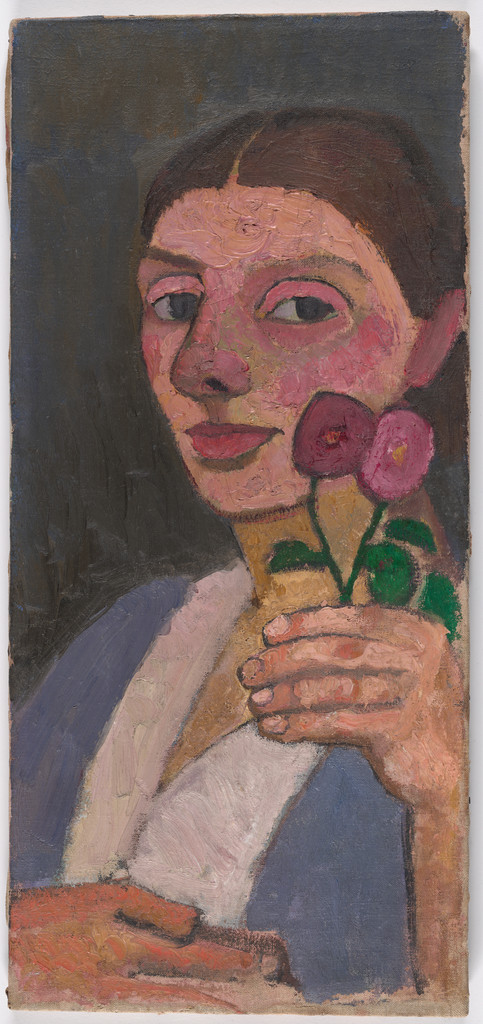
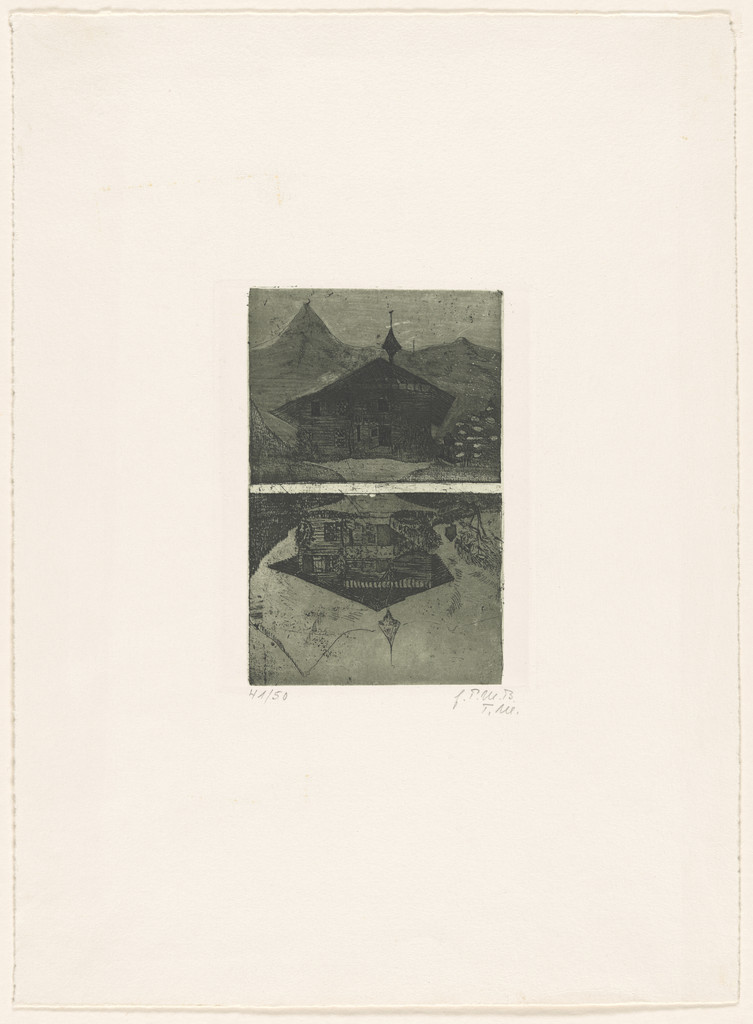
The flat terrain, birch trees, and dramatic wide-open skies depicted in these works (2003.4 and 2000.264) are characteristic of Worpswede, a small peasant village near Bremen in northern Germany. It was there in an artist’s colony that Modersohn-Becker, inspired by the region’s rural inhabitants and the simplicity of its landscape, developed her signature “naive” style. Following the teachings at the colony, she applied paint swiftly and directly to the support. With the central position of the birch tree in the scene, she also disrupted a more conventional, picturesque view, while still creating a sense of depth in the small landscape. Girl in a Red Dress (2000.264) derives the strength of its subject from reduced color and simplified forms.
继续阅读
Modersohn-Becker’s style, in particular her thickly painted brushstrokes, shows the influence of postimpressionist painters such as Cézanne, Gauguin, and Van Gogh, whose work she saw during several extended visits to Paris beginning in 1900. In her short career, Modersohn-Becker’s early pursuit of formal simplification and the sensitivity of her themes made her one of the foremost expressionist painters in Germany.
With her parents’ consent Paula decides to go to Worpswede: it was meant to be a short holiday trip, two weeks of drawing with Fritz Mackensen — who agreed to teach her thanks to her father’s influence — and then, in the autumn, a post as a governess in Paris. But already in September 1898 Paula settles in Worpswede for a long time.
December 1899
The first trip to Paris
On the eve of 1900 Paula leaves for Paris, the centre of European art she had dreamed of since her Berlin studies; Clara Westhoff had gone there at the end of 1899, hoping to study with Auguste Rodin. In Germany salon art still dominated, while Paris was more open to the new.
December 1899
A savage review at the Bremen Kunsthalle
In December 1899 two paintings Paula exhibits at the Bremen Kunsthalle are sharply criticised in a “hysterical” attack by the art critic Arthur Fitger and have to be removed during the exhibition; he was later regarded as more outraged by the inclusion of women artists in the show than by anything in the works themselves. Meanwhile her own artistic interests were shifting noticeably toward Paris, and in Worpswede, rooted in romanticised traditions of landscape, she felt increasingly alienated.
1900
At Vollard’s: Cézanne, who struck her like a thunderstorm
Together with Clara Westhoff Paula goes to exhibitions and galleries; Clara later recalled a visit to Ambroise Vollard, where the then unknown Paul Cézanne made an indelible impression on Paula. In a letter to Clara, Paula compared the effect of his painting to a thunderstorm.
1900
Rainer Maria Rilke in Worpswede: “a true friend”
At about this time Paula meets the poet Rainer Maria Rilke: he took Clara Westhoff and Paula for sisters and in his diary called them the fair and the dark artists; Clara he regarded as an artist, but Paula was for him “a true friend”, and he dedicated poems to her that were later published in his “Book of Images”. Other accounts place the start of their friendship in 1898.
12 September 1900
Engagement to Otto Modersohn
While Paula recovers from her Paris life, Otto Modersohn sometimes keeps her company; feelings grow between them, and on 12 September 1900, three months after Helene’s death, they announce their engagement.

 Paula Modersohn-Becker德国, 1876–1907