与此同时,在Dante Gabriel Rossetti的生活中
完整生平1862–1882
A Tudor house at 16 Cheyne Walk
After his wife’s death Rossetti leased a Tudor house at 16 Cheyne Walk in Chelsea, where he lived for twenty years surrounded by extravagant furnishings and a parade of exotic birds and animals.
1869
Poems from the grave: the exhumation
Prevailed upon by friends, in particular Charles Augustus Howell, Rossetti in 1869 had his poems exhumed from his wife’s grave in order to collate and publish them.
1869–1874
Kelmscott Manor: a summer house and a retreat
In 1869 Morris and Rossetti rented Kelmscott Manor at Kelmscott, Oxfordshire, as a summer home, but it became a retreat for Rossetti and Jane Morris: they spent summers there with the Morrises’ children while William Morris travelled to Iceland in 1871 and 1873.
1870
The 1870 “Poems”
In 1870 Rossetti published the volume “Poems by D. G. Rossetti,” collating the recovered texts and some translations, such as his 1869 “Ballad of Dead Ladies” after Villon; the word “yesteryear” is credited to Rossetti as a neologism used for the first time in this translation.
1871
Love for Jane Morris
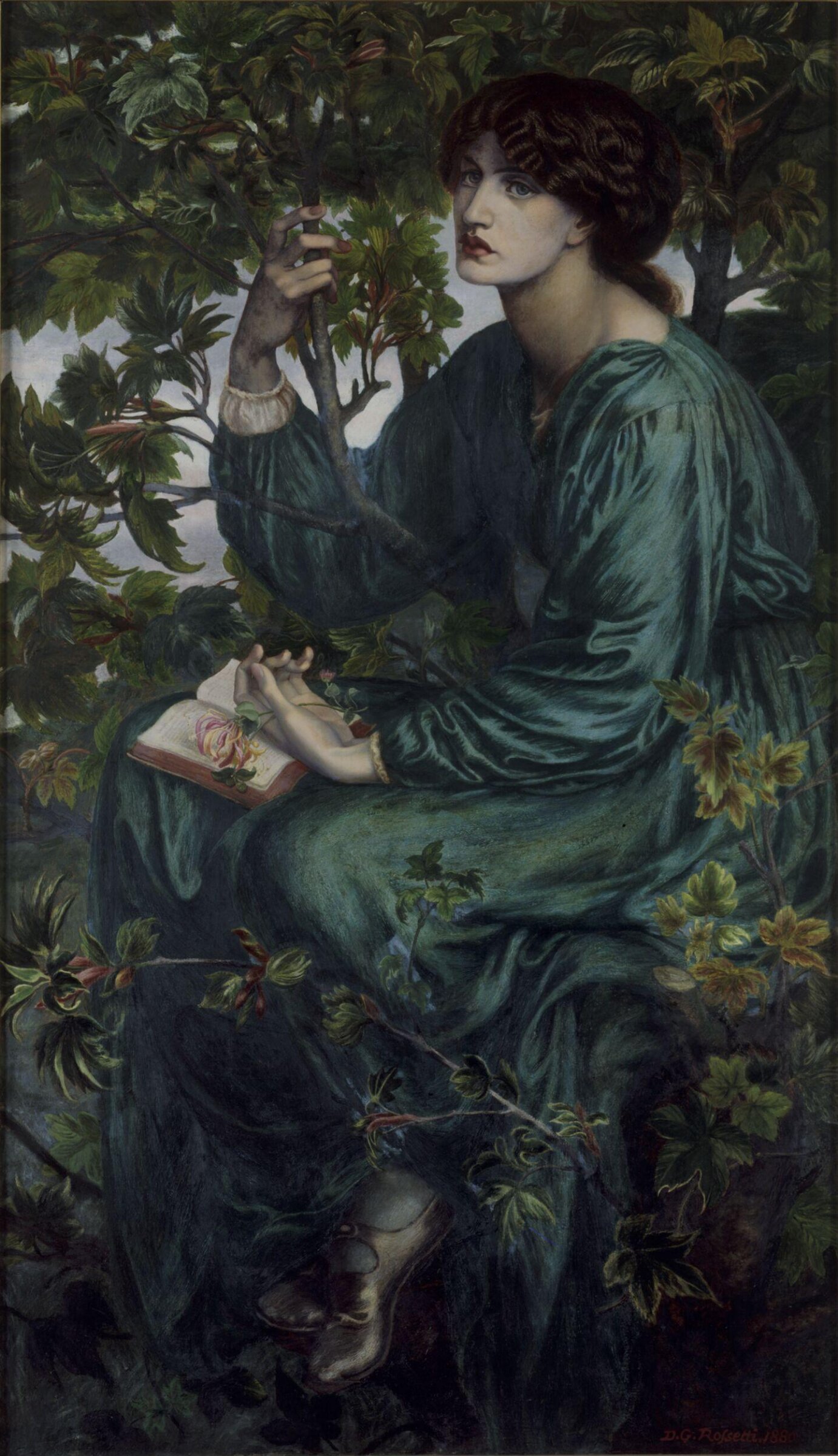
In 1871 Rossetti fell in love again — with Jane, the wife of his friend William Morris; they became lovers, and Jane sat for him often.
October 1871 – May 1872
Buchanan’s attack: the “fleshly school of poetry”
In October 1871 Robert Buchanan attacked both Rossetti’s poems and his morality in The Contemporary Review; against the advice of his brother William Michael, Rossetti issued a written reply in December, and in May 1872 Buchanan published a 100-page pamphlet, “The Fleshly School of Poetry and Other Phenomena of the Day.”