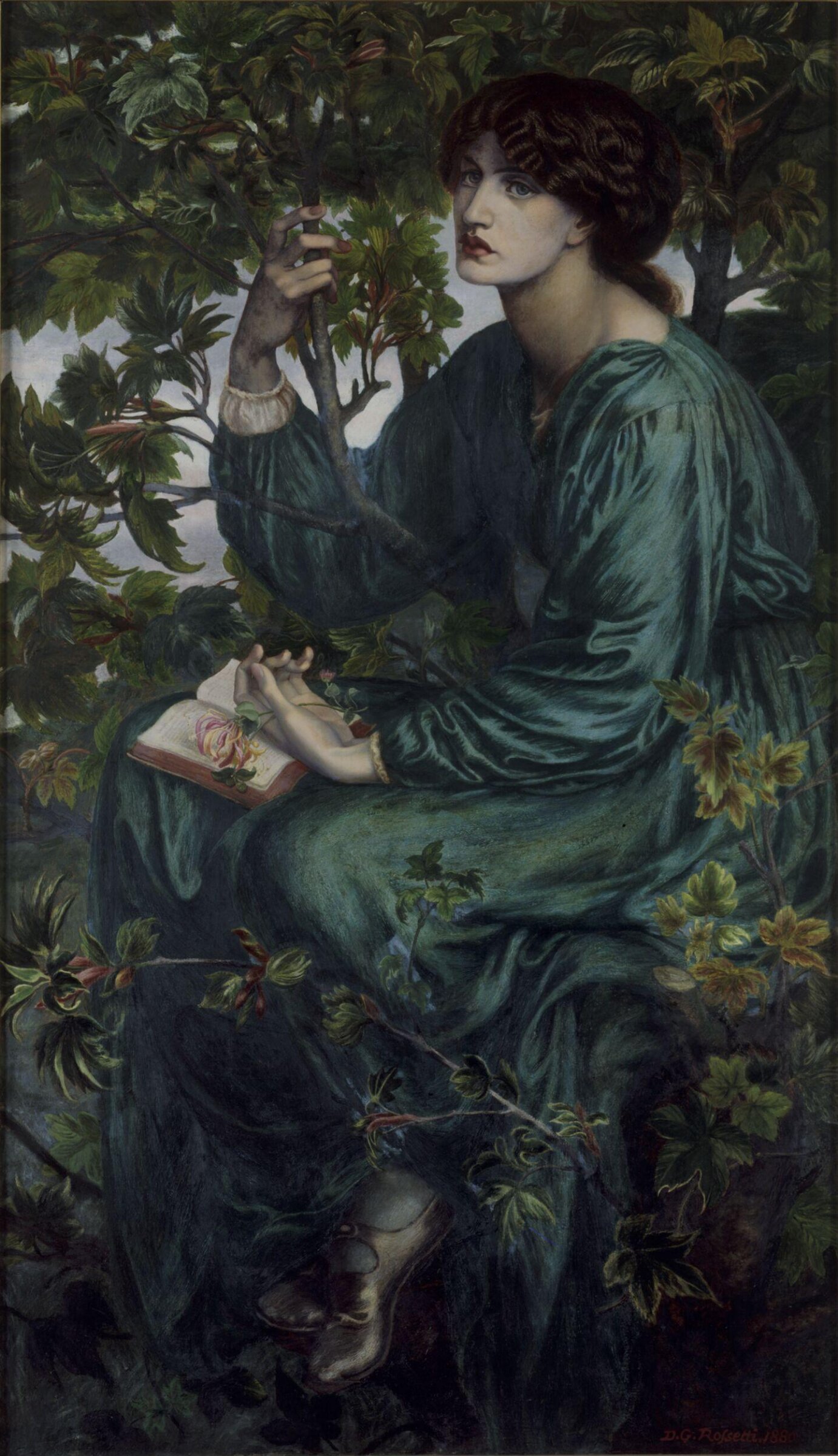
Dante Gabriel Rossetti英格兰, 1828–1882
Aurea Catena
能看到吗?
目前未展出
《Aurea Catena》现在在哪里? 收藏方: 哈佛藝術博物館, 剑桥. 目前未展出. 核实 2026年9月29日.

剑桥, 美國
仍属馆藏,只是目前没有展出。
- 核实
- 此状态始于
- 出处
- 博物馆
关于作品
Three sheets, joined (vertical strip at upper left; horizontal join below center). Laid down. Drawing is slightly irregular.
哈佛藝術博物館
作品信息
- 馆藏编号
- 1943.744
已收入目录
出处
- 哈佛藝術博物館
- 图片: 哈佛藝術博物館 — © President and Fellows of Harvard College
Dante Gabriel Rossetti当时的生活
完整生平1862–1866
Designing his sister Christina’s books
With his sister, the poet Christina Rossetti, Dante Gabriel designed and illustrated the first edition of “Goblin Market” (1862) and “The Prince’s Progress” (1866); his key bindings were designed between 1861 and 1871.
1862–1882
A Tudor house at 16 Cheyne Walk
After his wife’s death Rossetti leased a Tudor house at 16 Cheyne Walk in Chelsea, where he lived for twenty years surrounded by extravagant furnishings and a parade of exotic birds and animals.
1864–1867
The first commissions from the patron Leyland
In 1864–1867 Rossetti began to receive his first commissions from the patron and collector Frederick Richards Leyland, who collected Renaissance art and Pre-Raphaelite painting.
1869
Poems from the grave: the exhumation
Prevailed upon by friends, in particular Charles Augustus Howell, Rossetti in 1869 had his poems exhumed from his wife’s grave in order to collate and publish them.
1869–1874
Kelmscott Manor: a summer house and a retreat
In 1869 Morris and Rossetti rented Kelmscott Manor at Kelmscott, Oxfordshire, as a summer home, but it became a retreat for Rossetti and Jane Morris: they spent summers there with the Morrises’ children while William Morris travelled to Iceland in 1871 and 1873.
1870
The 1870 “Poems”
In 1870 Rossetti published the volume “Poems by D. G. Rossetti,” collating the recovered texts and some translations, such as his 1869 “Ballad of Dead Ladies” after Villon; the word “yesteryear” is credited to Rossetti as a neologism used for the first time in this translation.