 David Hockney英国, 1937–2026
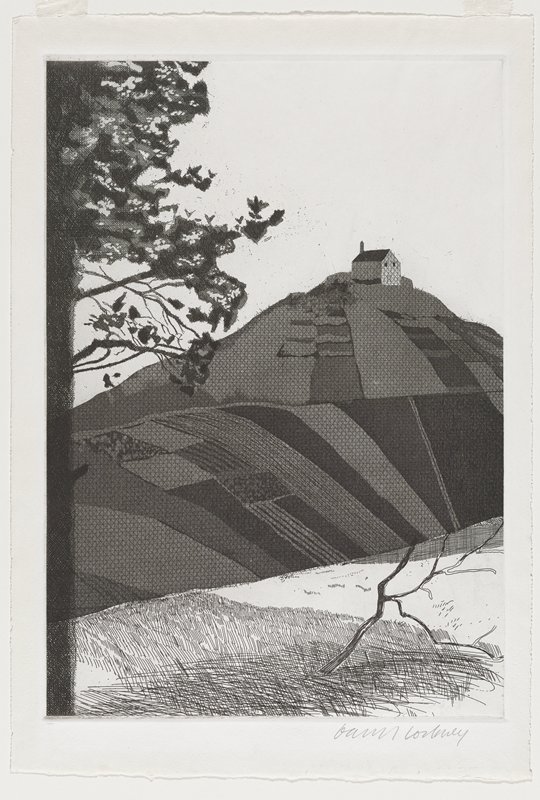
A Wooded Landscape

关于作品
A landmark of 20th-century book illustration, David Hockney’s unconventional interpretation of fairy tales selected from the hundreds compiled by the Brothers Grimm (Jakob Ludwig Carl Grimm and Wilhelm Carl Grimm) during the 19th century, considers the supernatural and psychological content of these bizarre stories in visual terms. With a virtuoso handling of linear and tonal intaglio printmaking, Hockney explores the characters’ motivations, values, and temperaments, presenting his own reading of the tales while seeking a greater understanding of human mentality. The illustrations also reference art of the past, a common feature of Hockney’s work, with visual allusions to Uccello, Carpaccio, Leonardo, Brueghel, and René Magritte. As a result, there is a timeless quality to the images that complements the stories’ centuries-old legacy of folklore.
明尼阿波利斯美術館
作品信息
- 馆藏编号
- 2017.152.2
已收入目录
出处
- 明尼阿波利斯美術館:博物馆的开放数据 · 8天前获取
- 图片: 明尼阿波利斯美術館 — © David Hockney
与此同时,在David Hockney的生活中
完整生平1966–1978
Stage designer: “Ubu Roi” and the Glyndebourne operas
Hockney’s first stage designs are for “Ubu Roi” at London’s Royal Court Theatre (1966), followed by Stravinsky’s “The Rake’s Progress” (1975) and “The Magic Flute” (1978) for the Glyndebourne Festival Opera. It is the start of the opera work that will go on in New York, Los Angeles, Chicago and London.
1967 · 获奖
John Moores Painting Prize
from 1968
Double portraits of friends, lovers and relatives
From 1968, and for the next few years, Hockney paints portraits and double portraits of friends, lovers and relatives just under life-size, in a realistic style that adroitly captures the likenesses. He returns to the portrait throughout his career, creating over 300 self-portraits.
1968年6月27日–1968年10月6日
Exhibition: 4. documenta
by 1970
A retrospective at London’s Whitechapel Gallery
By 1970 London’s Whitechapel Gallery has organised the first of several major retrospectives of Hockney’s work, which subsequently travel to three European institutions.