Edgar DegasFransa, 1834–1917
At the Milliner's
Görebilir miyim?
Bilinmiyor
“At the Milliner's” şu anda nerede? Koleksiyon: Thyssen-Bornemisza Müzesi, Madrid. Bugün sergilenip sergilenmediği bilinmiyor.
Madrid, İspanya
Sahibi biliniyor; bugün sergilenip sergilenmediği bilinmiyor.
- Bu durumun başlangıcı
- Kaynak
- Müze
Tablo hakkında
At the Milliner’s, Edgar Degas’s pastel of 1882 at Madrid’s Thyssen-Bornemisza Museum, places the viewer behind a counter covered with hats. One woman turns her back while watching another try on a bonnet. Red, blue and white trimmings cross the diagonal arrangement. This was the first pastel from Degas’s millinery series to be exhibited publicly, in London in 1882.
Ayrıntılar
- Envanter numarası
- 516 (1978.10)
Katalogda
Kaynaklar
- Wikidata
- Görsel: Thyssen-Bornemisza Müzesi — Edgar Degas · Public domain · Wikimedia Commons
Edgar Degas: hayatındaki yeri
Tüm yaşam öyküsüautumn 1879 – April 1880
The prints journal: Degas abruptly withdraws
In the autumn and winter of 1879–1880 Degas and Cassatt worked closely together on a prints journal; he owned a small printing press. In April 1880 Degas abruptly withdrew, and without his support the project folded.
by 1880
The end of his financial crisis
By 1880 Degas had fully overcome his financial crisis and become a respected figure in the Paris art world; the Impressionist exhibitions, which proved commercially useful to him, helped.
1881
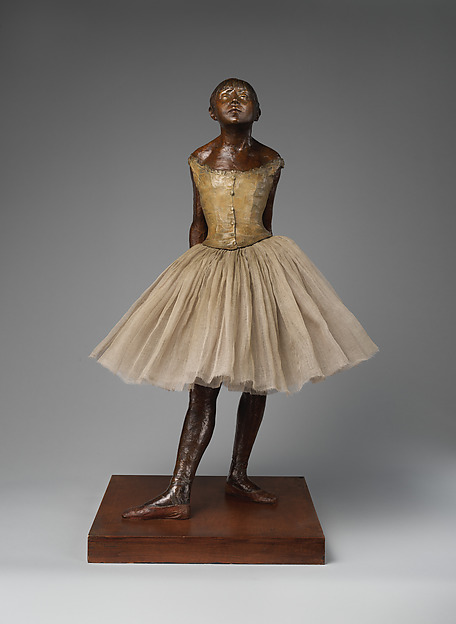
“The Little Dancer of Fourteen Years” on show
The nearly life-size wax figure with real hair and a cloth tutu, modelled on Marie van Goethem, provoked a strong reaction: critics found its realism extraordinary, but many denounced the dancer as ugly. It was the only sculpture Degas showed in his lifetime.
1881
The pastels “Criminal Physiognomies”
Degas attended the trial of the young gang members convicted of murder in the Abadie affair, sketchbook in hand, and in 1881 exhibited two pastels, “Criminal Physiognomies”. The drawings reveal his interest in features that some nineteenth-century scientists took as evidence of innate criminality.
by 1882
His eyesight sharply worsens
By 1882 Degas's eyesight began to worsen sharply: he turned to pastel and then to sculpture, where he could rely more on touch.