 Philippe de ChampaigneFrankrike, 1602–1674
VANITE
Kan jag se verket?
Okänt
Var finns ”VANITE” nu? Samling: Musée de Tessé, Le Mans. Okänt om verket visas i dag.
Le Mans, Frankrike
Ägaren är känd, men vi vet inte om verket visas i dag.
- Denna status sedan
- Källa
- Museet
Om målningen
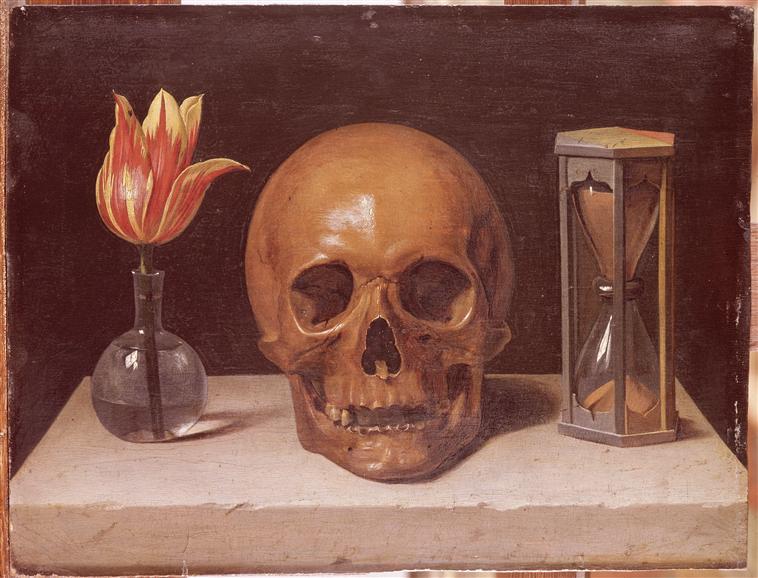
Vanitas, also known as Allegory of Human Life or Still Life with a Skull, is an oil on panel painting attributed to Philippe de Champaigne, from 1667. It is held in the musée de Tessé, in Le Mans, which bought it at a public auction in 1884.
Uppgifter
- Inventarienummer
- LM 10.572
Vad bilden föreställer
I katalogen
Källor
- Musée de Tessé
- Bild: Musée de Tessé — Réunion des musées nationaux - utilisation soumise à autorisation; Ministère de la Culture (France), base Joconde
I Philippe de Champaignes liv
Hela livet1625–1627
Decorates the Luxembourg Palace with Duchesne
Champaigne assisted Nicolas Duchesne in decorating Queen Marie de' Medici's Luxembourg Palace; Nicolas Poussin worked there with him, and Champaigne painted a landscape for him.
1628
Marries Nicolas Duchesne's daughter
According to Houbraken, Duchesne resented Champaigne's growing popularity at court, so Champaigne went back to Brussels to live with his brother; only on hearing of Duchesne's death did he return to marry his daughter. Succeeding Duchesne, he became the Queen's Painter with a salary of 1,200 livres.
1640
Comes under the influence of Jansenism
From 1640 onward, in the later part of his life, Champaigne came under the influence of Jansenism.
1648
A founder of the Royal Academy
Champaigne was one of the founding members of the Académie royale de peinture et de sculpture, the premier art institution of Ancien Régime France.
c. 1662
His daughter's miraculous cure at Port-Royal
The artist's paralyzed daughter, who lived at the convent of Port-Royal, was reportedly cured by a miracle. Champaigne then painted the atypical votive picture “Ex-Voto de 1662” (Louvre), showing his daughter with Mother Superior Agnès Arnauld.
12 augusti 1674
Died