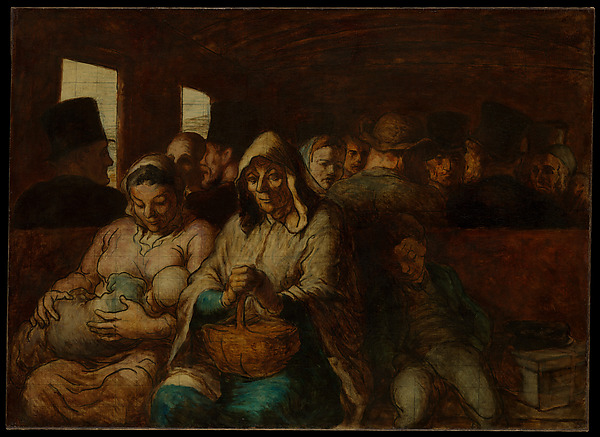
Honoré DaumierFrankrike, 1808–1879
Unknown Man
Kan jag se verket?
Visas inte just nu
Var finns ”Unknown Man” nu? Samling: Nationalmuseum, Stockholm, Stockholm. Visas inte just nu. Kontrollerat 9 november 2026.

Stockholm, Sverige
Tillhör samlingen men visas inte just nu.
- Kontrollerat
- Denna status sedan
- Källa
- Museets webbplats
Uppgifter
I katalogen
Tidigare visningar
Visas inte just nu
Nationalmuseum, Stockholm · 9 okt. 2026 — nu · Kontrollerat
Okänt om verket visades
Nationalmuseum, Stockholm · 27 sep. 2026 — 9 okt. 2026 · Obekräftat
Källor
- Nationalmuseum, Stockholm
- Bild: Nationalmuseum, Stockholm — CC BY-SA 4.0
I Honoré Daumiers liv
Hela livet1820s
Learning Lithography
Daumier studied lithography under Charles Ramelet and in the mid-to-late 1820s worked for the publisher Zéphirin Belliard, producing, often anonymously, illustrations, advertisements, street scenes, portraits, and caricatures.
1829–1831
First Notable Works in La Silhouette
Daumier's first significant works appeared in La Silhouette, France's first illustrated satirical weekly, published from December 1829 to January 1831.
1830
Invited to Join La Caricature
After the July Revolution of 1830, Daumier was invited to join the staff of Charles Philipon's new satirical journal La Caricature, working alongside Devéria, Grandville, and Raffet; the literary editor was the young Balzac, who said of his lithographs, "This fellow has Michelangelo in his blood!"
1831
Publication of the Caricature "Gargantua"
In December 1831 Daumier's caricature of King Louis-Philippe, "Gargantua," was published, bringing him widespread notoriety and criminal prosecution.
1832
Trial for Insulting the King
In February 1832 Daumier stood trial on charges of "inciting hatred and contempt for the government and insulting the king" and was sentenced to six months in prison and a fine of 500 francs; execution of the sentence was deferred.
1832
Arrest and Imprisonment at Sainte-Pélagie
In August 1832 Daumier was arrested at his parents' apartment and placed in the Sainte-Pélagie prison to serve his six-month sentence; in prison he remained defiant and continued to draw "to spite the government." His imprisonment brought him considerable fame.