Paul KleeTyskland, 1879–1940
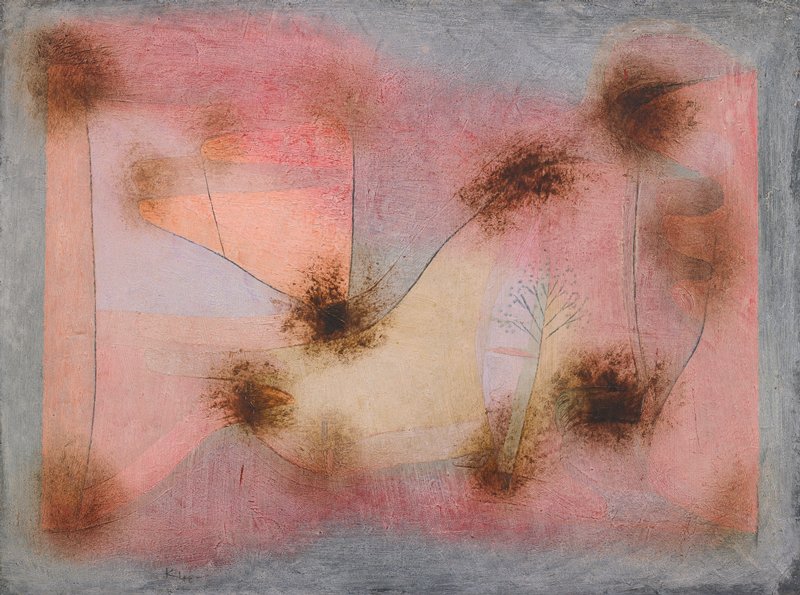
Sunset
Kan jag se verket?
Visas inte just nu
Var finns ”Sunset” nu? Samling: Art Institute of Chicago, Chicago. Visas inte just nu. Kontrollerat 2 november 2026.

Chicago, USA
Tillhör samlingen men visas inte just nu.
- Kontrollerat
- Denna status sedan
- Källa
- Museet
Om målningen
Paul Klee’s Sunset, painted in 1930, is at the Art Institute of Chicago, Chicago. Tiny dots form a layered pattern over a neutral ground. Geometric shapes overlap, but recognizable signs remain, including a face at upper left and a red sun beside an arrow at lower right. Klee’s musical training informed his interest in translating rhythm into painting. Here he organized lines, shapes and tonal relationships into a measured image that appears to vibrate. He also taught theories of form as part of the Bauhaus introductory design course.
Med museets egna ord
Paul Klee was an artist and teacher at the Bauhaus for most of that famed school’s existence. Initially head of the bookbinding department, Klee made his greatest contribution as a lecturer on the theory of form in art for the basic design course. There, he developed his ideas about the “polyphony” of painting—the simultaneous effect of formal elements that produces “a transformed beholder of art.”
Läs vidare
Klee was also a trained musician and shared with many artists of the early twentieth century the idea that music was the key to producing a new, abstract art. He was interested in the temporal character of music and its possible translation into forms of art. Works like Sunset reflect the principles of rhythm: linear structures, forms, and tonal values are orchestrated into a measured, vibrating image. To produce such a harmonious effect, Klee layered an intricate pattern of dots over a neutral background. Abstract, geometric, and overlapping shapes balance with recognizable forms, such as the schematic face in the upper left and the red sun and arrow in the lower right. The resulting composition—balancing stillness and movement, shallowness and depth—relates to Klee’s larger project of looking to music to produce an art that “does not reproduce the visible, but makes visible.”
Art Institute of ChicagoCC BY 4.0
Uppgifter
- Inventarienummer
- 1981.13
Vad bilden föreställer
I katalogen
Källor
- Art Institute of Chicago
- Bild: Art Institute of Chicago — © the artist or rights holder
I Paul Klees liv
Hela livet1921–1931
The preliminary course on the “theory of form”
Klee developed a preliminary course in the “theory of form” that began with the “point as the beginning of all beginnings”, moving through space, and the “cosmic egg” from which line, spiral, square, circle and cube are born. Students listened to lectures illustrated with Klee’s own abstract watercolours and then painted their own, trying to express movement, balance, flight and tension.
1928–1929
A journey to Egypt
Egypt impressed Klee less than Tunisia, yet in the desert he felt an almost mystical bond with the land: he was drawn to the proportions of the ancient funerary monuments and to the esoteric numerology by which they were built. His later “Ad Parnassum” was influenced by the trip.
1929
The first major monograph on Klee
In 1929 the first major monograph on Klee’s work was published; it was written by Will Grohmann, a confidant of the artist.
1931
Leaving the Bauhaus for the Düsseldorf Academy
Teaching at the Bauhaus shifted ever more from painting towards an architectural aesthetic, which no longer suited Klee: in 1931 he gave up his post there and became a professor at the Düsseldorf Academy of Art.