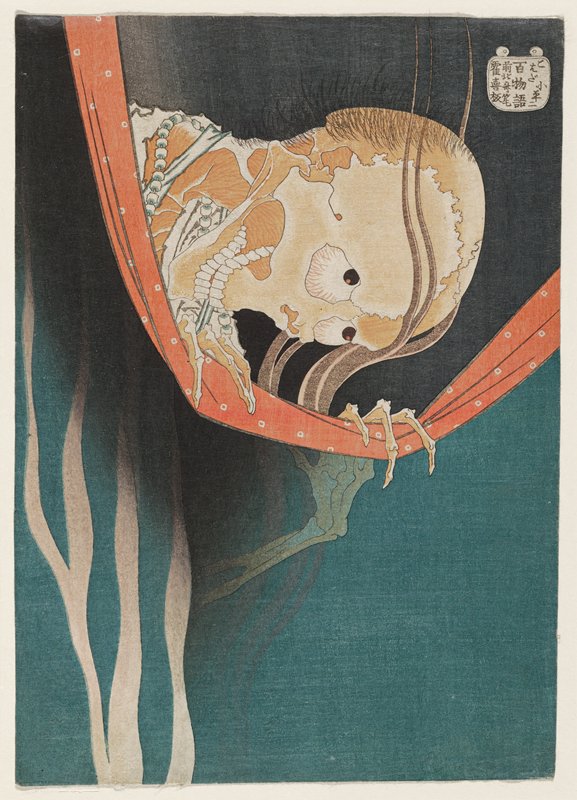
Katsushika HokusaiJapan, 1760–1849
Nachtelijke regen te Karasaki
Kan jag se verket?
Okänt
Var finns ”Nachtelijke regen te Karasaki” nu? Samling: Rijksmuseum, Amsterdam. Okänt om verket visas i dag.

Amsterdam, Nederländerna
Ägaren är känd, men vi vet inte om verket visas i dag.
- Källa
- Museet
Om verket
Museets text på nederländska
Regen landschap met pijnbomen langs een meer en twee aangelegde roeiboten; bergen op de achtergrond.
Rijksmuseum
Uppgifter
- Inventarienummer
- RP-P-1961-42
Vad bilden föreställer
I katalogen
Källor
- Rijksmuseum
- Bild: Rijksmuseum — public domain
I Katsushika Hokusais liv
Hela livet1804–1815
Illustrating the novels of Takizawa Bakin
Hokusai illustrated books by the popular novelist Takizawa Bakin; the fantasy novel Chinsetsu Yumiharizuki (Strange Tales of the Crescent Moon, 1807–1811), about Minamoto no Tametomo, made him especially famous. After thirteen works the partnership broke up, whether over clashing personalities or over how the illustrations should be drawn.
1811
Takes the name Taitō
At 51 Hokusai changed his name to Taitō and entered the period of the Hokusai Manga and his drawing manuals. The first of them, Quick Lessons in Simplified Drawing, appeared in 1812, meant to earn money and attract pupils.
1812
Friendship with the artist Bokusen
Hokusai began a close friendship with the artist Bokusen (1775–1824), thanks to which the Hokusai Manga albums came out in Nagoya between 1814 and 1834.
1812
Journey to the Kansai region
The sketches Hokusai made on a journey to the Kansai region so amazed his pupils Maki Bokusen, Hokuun and Hokutei that they persuaded their teacher to publish them as a book — the origin of the Hokusai Manga.
1814
The first volume of the Hokusai Manga
The first 54-page volume of the Manga, signed Tamekazu, appeared in Edo and Nagoya and sold out within about a week. This diary in drawings — city scenes, people, animals — grew to twelve volumes in the artist's lifetime and is called an “encyclopedia of the Japanese people”.