Mark RothkoUSA, 1903–1970
Antigone
Kan jag se verket?
Visas inte just nu
Var finns ”Antigone” nu? Samling: National Gallery of Art, Washington, D.C. Visas inte just nu. Kontrollerat 2 november 2026.

Washington, D.C., USA
Tillhör samlingen men visas inte just nu.
- Kontrollerat
- Denna status sedan
- Källa
- Museet
Om målningen
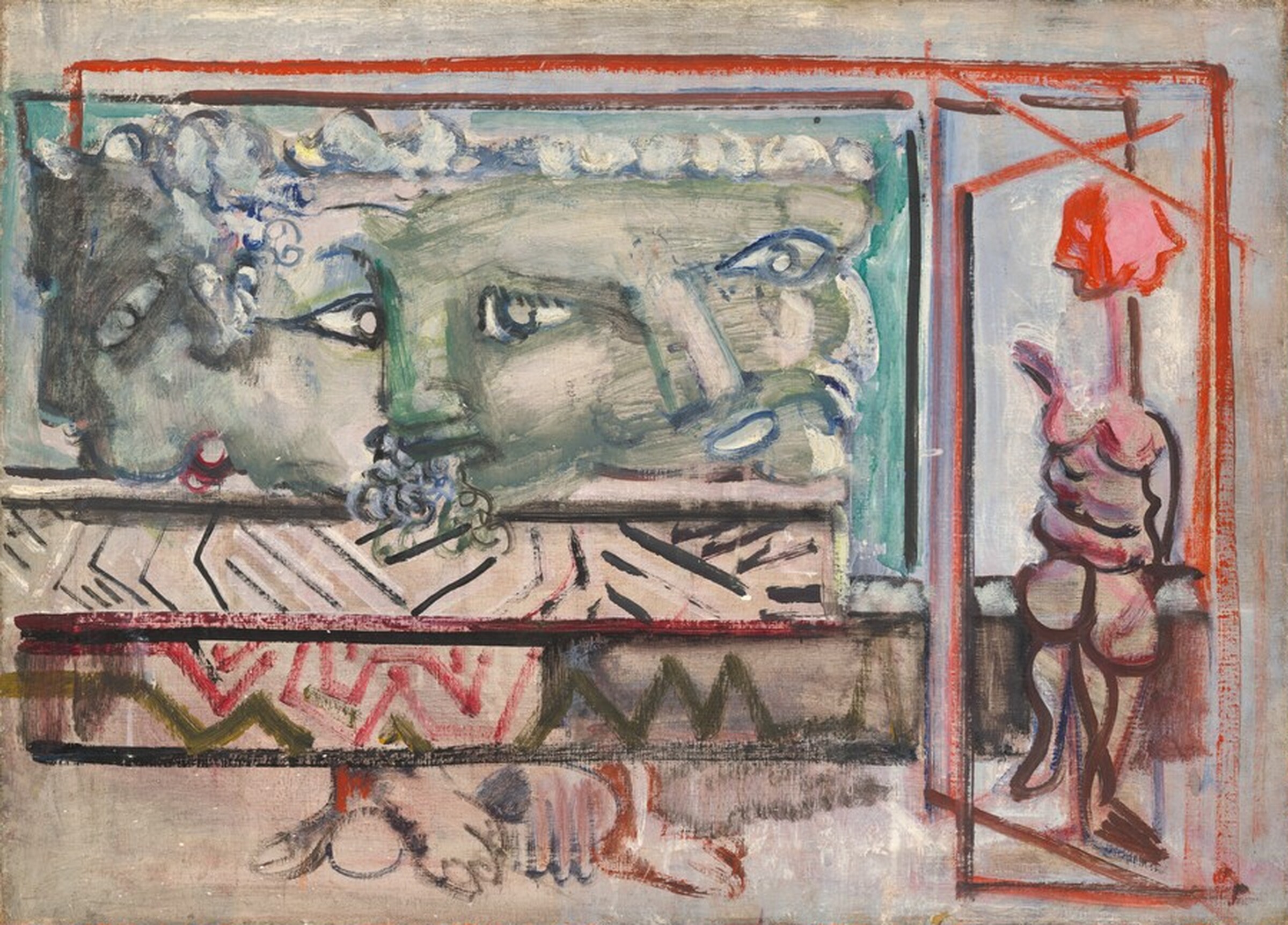
Antigone, painted around 1941 by Mark Rothko, is in the National Gallery of Art in Washington. Four overlapping faces hover above nude torsos against a grey and ivory ground. Below them, a blue rectangular band contains a white sphere and groups of paw-like forms. Rothko combined charcoal with oil paint on a canvas measuring 86.4 by 116.2 centimetres. The picture is currently off display.
Uppgifter
- Inventarienummer
- 1986.43.119
Vad bilden föreställer
I katalogen
Källor
- National Gallery of Art
- Bild: National Gallery of Art — © the artist or rights holder
I Mark Rothkos liv
Hela livet1940
Shortens his name to Mark Rothko
Concerned about rising antisemitism in Europe and America, Rothko shortened “Markus Rothkowitz” to “Mark Rothko” in 1940; “Roth” still sounded identifiably Jewish, so he settled on “Rothko”. All his works have been signed with that name since.
1940
A pause in painting for the study of myth
In 1940, it is said, Rothko stopped painting altogether to immerse himself in James Frazer’s The Golden Bough and Freud’s The Interpretation of Dreams; he later said his approach had been “reformed” by the study of the dramatic themes of myth.
1942
The Rothko–Gottlieb manifesto after the Macy’s show
New paintings were shown at a 1942 exhibition at Macy’s department store; answering a negative review in The New York Times, Rothko and Gottlieb issued a manifesto written mainly by Rothko, declaring themselves for the simple expression of the complex thought, for the large shape and for flat forms that destroy illusion and reveal truth.
1943
Berkeley: friendship with Clyfford Still
Hoping a change of scenery would help, Rothko returned to Portland and then travelled to Berkeley, where he met Clyfford Still and the two became close friends; Still’s deeply abstract paintings are thought to have influenced Rothko’s later work.
autumn 1943
Peggy Guggenheim
In the autumn of 1943 Rothko returned to New York and met the collector and dealer Peggy Guggenheim, who was at first reluctant to take on his work.
13 June 1943
Separation from Edith Sachar and depression
On 13 June 1943 Rothko and Edith Sachar separated again, and the divorce (1944) left him depressed for a long time.