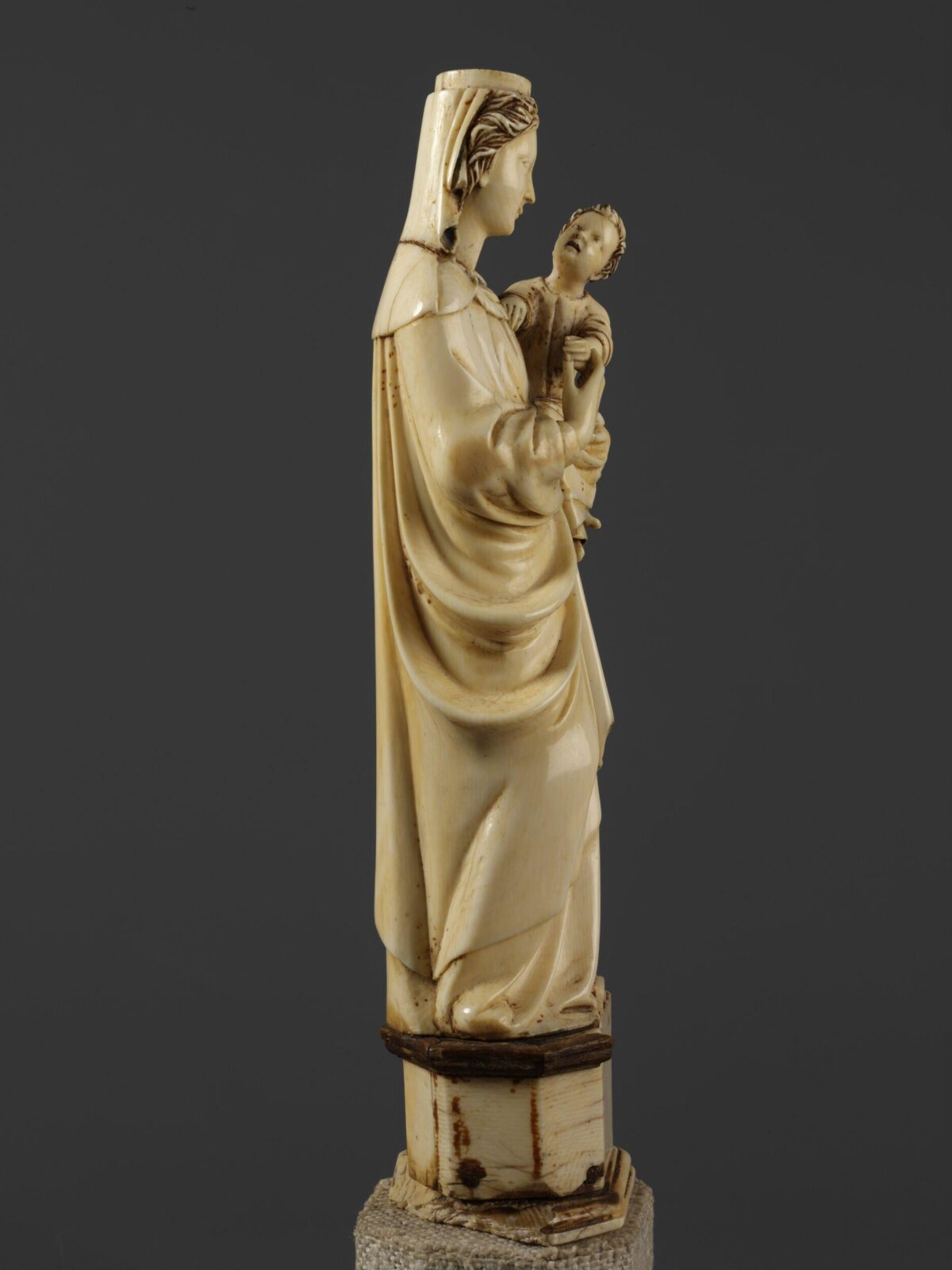
The Virgin and Child
Можно ли лицезреть?
Сейчас не принимает

Музей Виктории и Альберта
Лондон, Великобритания
Числится в собрании, но в залах её сейчас нет.
- Проверено
- В этом положении с
- Источник
- Музей
О скульптуре
Словами музея — на английском
This is an ivory statuette of the Virgin and Child, made in Italy (Sicily), possibly fifteenth or early sixteenth century, after a mid-fourteenth-century model.
Three dimensional images of the Virgin and Child were ubiquitous from the twelfth to the fifteenth centuries, produced in a wide range of materials and sizes and testifying the overwhelming devotion to th Virgin. Together with the Crucifixion, statues and statuettes of the Virgin and Child were the pricipal objects of devotion in the Christian Church, and vast numbers were made for ecclesisastical, monastic and private worship.
Читать дальше
The present Virgin and Child statuette follows the form of the Madonna in the church of SS. Annunziata in Trapani, Sicily. This over-life-size marble statue, stylistically in the mid-fourteenth-century orbit of Nino Pisano, was much venerated; It rapidly gained a reputation for its miraculous properties and by the fifteenth century copies were being made in good numbers by Francesco Laurana and others (Kruft 1970). This copying quickly turned into mass-production in different materials and varying sizes: most of these are in marble or alabaster, but several examples in ivory are known, including a more frontally-posed version in Bolgona (Venturi 1906, fig. 743). It seems likely that the present piece acted in turn as the model for a larger ivory Virgin and Child, also in the V&A (V&A Mus. no: A.550-1910).
Музей Виктории и Альберта
Сведения
- Инвентарный номер
- 208-1867
В каталоге
Источники
- Музей Виктории и Альберта
- Изображение: Музей Виктории и Альберта — © Музей Виктории и Альберта