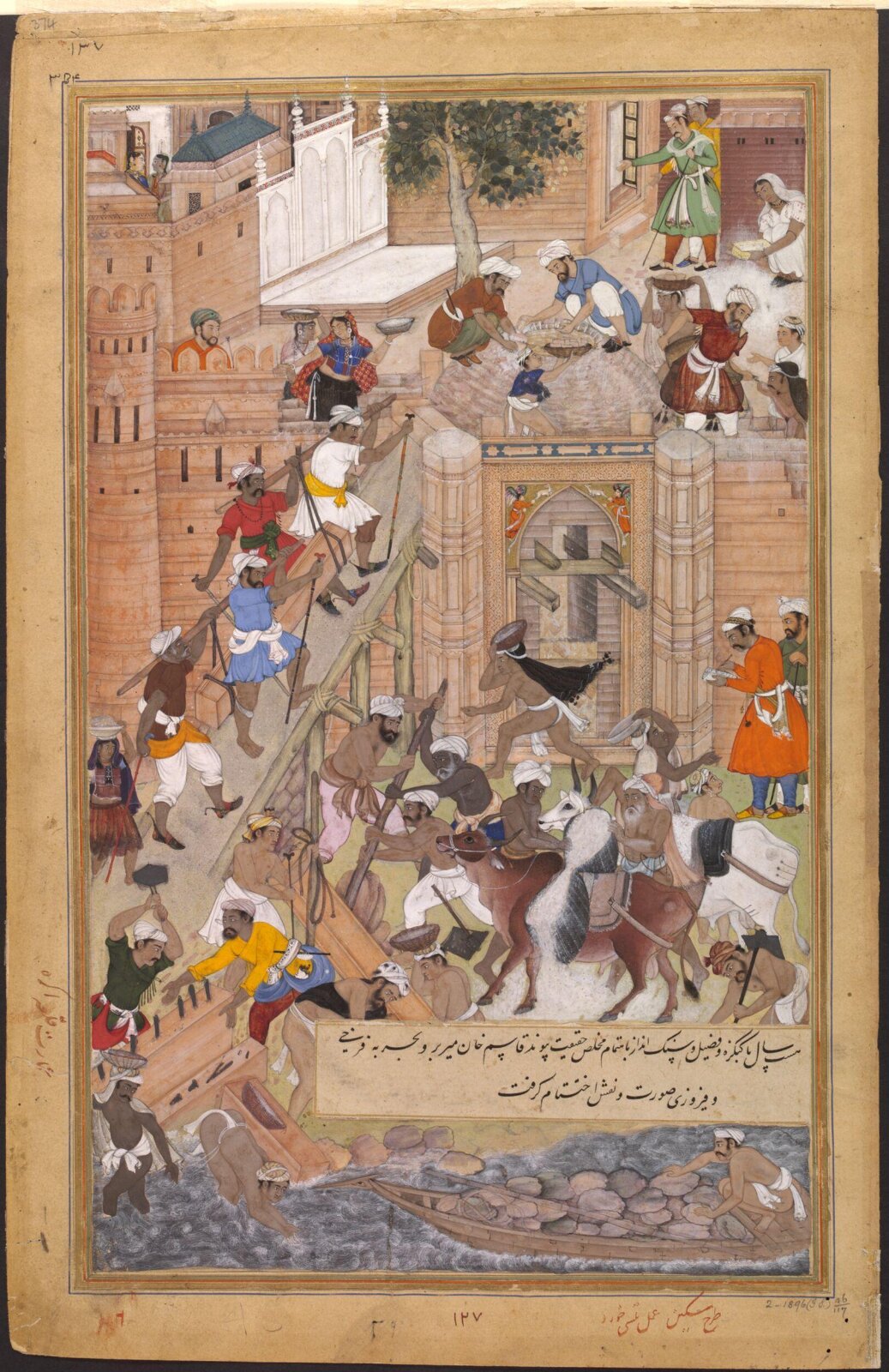
Tulsi the Younger
Painting
Можно ли лицезреть?
Неизвестно

Музей Виктории и Альберта
Лондон, Великобритания
Владелец известен, а выставлена ли она сейчас — неизвестно.
- В этом положении с
- Источник
- Музей
О картине
Словами музея — на английском
This is the left side of a double-page composition designed by the Mughal court artist Miskin and coloured by Tulsi the Younger. It is an illustration to the Akbarnama (Book of Akbar), and depicts the construction of the fort at Agra for the Mughal emperor Akbar (r.1556–1605). The fort was completed in 1566 and enclosed an area of 2 kilometres. This painting illustrates various construction processes performed by male and female labourers, of whom there were three to four thousand according to the text. The right half of the painting (Museum no. IS.2:45-1896) similarly illustrates the construction process.
The architectural historian Ebba Koch notes that this is the construction of the water gate of the fort, and that the painted decoration of the spandrels depict winged figures holding gazelles. In Persianate culture these are paris, attendants of Solomon.
Читать дальше
The Akbarnama was commissioned by Akbar as the official chronicle of his reign. It was written in Persian by his court historian and biographer, Abu’l Fazl, between 1590 and 1596, and the V&A’s partial copy of the manuscript is thought to have been illustrated between about 1592 and 1595. This is thought to be the earliest illustrated version of the text, and drew upon the expertise of some of the best royal artists of the time. Many of these are listed by Abu’l Fazl in the third volume of the text, the A’in-i Akbari, and some of these names appear in the V&A illustrations, written in red ink beneath the pictures, showing that this was a royal copy made for Akbar himself. After his death, the manuscript remained in the library of his son Jahangir, from whom it was inherited by Shah Jahan.
The V&A purchased the manuscript in 1896 from Frances Clarke, the widow of Major General John Clarke, who bought it in India while serving as Commissioner of Oudh between 1858 and 1862.
Музей Виктории и Альберта
Сведения
- Инвентарный номер
- IS.2:46-1896
В каталоге
Источники
- Музей Виктории и Альберта
- Изображение: Музей Виктории и Альберта — © Музей Виктории и Альберта