Painting
Можно ли лицезреть?
Сейчас не принимает

Музей Виктории и Альберта
Лондон, Великобритания
Числится в собрании, но в залах её сейчас нет.
- Проверено
- В этом положении с
- Источник
- Данные самого музея
О картине
Словами музея — на английском
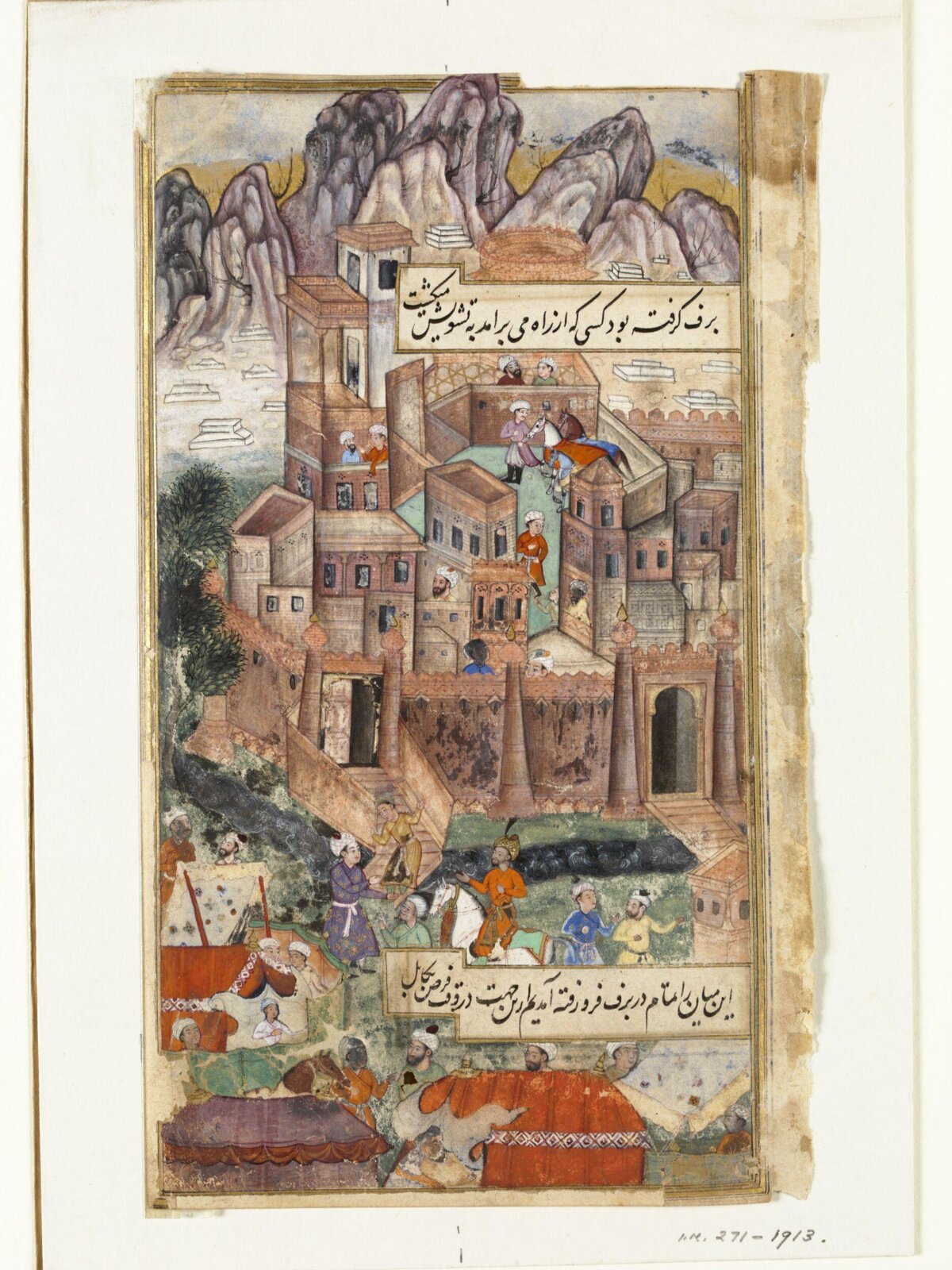
This is a detached folio from an illustrated manuscript commissioned by the Mughal emperor Akbar (r.1556-1605). The manuscript was a translation into Persian, the language of the court and of the administration of the empire, of the memoirs of the emperor's grandfather, Babur. This Central Asian prince, descended from Amir Timur whose capital was at Samarkand, had founded what would become the Mughal empire by invading Hindustan and defeating the Sultan of Delhi in 1526. Akbar expanded Mughal territories enormously through vigorous military campaigns and territorial alliances. By the end of the sixteenth century the empire was secure, wealthy and well-governed. The emperor commissioned a history of his reign, and translations of texts that would assist his historian, Abul Fazl, in his work.
Читать дальше
A major project was the translation of Babur's memoirs that had been written in eastern Turki, a language that few at the Mughal court still knew. Akbar ordered the multi-lingual scholar Abdul Rahim, his Khan-i khanan, to do the work. The finished volume was presented to the emperor in AH998/1589 AD, and illustrated copies were made.
This folio is one of 17 in the V&A, all but one of which appeared on the London art market in 1913 from a manuscript that had already been broken up. The other, from the same manscript, was acquired in 1950. Although any colophon that may have been in the manuscript has been lost, it must have been completed soon after the translation was finished, and it is conventionally dated to about 1590.
This painting depicts an incident that took place in 1508, during the long period before Babur made his attack on Hindustan and was able to establish a permanent power base. He had reached the city of Kabul and set up encampment near a cemetary.
Музей Виктории и Альберта
Сведения
- Инвентарный номер
- IM.271-1913
Что изображено
В каталоге
Источники
- Музей Виктории и Альберта: открытые данные самого музея · получено 10 дней назад
- Изображение: Музей Виктории и Альберта — © Музей Виктории и Альберта