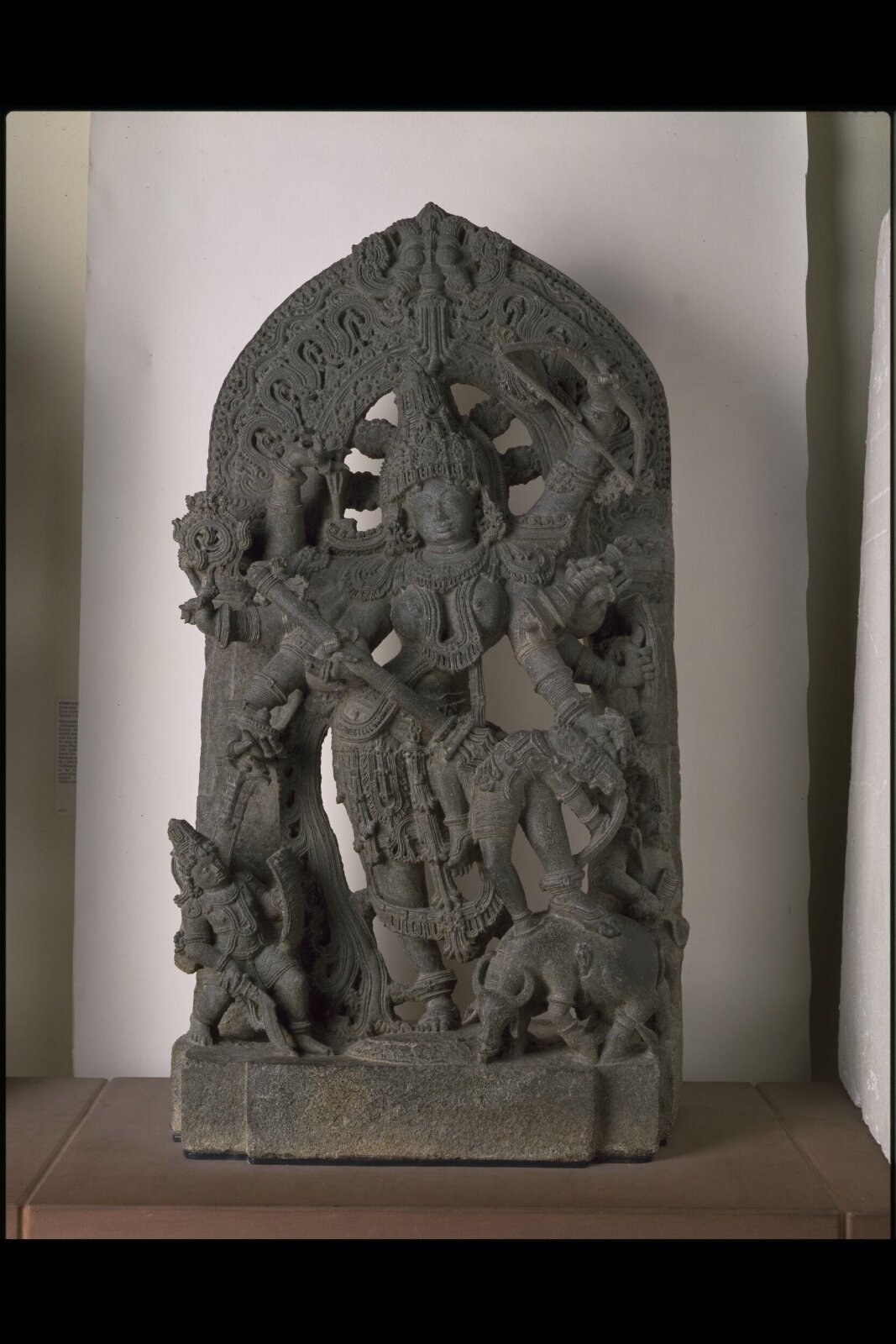
Durga Mahishasuramardini
Можно ли лицезреть?
Сейчас не принимает

Музей Виктории и Альберта
Лондон, Великобритания
Числится в собрании, но в залах её сейчас нет.
- Проверено
- В этом положении с
- Источник
- Данные самого музея
О скульптуре
Словами музея — на английском
The goddess Durga, the sakti or female energy of Shiva, in her ferocious form as the slayer of the buffalo demon Mahisa. Durga is represented in her eight-armed aspect, wielding the sacred weapons used against the forces of evil. The demon is seen emerging from his buffalo guise as Durga’s trisula (trident) pierces his body. The goddess is eight-armed and holds the supernatural weapons of the gods, notably the bana, chakra, khadga and trisula in her right arms and the dhanus, ghanta and khetaka in her upper left hands, pressing Mahisa's head with the remaining hand. The demon is pierced by Durga's trident as he emerges from the dying buffalo form. Two other demons (asuras) are shown - one is pierced by an arrow and the other receives a thrust from Durga's sword. The goddess wears elaborate ornaments including a ratna mukuta, karas, yajna pavita, katibandha, makara kindalas and rings, bracelets, armlets and anklets. Behind the group is makara torana with kirttimukha at the top.
Читать дальше
The Hoysalas established their capital at Halebid early in the 11th century and endowed many major temples in southern Karnataka. Their flamboyant sculptural style derived from the late Calyuka traditions and flourished throughout the 12th and 13th centuries. This sculpture was presented to the seventh Viscount Powerscourt whilst in Karnataka in 1861. The precise provenance of this sculpture is not recorded but close parallels can be seen in the sculptures at Sadasiva Temple, Nuggihalli, southeast of Halebid.
Музей Виктории и Альберта
Сведения
- Инвентарный номер
- IS.77-1965
В каталоге
Источники
- Музей Виктории и Альберта: открытые данные самого музея · получено 11 дней назад
- Изображение: Музей Виктории и Альберта — © Музей Виктории и Альберта