Джордж Уэсли БеллоузСША, 1882–1925
Counted Out
Можно ли лицезреть?
Сейчас не принимает

Чикагский институт искусств
Чикаго, США
Числится в собрании, но в залах её сейчас нет.
- Проверено
- В этом положении с
- Источник
- Данные самого музея
О работе
Словами музея — на английском
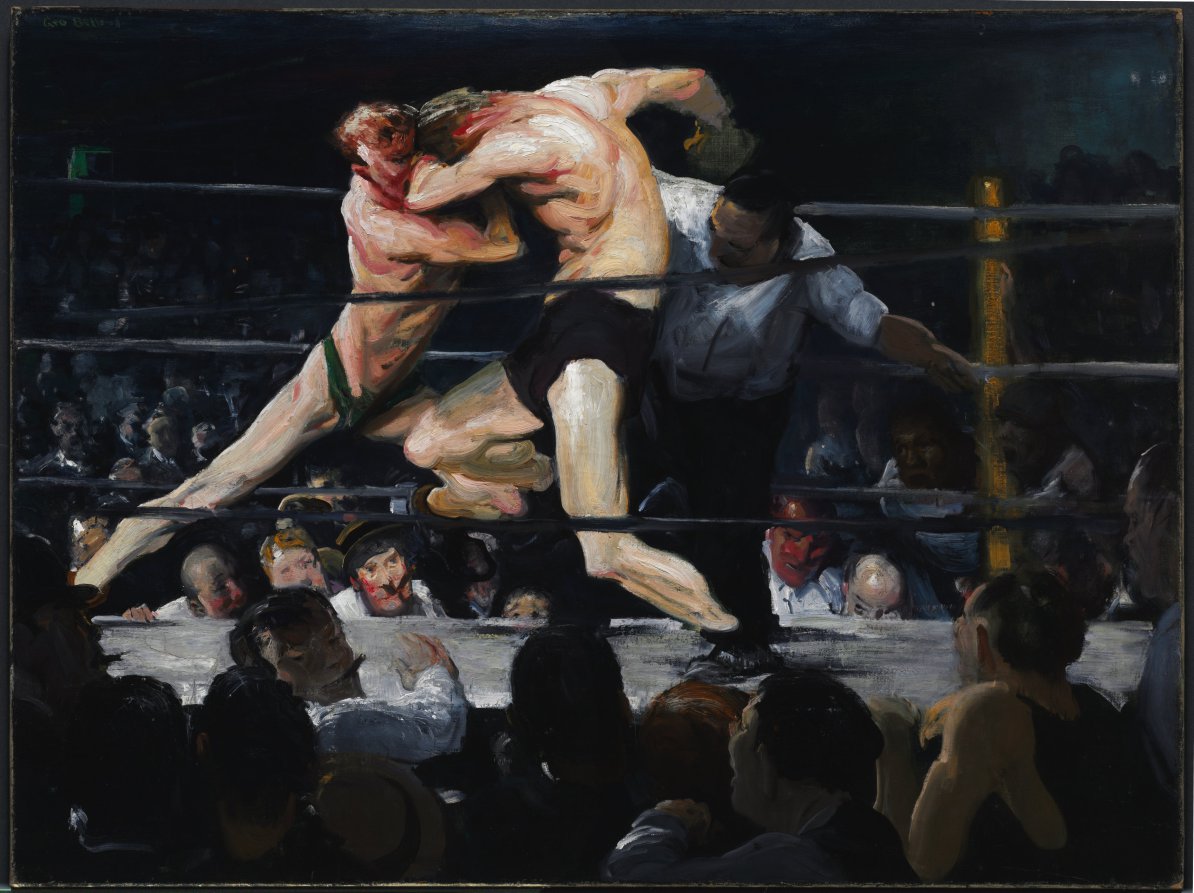
A native of Ohio, George Wesley Bellows studied early on with Robert Henri, a proponent of urban realism. Encouraged by Henri, Bellows sought out subjects that represented the vitality of the everyday lives of New Yorkers. His first studio was located across the street from Sharkey’s Athletic Club, where he became an avid boxing fan. A number of dramatic paintings, such as his 1909 Stag at Sharkey’s (now in the Cleveland Museum of Art), established his reputation as the preeminent painter of this quintessential urban subject.
Читать дальше
In 1913 American Magazine commissioned Bellows to produce four drawings to accompany an article by L. C. Moíse recounting the fight between former lightweight champion Jimmy Nolan and his nemesis, Tornado Black. Counted Out is one of the four. When the fight started, the two men could hardly contain their hatred for one another, and the energy inside the ring fueled the frenetic audience. Just before the third round, Nolan realized he had “lost his punch,” and did everything possible to fend off Black’s fierce attacks. When he finally mustered his “last ounce,” he prevailed, and the “Tornado dropped senseless to the floor.” The four drawings together illustrate the entire event; the Art Institute’s sheet depicts Nolan’s moment of triumph. We don’t know whether Bellows actually attended the fight, but he faithfully adhered to many visual details in Moíse’s article, such as the long scar on Black’s face and Nolan’s disfigured ear, overly pronounced jaw, and dramatic pose.
For this drawing, Bellows used lithographic crayon, a medium he preferred for its ability to create rich gradations of black. He emphasized the theatricality of the scene by placing the viewer inside the ropes, using dramatic lighting that heightens certain faces in the crowd while obscuring others, and by exaggerating gesture, such as the referee’s wildly splayed arms and Black’s crucified pose. Finally, Bellows constructed the composition around a strong pyramidal shape formed by the three protagonists, which draws us into the action and directs our focus.
Чикагский институт искусствCC BY 4.0
Сведения
- Инвентарный номер
- 1998.721
В каталоге
Источники
- Чикагский институт искусств: открытые данные самого музея · получено 7 дней назад
- Изображение: Чикагский институт искусств — CC0
А тем временем в жизни художника
Вся жизнь целиком1910
Женитьба на Эмме Стори
Женится на Эмме Стори; она и будущие дочери Энн и Джин станут любимыми героями его поздних картин на семейные темы.
1911
Родилась дочь: Anne Bellows Kearney
1911
Рисунки для журнала „Массы“
С 1911 года публикует много рисунков и литографий в социалистическом журнале «Массы» и входит в его редколлегию, но часто спорит с другими авторами: свобода художника, по его убеждению, важнее любой идеологической политики редакции.
17 февраля 1913 – 19 мая 1913
Выставка: Арсенальная выставка


.jpg?width=1280)