ART WIKI32 963 в залах
КартаКоллекцияХудожникиМузеиВыставкиЖурнал
Войти

ART WIKI

Где висит шедевр и когда к нему пускают.

Собрания: Гарвардские художественные музеи, Государственный музей изобразительных искусств имени А. С. Пушкина, Государственный музей искусств, Лувр, Метрополитен-музей, Миннеаполисский институт искусства, Музей американского искусства Уитни, Музей Виктории и Альберта, Музей Гетти, Музей современного искусства, Музей Хиршхорн и сад скульптур, Национальная галерея искусства, Национальная портретная галерея, Рейксмюсеум, Русский музей, Смитсоновский музей американского искусства, Третьяковская галерея, Художественный музей Кливленда, Чикагский институт искусств, Эрмитаж, Getty Villa, National Museum of Asian Art, Госкаталог Музейного фонда России (274 музея), Европеана (19 музеев), Викиданные (6 музеев), Парижские музеи (12 музеев) и Жоконда, база музеев Министерства культуры Франции (495 музеев). Изображения принадлежат правообладателям.

Разделы

  • Карта
  • Поиск
  • Коллекция
  • Шедевры
  • Сейчас в залах
  • Художники

Ещё

  • Музеи и галереи
  • Выставки
  • Журнал
  • Откуда данные
  • Конфиденциальность и куки
ГлавнаяКартаКаталог
  1. Коллекция/
  2. Чикагский институт искусств/
  3. Blue Tilt
Blue Tilt, Дженни Хольцер, 2004
ДДженни ХольцерСША, 1950

Blue Tilt

2004 · Медиаискусство

Можно ли лицезреть?

Сейчас не принимает

Чикагский институт искусств

Чикаго, США

Числится в собрании, но в залах её сейчас нет.

Проверено
3 дня назад
В этом положении с
19 авг. 2026 г.
Источник
Музей
На картеСтраница музея

О работе

Словами музея — на английском

Since the 1970s, Jenny Holzer has used language as her medium of choice to communicate penetrating ideas about life and death, sex, power, and war. Like contemporaries including Barbara Kruger, Sherrie Levine, and Cindy Sherman, she appropriates mass media and advertising strategies in her work. Holzer rose to prominence with her Truisms series (1977–79), which consisted of nearly three hundred aphorisms and slogans that play on commonly held truths and clichés such as “A lot of professionals are crackpots” and “A man can’t know what it is like to be a mother.” Displayed as anonymous broadsides on buildings, fences, and walls throughout Manhattan, these statements were meant to provoke public debate. In her more recent work, Holzer continues to use language and current modes of communication to assail established ideas about art’s place, audience, and meaning in modern society. Her texts have appeared on benches, billboards, Internet sites, posters, sarcophagi, in the form of monumental Xenon projections, and, most commonly, as LED (light-emitting diode) signs.

Читать дальше

Blue Tilt features texts from five of Holzer’s iconic series: Truisms; Inflammatory Essays (1979–82), one hundred words in twenty lines inspired by the literature of Emma Goldman, Rosa Luxembourg, Lenin, Mao, and others, also printed on posters; Living (1980–82), matter-of-fact writings on “everyday life with a twist” that were originally shown on cast-bronze plaques and hand-lettered metal signs; the urgent Survival (1983–85), which appeared on the Spectacolor board in New York’s Times Square and was the first series the artist conceived for electronic signs; and the desperate Under A Rock (1986), which was engraved on stone benches shortly after Holzer’s move to the countryside of upstate New York. Although all of these texts are the artist’s invention, they do not necessarily reflect her personal views.

Indeed, they employ a variety of contradictory voices, assuming a tone of anonymous authority in order to express a wide spectrum of biases and beliefs in which truth is relative. Blue Tilt captures each of these signature moments in the medium most readily associated with Holzer—the LED.

The structure of Blue Tilt’s installation is architectural and dramatic, with imposing sixteen-foot, double-sided signs towering over viewers and bathing the entire space in the light of a relentless stream of words. “One reason I’ve stayed with LEDs so long,” remarked Holzer, “is that part of the experience is that the light and words hit the body. This might give you vertigo; it might represent that there’s always too much information and ‘how do I process it?’ It could make you unsure of the floor; I try to use reflections to that end.” Under her control, the gallery becomes a stage that at once creates and serves an audience that can no longer make itself comfortable.

Чикагский институт искусств · CC BY 4.0

Сведения

2004 · 54 года
1950ныне
Инвентарный номер
2007.357

В каталоге

Современное искусствоXXI векСША

Источники

  • Чикагский институт искусств
  • Изображение: Чикагский институт искусств — © автор или правообладатель

Ещё работы: Дженни Хольцер

Все работы
Living: You should limit the number of times..., Дженни Хольцер, 1980-82

Living: You should limit the number of times...

1980-82 · Музей современного искусства

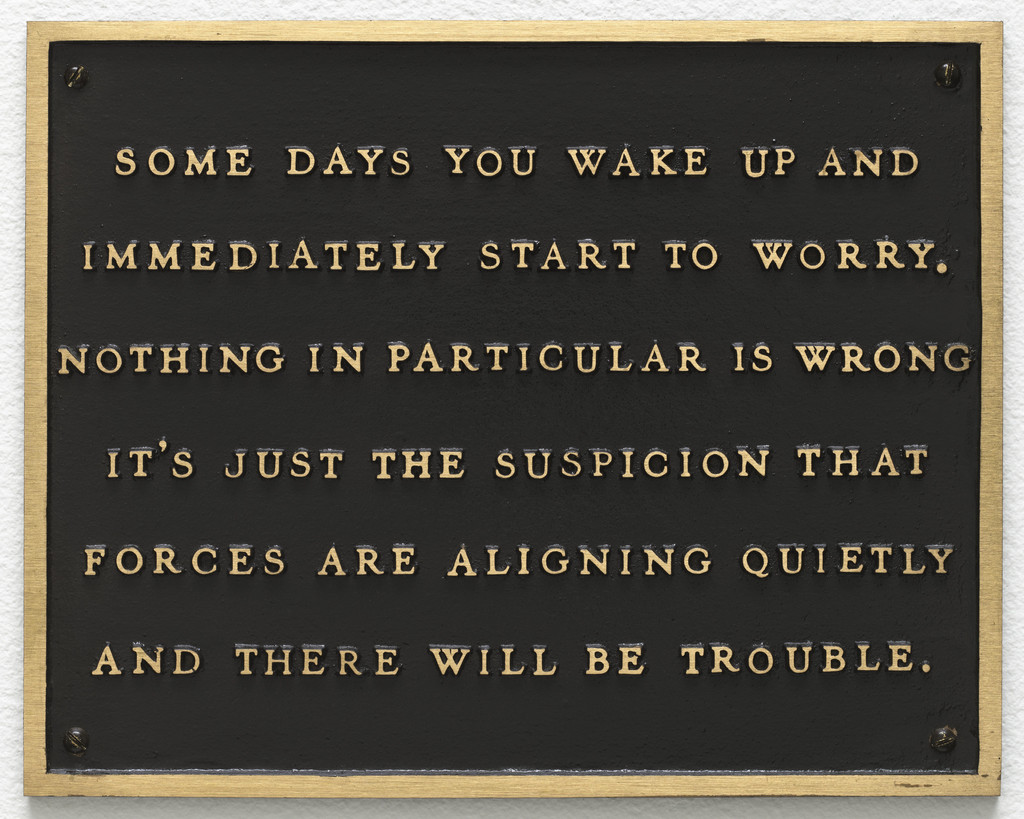
Living: Some days you wake up and immediately..., Дженни Хольцер, 1980-82

Living: Some days you wake up and immediately...

1980-82 · Музей современного искусства

Truism, Дженни Хольцер, 1977

Truism

1977 · Не выставлена · Национальная галерея искусства

Truism, Дженни Хольцер, 1977

Truism

1977 · Не выставлена · Национальная галерея искусства

Truism, Дженни Хольцер, 1977

Truism

1977 · Не выставлена · Национальная галерея искусства

Truism, Дженни Хольцер, 1977

Truism

1977 · Не выставлена · Национальная галерея искусства

Truism, Дженни Хольцер, 1977

Truism

1977 · Не выставлена · Национальная галерея искусства

Truism, Дженни Хольцер, 1977

Truism

1977 · Не выставлена · Национальная галерея искусства

Соседи по залам: Чикагский институт искусств

Страница музея
Спальня в Арле, Винсент Ван Гог, 1889

Винсент Ван Гог

Спальня в Арле, 1889

Воскресный день на острове Гранд-Жатт, Жорж-Пьер Сёра, 1884–1886, бордюр дописан 1888–1889

Жорж-Пьер Сёра

Воскресный день на острове Гранд-Жатт, 1884–1886, бордюр дописан 1888–1889

Парижская улица в дождливую погоду, Гюстав Кайботт, 1877

Гюстав Кайботт

Парижская улица в дождливую погоду, 1877

Две сестры (На террасе), Пьер Огюст Ренуар, 1881

Пьер Огюст Ренуар

Две сестры (На террасе), 1881

Корзина с яблоками, Поль Сезанн, ок. 1893

Поль Сезанн

Корзина с яблоками, ок. 1893

Stacks of Wheat (End of Summer), Клод Моне, 1890–91

Клод Моне

Stacks of Wheat (End of Summer), 1890–91

Американская готика, Грант Вуд, 1930

Грант Вуд

Американская готика, 1930

Полуночники, Эдвард Хоппер, 1942

Эдвард Хоппер

Полуночники, 1942