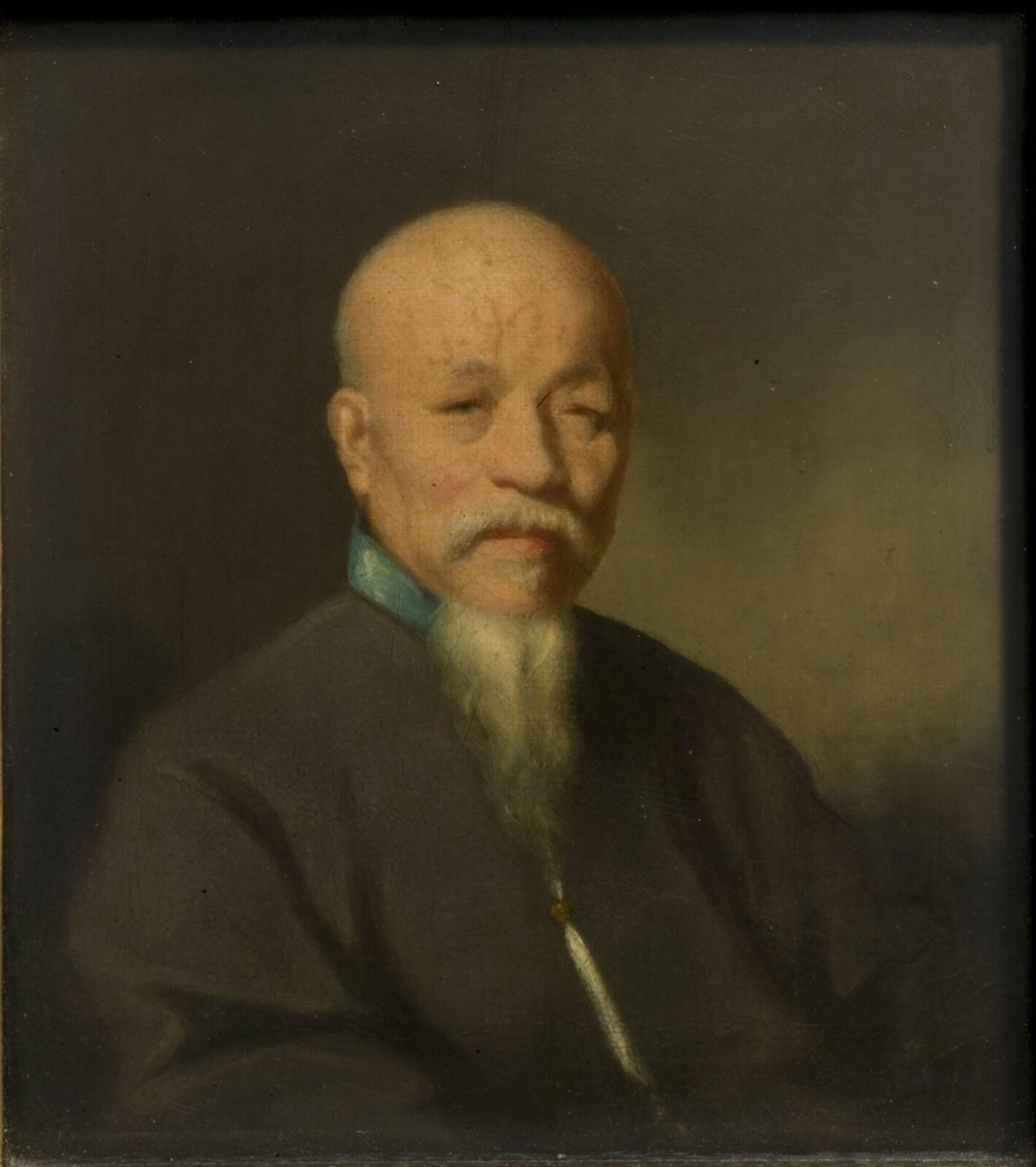
 Джордж ЧиннериАнглия, 1774–1852
A Chinese Mandarin
Можно ли лицезреть?
Сейчас не принимает

Музей Виктории и Альберта
Лондон, Великобритания
Числится в собрании, но в залах её сейчас нет.
- Проверено
- В этом положении с
- Источник
- Музей
О картине
Словами музея — на английском
Mr. C. D. Rotch, of Wimbledon, London, was a collector with a particular interest in furniture. Like other furniture collectors of the early 20th century he was influenced by the furniture connoisseur and dealer R.W. Symonds. Following the prevailing taste of the time, his collection focused on early to mid-Georgian carved mahogany examples and was later bequeathed to the Victoria and Albert Museum on his death in 1962 (see R.W. Symonds, 'Mr. C.D. Rotch's Collection of Furniture', Country Life, 7 June 1924, pp.937-39). At the time, his bequest was described by the authorities as "The most remarkable single gift of English Furniture ever presented to the Museum". The bequest also included just over twenty 17th, 18th and early 19th century portraits and figure studies, in pastel and in oil, as well as a selection of still lives and animal pictures.
Читать дальше
George Chinnery (1774-1852) was born in London, the son of a writing m aster with artistic ambition, who exhibited portraits at the Free Society of Artists in 1764 and 1766. George established himself as a miniature painter (small portraits in watercolour on ivory), exhibiting miniature portraits at the Royal Academy from 1791 to 1795. In 1796 he moved to Dublin, where he had some relations, marrying there in 1799. He began to paint landscapes and large portraits in oil. The abolition of the Irish parliament in 1800 led to many of Dublin's wealthier inhabitants to leave the city, and perhaps for this reason, fearing the loss of potential patrons) Chinnery also departed the city. In 1802 he received permission from the East India company to travel from England to India, where he worked as a painter, leaving his wife and children behind in Britain.
He was initially based in Madras with his elder brother, a merchant and employee of the East India Company. Gradually he received more prestigious portrait commissions, and by 1812, he was established in Calcutta as the principal Western artists in the capital of British India. His wife rejoined him there in 1818. While in India he made many sketches in pencil of local life, people engaged in their everyday activities, and painted scenes of local architecture in watercolour. Although he was successful and well paid, he was often in debt. In 1825 he abandoned his wife and creditors and sailed for China. He was based in the Portuguese enclave of Macau, which was to be his home for the rest of his life, apart from visits to Canton (modern Guangzhou), Whampoa and Hong Kong.
Trade between China and the West was centred on Canton, but Western merchants were only allowed to stay there briefly, and their families were based in Macau. As in India, Chinnery sketched local scenes in pencil, painting finished topographical scenes in watercolour and in oil back in his studio. He received commissions however for portraits of British merchants, especially those associated with the firm of Jardine, Matheson, and also painted Chinese, Portuguese, American, Swedish and Parsi sitters. Chinnery's Chinese sitters included many Cantonese "hong merchants" who were responsible for all dealings with Western traders. As Hong Kong developed in the 1840s the Western traders and their families began to move from Macau to the new settlement. But Chinnery chose to stay in his home in Macau and died there in 1852 from a stroke.
During Chinnery's last years he had a number of Chinese followers, who painted in the European style. It should be noted that one follower, known in the West as Lam Qua (or Lamqua), sent a Head of an Old Man to the Royal Academy summer exhibition in 1833. As his pupils frequently copied his pictures, both portraits and landscapes, and Chinnery himself painted copies of his own works but rarely signed his paintings, inevitably there have been difficulties in securing attributions to Chinnery. The attribution of this painting to Chinnery however has not been questioned. Interestingly a self portrait by Lam Qua (Peabody Essex Museum, Salem, Massachusetts, USA) shows a young clean shaven man dressed in a similar jacket to that worn by the old man in this portrait by Chinnery. Hongxing Zhang, Asian Department, V&A, has commented that "the coat is typical daily wear of the time, and was worn by any man from the gentry or merchant class".
Between 1802 and 1830 Chinnery sent no works to the Royal Academy exhibitions, but from 1830 he began again to send pictures for exhibition. In 1830 (with his address as Canton, China), he exhibited Portrait of a Hong merchant (166) and in 1831 Portrait of Howqua, senior hong merchant at Canton, China (248) ("Howqua" was the principal hong merchant, Wu Bingjian). Hongxing Zhang has further commented that it is likely that Howqua would have been painted wearing grand official robes with a rank badge; although he was not an official, Howqua was 'awarded' an official rank by the imperial court for his successful business, and would probably have wanted to demonstrate this honour. It is unlikely therefore that this portrait is of Howqua, but is a commissioned portrait of a member of the gentry or merchant class, most probably a "hong" merchant, the Cantonese merchants responsible for all dealings with western traders.
Музей Виктории и Альберта
Сведения
- Инвентарный номер
- P.27-1962
В каталоге
Источники
- Музей Виктории и Альберта
- Изображение: Музей Виктории и Альберта — © Музей Виктории и Альберта


![A Village Scene in India [verso], Джордж Чиннери, 1814/1824](https://api.nga.gov/iiif/8d906758-e2f9-4795-a830-446e3e4882fb/full/!2400,2400/0/default.jpg)
![A Village Hut in India [recto], Джордж Чиннери, 1814/1824](https://api.nga.gov/iiif/24134450-f3a2-494a-9837-cc97f2f761da/full/!2400,2400/0/default.jpg)








