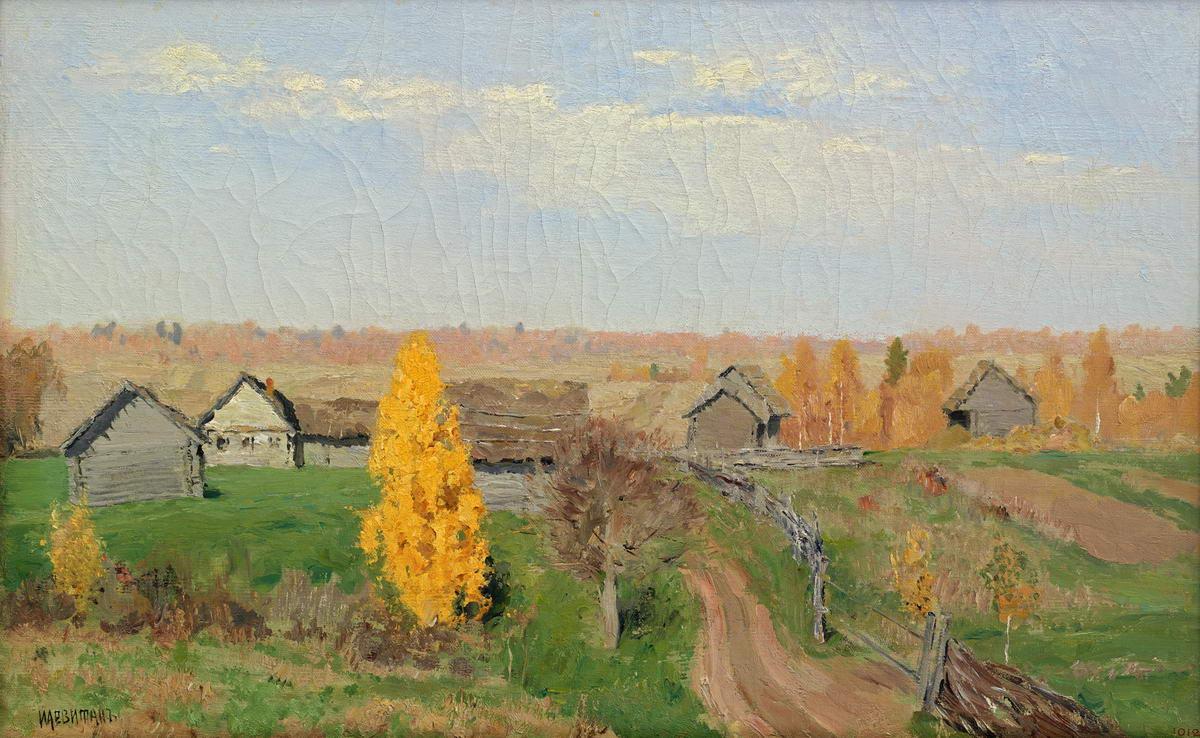
Isaac Levitan1860–1900
Заросший пруд
Posso vê-la?
Desconhecido
Onde está «Заросший пруд» hoje? Coleção: Museu Estatal de Belas Artes de Nizhniy Tagil, Nizhny Tagil. Desconhecido.
Nizhny Tagil, Rússia
O proprietário é conhecido; não se sabe se hoje está exposta.
- Neste estado desde
- Fonte
- O museu
Pormenores
- Número de inventário
- Ж-331
No catálogo
Fontes
- O Catálogo Estatal do Fundo Museológico da Rússia
- Imagem: Museu Estatal de Belas Artes de Nizhniy Tagil — © Нижнетагильский музей изобразительных искусств · Госкаталог музейного фонда РФ
Na vida de Isaac Levitan
A vida inteira1879
Expelled from Moscow after the attempt on the tsar
After Alexander Soloviev's attempt on Alexander II (2 April), a decree is issued forbidding Jews to live in Moscow, and the eighteen-year-old Levitan is expelled; for the next couple of years he lives with his brother, sister and brother-in-law in a small dacha at Saltykovka near Balashikha. A year later, with the money from the sale of his painting “Evening after Rain”, he rents a furnished room on Bolshaya Lubyanka.
1880
Tretyakov buys “Autumn Day” for 100 roubles
The famous philanthropist and art collector Pavel Mikhailovich Tretyakov buys the painting for 100 roubles and will go on to acquire about twenty more of Levitan's works.
by 1883
The school rejects his picture for the medal
By 1883, disillusioned with the school, Levitan submits a landscape for a silver medal that would have made him a classed artist; Savrasov, by then drinking heavily and no longer teaching, writes “silver medal” on the back of the canvas, but the school rejects the painting and Levitan stops attending classes. Korovin repeated gossip that antisemitism played a part in the rejection.
mid-1880s
His heart disease sharply worsens
Levitan's material situation improves in the mid-1880s, but a hungry childhood, an unsettled life and hard work tell on his health: his heart disease sharply worsens.
spring 1888
He discovers Plyos on the Volga
In spring 1888 he sails by steamer along the Oka to Nizhny Novgorod and on up the Volga with the artist Alexei Stepanov and Sofia Kuvshinnikova; to their own surprise they discover the small, quiet town of Plyos and decide to stay on for a while. The three summer seasons there (1888–1890) prove extremely productive: some two hundred works bring Levitan wide fame.
22 de julho de 1900
Died