Albrecht DürerAlemanha, 1471–1528
Young Bull
Será possível contemplá-la?
De momento, não recebe

Chicago, Estados Unidos
Pertence à coleção, mas de momento não está exposta.
- Verificado
- Neste estado desde
- Fonte
- O museu
Sobre a obra
From an early age, Albrecht Dürer displayed an inquisitive mind and exceptional talent as a draftsman. He was born in Nuremberg and first trained as a goldsmith in his father’s shop before apprenticing with the painter Michael Wolgemut. One of his earliest animal drawings, Young Steer shows its subject grazing in an unseen field. The artist’s sure strokes and adept cross-hatching delineate the steer’s sculptural form, with taut skin stretched over a strong yet bony frame. Dürer’s precise draftsmanship recalls the drawings and prints of the celebrated German master Martin Schongauer, whom he greatly admired. This work was probably a study from nature; sketchy lines around the animal’s right hind foot, back, muzzle, and horns reveal that the artist originally drew the steer in a slightly different position, with his mouth open.
Ler mais
A masterful engraver who would elevate printmaking to an expressive art form over the course of his career, Dürer employed the steer’s hindquarters for the barnyard scene in his engraving The Prodigal Son amid the Swine (1494/96), an impression of which is in the Art Institute.
Art Institute of ChicagoCC BY 4.0
Pormenores
- Número de inventário
- 1965.408
O que mostra
No catálogo
Fontes
- Art Institute of Chicago
- Imagem: Art Institute of Chicago — CC0
Entretanto, na vida de Albrecht Dürer
A vida inteira1494
Marries Agnes Frey
Soon after returning to Nuremberg the 23-year-old Dürer married Agnes Frey, daughter of a prominent brass worker and amateur harpist; the match had been arranged in his absence, and marriage was required to open a workshop of his own. They had no children, and his letters suggest the marriage was not a happy one.
7 de julho de 1494
Married: Agnes Dürer
1494–1495
First journey to Italy
Within three months of the wedding Dürer left alone for Italy, perhaps fleeing an outbreak of plague in Nuremberg. Crossing the Alps he made watercolour landscapes; in Venice he studied its art and judged Giovanni Bellini the best of its painters; Mantegna and Pollaiuolo left their mark on him.
1495
Opens his own workshop
Dürer opened his own workshop in Nuremberg, where over the next ten years he created much of his printmaking. His godfather, the publisher Anton Koberger, helped issue the first series; the city's crafts were governed by the Council rather than guilds, leaving him free to try new techniques and sell his own impressions.
1500
Jacopo de' Barbari and the secret of proportion
The Venetian Jacopo de' Barbari, whom Dürer had met in Venice, came to Nuremberg, and Dürer said he learned much from him about perspective, anatomy and proportion. Feeling that de' Barbari would not explain everything he knew, Dürer began studies of his own that became a lifelong preoccupation.
1505
Second journey to Italy
Dürer set off for Italy again — perhaps not only to earn money but also to stop Marcantonio Raimondi from copying his prints. His stay in Venice is known from ten surviving letters to Pirckheimer.
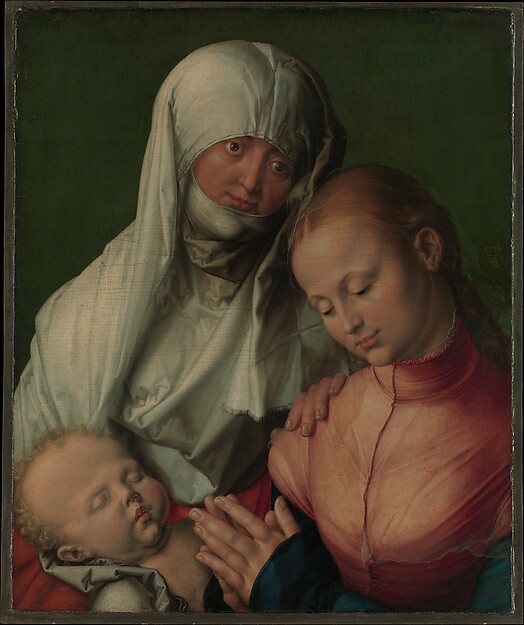
![Madonna and Child [obverse], Albrecht Dürer, c. 1496/1499](https://api.nga.gov/iiif/878db7e6-10ae-4cae-ba5d-6d6f5c413ae8/full/!2400,2400/0/default.jpg)
![Lot and His Daughters [reverse], Albrecht Dürer, c. 1496/1499](https://api.nga.gov/iiif/7565a449-f82a-414b-9bda-c93f55a51b4d/full/!2400,2400/0/default.jpg)