Edgar DegasFrança, 1834–1917
Waiting (L'Attente)
Será possível contemplá-la?
De momento, não recebe
Los Angeles, Estados Unidos
Pertence à coleção, mas de momento não está exposta.
- Verificado
- Neste estado desde
- Fonte
- O museu
Sobre a obra
A young ballet dancer bends forward to massage her foot, while her somberly dressed older companion sits silently beside her on a bench. They appear to be waiting, perhaps for an audition or its outcome. The two figures are a study in contrasts: The athletic dancer dressed in a dazzling costume reflects the glamour and artifice of the stage, while the shabbily dressed, bent figure represents the drabness of everyday life. Edgar Degas painted modern life; his subjects, including laundresses, milliners, nightclub singers, horse races, and the ballet, reflected contemporary Parisian occupations and diversions. From the 1860s onward, Degas frequented the Paris Opéra, where he made numerous studies of performances, rehearsals, and backstage scenes. Later, he would refine and combine these motifs in his studio, in exercises of daring technical skill and compelling psychological subtlety.
Ler mais
Here he demonstrated his complete mastery of the pastel technique. Delicately blended strokes are combined with bold hatching and emphatic slashes; pink, blue, and creamy tones describe the dancer in contrast to the dark, severe form of the older woman.
Museu J. Paul Getty
Pormenores
- Número de inventário
- 83.GG.219
No catálogo
Fontes
- Museu J. Paul Getty
- Imagem: Museu J. Paul Getty — Open Content
Entretanto, na vida de Edgar Degas
A vida inteiraautumn 1879 – April 1880
The prints journal: Degas abruptly withdraws
In the autumn and winter of 1879–1880 Degas and Cassatt worked closely together on a prints journal; he owned a small printing press. In April 1880 Degas abruptly withdrew, and without his support the project folded.
by 1880
The end of his financial crisis
By 1880 Degas had fully overcome his financial crisis and become a respected figure in the Paris art world; the Impressionist exhibitions, which proved commercially useful to him, helped.
1881
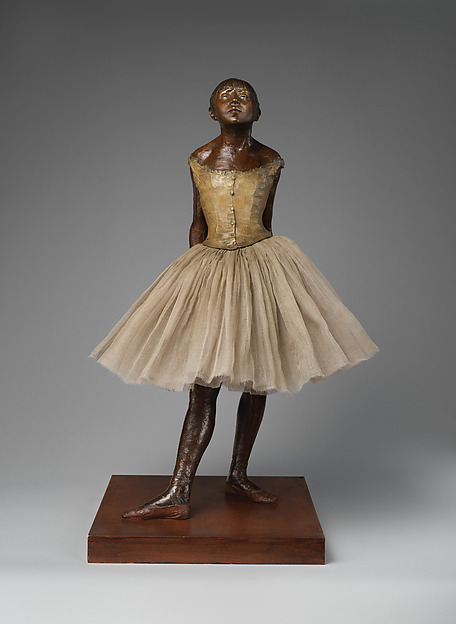
“The Little Dancer of Fourteen Years” on show
The nearly life-size wax figure with real hair and a cloth tutu, modelled on Marie van Goethem, provoked a strong reaction: critics found its realism extraordinary, but many denounced the dancer as ugly. It was the only sculpture Degas showed in his lifetime.
1881
The pastels “Criminal Physiognomies”
Degas attended the trial of the young gang members convicted of murder in the Abadie affair, sketchbook in hand, and in 1881 exhibited two pastels, “Criminal Physiognomies”. The drawings reveal his interest in features that some nineteenth-century scientists took as evidence of innate criminality.
by 1882
His eyesight sharply worsens
By 1882 Degas's eyesight began to worsen sharply: he turned to pastel and then to sculpture, where he could rely more on touch.