Gustave CaillebotteFrança, 1848–1894
Vue de toits
Posso vê-la?
Desconhecido
Onde está «Vue de toits» hoje? Coleção: Museu de Orsay, Paris. Desconhecido.

Paris, França
O proprietário é conhecido; não se sabe se hoje está exposta.
- Neste estado desde
- Fonte
- O museu
Sobre a pintura
Vue de toits (Effet de neige) (English title: View of rooftops (Effect of snow)) is an oil painting executed during the winter of 1878 and 1879 by French impressionist Gustave Caillebotte. The canvas measures 81 by 65 centimetres (32 in × 26 in). It was originally gifted by Caillebotte's brother in 1894 to the Musée du Luxembourg, then transferred to the Musée du Louvre in 1929. In 1947, it was moved to the Galerie nationale du Jeu de Paume, which held many impressionist works in France after World War II. In 1986, it was transferred again to the Musée d'Orsay in Paris. The painting is one of the few Caillebotte works that have remained in public view since the artist's death in 1894.
Ler mais
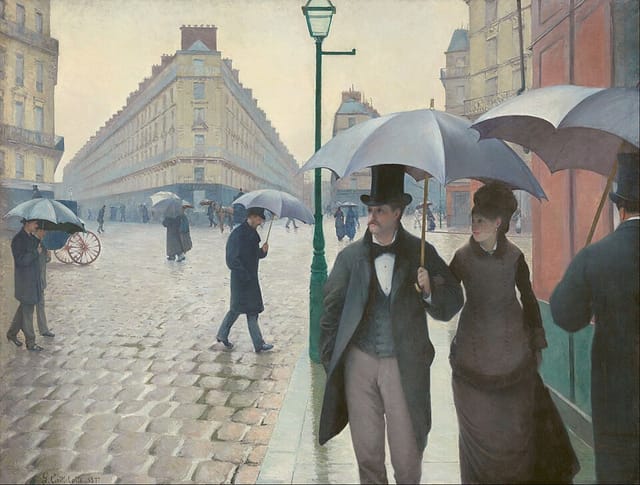
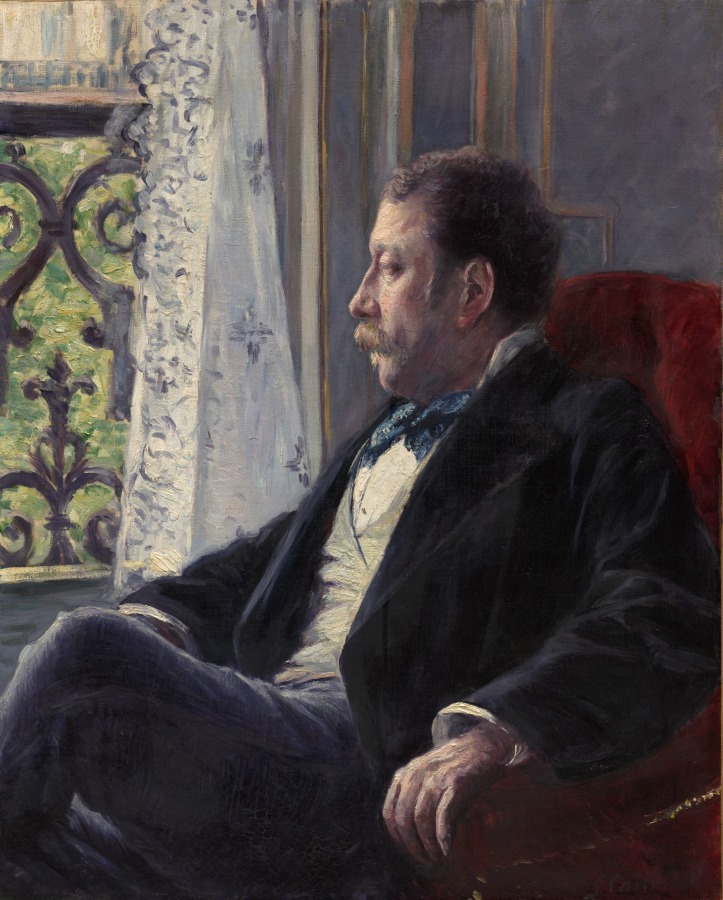
Caillebotte created many paintings showing urban Paris from unexpected perspectives, such as a streetscape seen from indoors in Jeune homme à la fenêtre (1875), or the exaggerated perspective of Rue de Paris, temps de pluie (1877). Vue de toits depicts snow-covered rooftops in Montmartre, Paris from a high vantage point, possibly a balcony. Here Caillebotte employs a largely monochromatic palette of grays, adding additional color to highlight building features. This perspective was not at all common in French paintings, and in fact Caillebotte may have been inspired by the photographic works of Hippolyte Bayard.
The painting was first shown at the fourth Impressionist Exhibition held in Paris in 1879, one of 25 works Caillebotte brought to the show. At the time, it did not garner much interest from the crowds, who preferred his portraits and nautical images. However, this image, and one other showing views of rooftops at that show, are now considered important works.
Pormenores
- Número de inventário
- RF 876
No catálogo
Fontes
- Wikidata
- Imagem: Museu de Orsay — Gustave Caillebotte · Public domain · Wikimedia Commons
Na vida de Gustave Caillebotte
A vida inteira1876
His younger brother René dies
In 1876 René (1851–1876), Gustave’s younger brother, died; in some of his early works Caillebotte had used his mother and brothers as models.
1876
A debut at the Second Impressionist Exhibition
In 1876 Caillebotte made his debut at the Second Impressionist Exhibition with eight paintings, including “The Floor Scrapers” (1875), his earliest masterpiece.
c. 1876 – 1878
Writes his will before the age of thirty
Convinced after René’s death that his own life would be short, Caillebotte wrote his will while still in his twenties, bequeathing a large collection to the French government.
1877
Takes charge of the Third Impressionist Exhibition
By the Third Impressionist Exhibition in 1877 Caillebotte had assumed the leadership role: he secured rental space, selected artists and works and hung the paintings. His involvement eventually declined, but in the end he showed works in five of the eight Impressionist exhibitions.
after 1878
Living with his brother Martial: photographs after his paintings
After their parents’ deaths Gustave lived for a long time with his brother Martial, first in Paris and then in Gennevilliers, where they bought an estate; the brothers shared an interest in faience collecting, philately and sailing, and Martial, a composer and photographer, often reproduced the compositions of his brother’s paintings in his photographs.
1879
The Fourth Impressionist Exhibition: 35 works on water and leisure
In 1879 Caillebotte submitted 35 paintings and pastels on water sports, boating and riverside leisure; “Oarsman in a Top Hat” (Boating Party) was considered one of the best of them, and the show is described as the most important exhibition of his works during his lifetime.