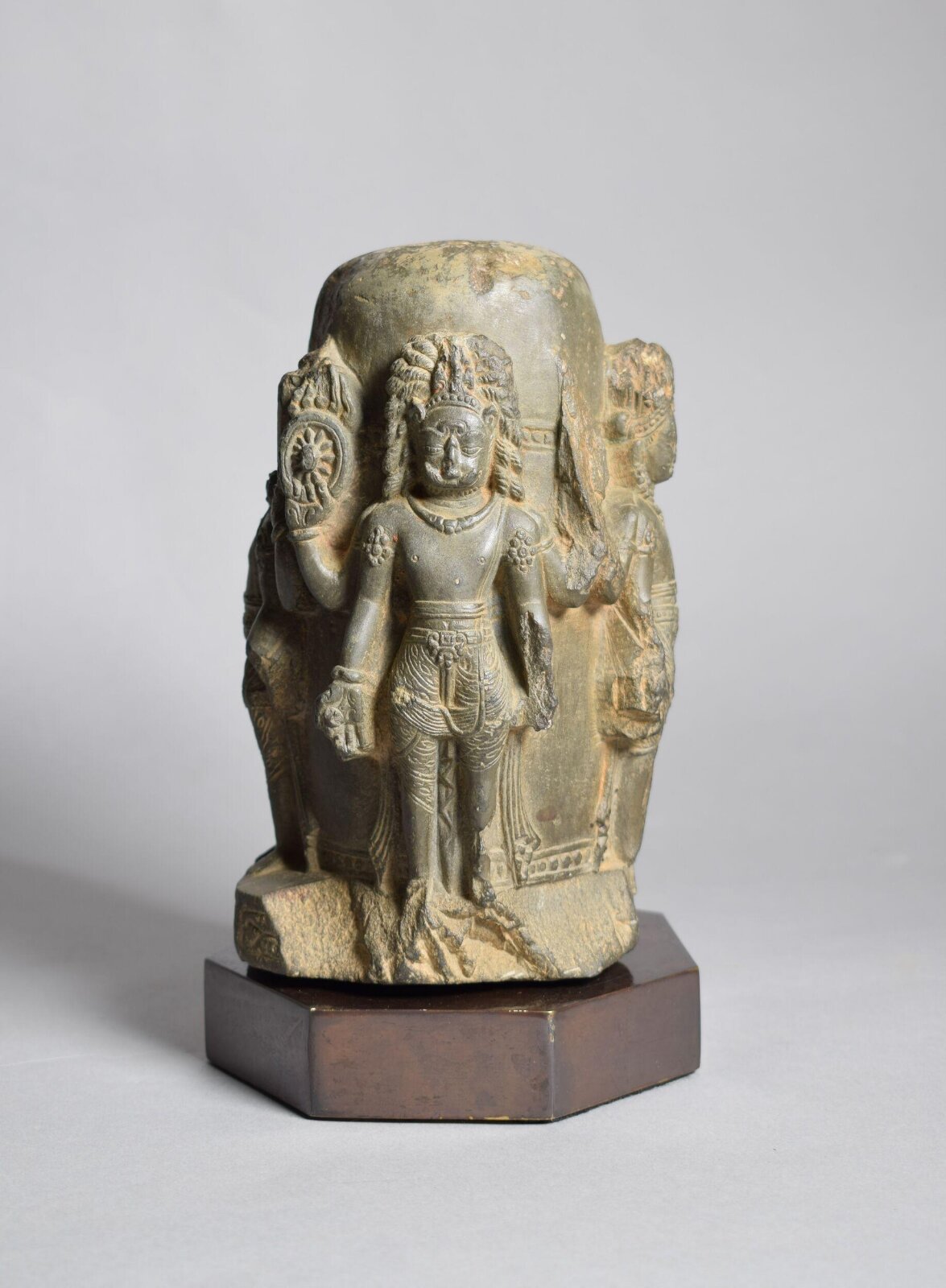
Vishnu Chaturmurti
Será possível contemplá-la?
De momento, não recebe

Museu Vitória e Alberto
Londres, Reino Unido
Pertence à coleção, mas de momento não está exposta.
- Verificado
- Neste estado desde
- Fonte
- Os dados da própria coleção do museu
About the sculpture
This sculpture takes the form of a pillar, with four figures of the Hindu god Vishnu emerging from the shaft. This four-fold manifestation is known as ‘caturmurti’. There are three representations of Vishnu in his supreme form as Para-Vasudeva, and one in his man-lion appearance (‘Narasimha avatara’).
The figures face the four cardinal directions, so asserting Vishnu’s claim as a Universal Sovereign. Vishnu in his human form holds in his raised arms an elliptical discus (‘cakra’) and a club (‘gada’). His lower hands are damaged but probably one held a conch shell (‘sangka’), while the other gestured grace to his devotees.
Read on
The pillar appears to take the form of a linga – the phallic symbol of Shiva. This is a reminder that this composition of multiple forms of Vishnu took its inspiration from the Saivite version of this subject. Ultimately it may be traced to the ‘caturmukhalinga’, the four-faced linga with the four aspects of Shiva, which first appeared in the early Kushan period (1st-3rd centuries AD), if not earlier.
The figures of Visnu stand on an octagonal plinth decorated with a foliate design inspired by the style of the Gupta period (320-about 540 AD) in northern India. This is a reminder that the model for this composition is to be found in that style of which the art of the Licchavi period (about 300-800 AD) in Nepal was a natural extension.
Museu Vitória e Alberto
Pormenores
- Número de inventário
- IS.30-1987
What it shows
No catálogo
Fontes
- Museu Vitória e Alberto: the museum's own open data · obtido há 10 dias
- Imagem: Museu Vitória e Alberto — © Victoria and Albert Museum, London